CBSE Class 12 Mathematics 2023 Previous Year Paper
CBSEMathematics2023 Previous Year Paper
Paper code: 65/3/3 · 2023Practise the full 2023 CBSE Class 12 Mathematics main-examination paper (65/3/3), then use the worked solutions to check your reasoning. This year-wise file pairs the English question paper with explanations organised by formula, concept and steps.
This set is one of the year's papers. See every set from 2023, grouped by series.
What the 2023 paper contains
This is a complete paper from one examination year, not a chapter-wise question bank. The paper allows 3 hours, carries 80 marks and contains 38 questions across five sections. Section A has 18 multiple-choice questions and two assertion–reason questions, each worth one mark. Sections B, C and D contain very short, short and long answers worth two, three and five marks per question, respectively. Section E has three four-mark case studies.
There is no overall choice: you cannot skip one question and replace it with another elsewhere in the paper. Where a question or subpart prints an OR, attempt one alternative in a timed sitting. The resource includes worked solutions for both printed alternatives, so you can use the unattempted branch for a separate practice attempt. Calculators are not allowed.

Mathematics 2023 | Class 12 | Previous Year Paper | Code 65/3/3
In the StudentCurio app
Complete CBSE Class 12 Mathematics paper from 2023 with worked solutions, covering topics across the syllabus. Helps students practise exam-style questions and review solution methods.
Functions and calculus: Read the domain before choosing a method
The paper covers inverse trigonometric functions, one-one and onto functions, differentiation, integration and differential equations. The function questions illustrate why the expression alone is not enough. To test whether a function is one-one, ask whether two distinct allowed inputs can have the same output. To test whether it is onto, compare the range with the stated codomain, not with a larger set you might normally associate with the formula. A restriction on the input interval can also change the range of an inverse trigonometric graph.
For a piecewise function, checking continuity where the pieces meet is not the same as checking differentiability there. At an interior joining point, the left- and right-hand derivatives must exist and agree for the function to be differentiable. In an area question, sketch the named boundaries before integrating: the sketch helps you identify the relevant region and set the limits.
Common mistakes: Treating matrix factors or line directions as interchangeable
The matrix questions move from recognising identities to working with matrix powers and using an inverse to solve simultaneous equations. Keep the order of multiplication as written: even when two matrices are square and of the same order, their products need not commute. For a product transpose, reverse the order: . If you use an inverse to solve a system, the coefficient matrix must be invertible.
The vector and three-dimensional geometry questions include projections, direction cosines, line intersections and a perpendicular from a point to a line. When you convert a line to parametric form, check that the signs in its direction vector agree with how the coordinates change as the parameter increases. A direction vector tells you how the line runs; a point on the line tells you where it is.
Editorial note: The adjugate and coordinate-determinant examples are not discussed here because the extracted notation is unclear.
Linear programming: Separate feasibility from optimisation
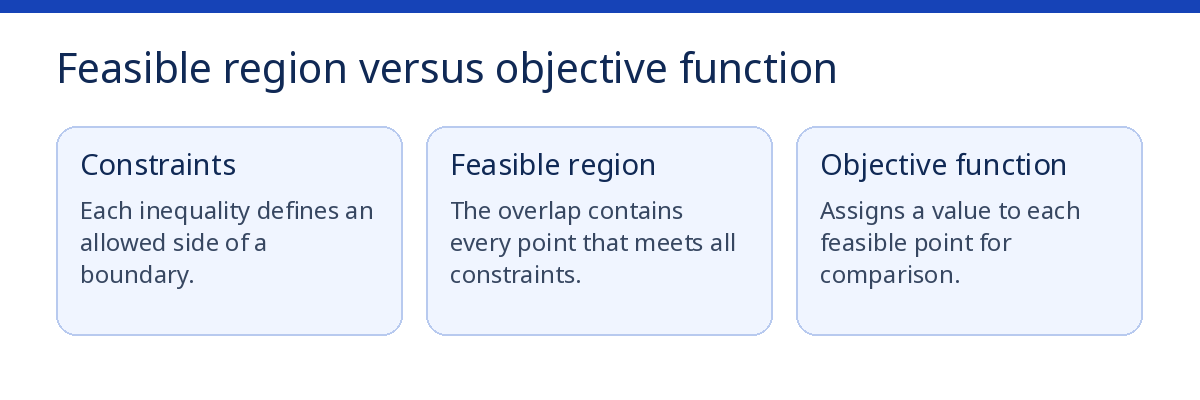
The linear programming questions ask you to read constraints from a diagram, reason about feasible solutions and solve an optimisation problem graphically. These are related but different tasks. A point is feasible only if it satisfies every constraint, including any non-negativity conditions. The objective function does not determine whether a point is feasible; it assigns a value to each feasible point.
When reviewing a graph, first check which side of each boundary line satisfies its inequality and whether the boundary itself is included. Then check the overlap. Do not confuse the corner points used in a graphical optimisation method with the entire feasible region. A point on an edge or in the interior can satisfy all the constraints without being a corner.
A useful connection: From probability models to case studies
Probability appears in several forms: independent events, a distribution defined from dice outcomes, and a conditional probability problem involving a fair and a biased coin. Keep independence distinct from conditioning. Independence says that learning one event occurred does not change the probability of the other, provided the conditioning event has positive probability. In the coin problem, the reported toss outcome is information to use when reasoning about which coin was selected.
The case studies use a rainwater tank, an octagonal prism and a volleyball serve. Each asks you to interpret a model before carrying out a calculation. In the tank problem, distinguish the capacity constraint from the cost being studied. In the prism problem, check that probabilities across the listed outcomes sum to one. In the serve problem, distinguish continuity from a maximum: justifying that a height function is continuous does not itself establish when the height is greatest.
Use the worked solutions to locate your first wrong step
For a mock attempt, start with the question-paper portion and leave the linked solutions unopened until the three hours are over. For a shorter review, choose a section and write enough reasoning to reconstruct your method later. In assertion–reason items, make two separate judgments: whether each statement is true and whether the reason actually explains the assertion. Two true statements do not necessarily have that explanatory relationship.
After attempting the paper, use the question-number links to compare your work with the formula, concept and steps in the solution. Rather than recording only a wrong option or final value, identify the first place your reasoning went off track. A misread inequality calls for a different kind of review from an omitted domain restriction or an algebra slip. For an internal choice, try the other branch before opening its solution so you can compare the demands of both alternatives yourself.
Spotted an error? Report a correction. Practise this in the app: notes, formula sheets and mind maps.





























































































































































Loading comments…