CBSE Class 12 Mathematics 2025 Paper With Solutions
CBSEMathematics2025 Previous Year Paper
Paper code: 65/4/3 · 2025Practise the full English-language 2025 CBSE Class 12 Mathematics main examination, paper code 65/4/3. Use the worked solutions to check not just your calculations, but also why each method applies.
This set is one of the year's papers. See every set from 2025, grouped by series.
What’s in the 2025 paper file
This is a year-wise previous year paper, not a chapter worksheet. It presents the complete 2025 main-examination paper in English, with a duration of 3 hours and a maximum of 80 marks. The file preserves the original question layout, options and diagrams. Its question-number index links to worked solutions for all 38 questions, including the printed internal choices.
The worked solutions separate the formula used, the concept used and the explanation in steps. That distinction helps when you recognise a formula but cannot see why it fits the question. The concept line gives you a reason to look for in the problem; the steps show how that reason translates into working.

Mathematics 2025 | Class 12 | Previous Year Paper | Code 65/4/3
In the StudentCurio app
Complete CBSE Class 12 Mathematics paper for 2025, code 65/4/3, with worked solutions covering questions across the syllabus, including three-dimensional geometry and differential equations. Helps students practise the board-exam format and review solution methods.
Use the full paper before opening the solutions
For a board-exam rehearsal, work from the question pages for the full three hours. Follow the printed instructions on which questions to attempt, and make your internal choices as you go. Leave the linked solutions unopened during the attempt. If you move on from a question, leave a note beside your work: did you have no starting method, or did you get stuck after making a start?
Use those notes to decide what to review first. If you had no starting method, read the concept line and then try to write the first step yourself. If your method was sound but your calculation went wrong, compare just the part where your working diverged. The solution index lets you revisit those questions without reading the entire file in order.
Common mistakes: losing the domain or missing the join
The displayed solutions cover inverse trigonometric domains, logarithmic expressions and continuity of piecewise functions. These topics all require checking the original expression before relying on a simplified one. For a real-valued inverse sine, its argument must lie in , including the endpoints. For a real logarithm, the argument must be positive and the base must be positive and different from one. Simplifying a logarithmic expression to a constant does not make that constant a valid replacement at inputs where the original logarithm is undefined.
For continuity at a join, checking each piece on its own interval is not enough. At an interior join, the left-hand limit, the right-hand limit and the defined function value must agree. In your working, keep these three checks separate so that a matching pair does not hide a missing condition.
When the matrix and determinant rules apply
The matrix solutions illustrate why the operation matters. A transpose can be compared with the negative of a square matrix to test for skew symmetry: . This requires opposite entries across the main diagonal and zeros on the diagonal. Matrix multiplication, by contrast, is associative: where the products are defined, you may regroup the factors without changing their order. Regrouping does not give you permission to swap them.
The determinant questions call for a different distinction. For square matrices of the same order, the determinant of a product is the product of the determinants. Taking the reciprocal of a determinant is the rule for the determinant of an inverse, so it applies only when that inverse exists. Check which operation the expression calls for before applying either rule.
Read calculus steps as decisions, not templates
The calculus material includes derivative-based reasoning, definite integrals, area and a separable differential equation. When using a derivative to establish increase or decrease over an interval, check its sign across the interval rather than at a single convenient point. A strictly positive derivative gives strict increase; if the question is about whether every value in a codomain is attained, that needs a separate argument.
In a definite integral, using substitution means changing both the differential and the limits if you evaluate in the new variable. When interpreting an integral as area between a curve and the horizontal axis, check whether the curve stays nonnegative over the interval: a signed integral and geometric area are not always the same. For a separable differential equation, preserve restrictions from the original equation, especially where a denominator cannot be zero.
Quick self-check: projection or midpoint?
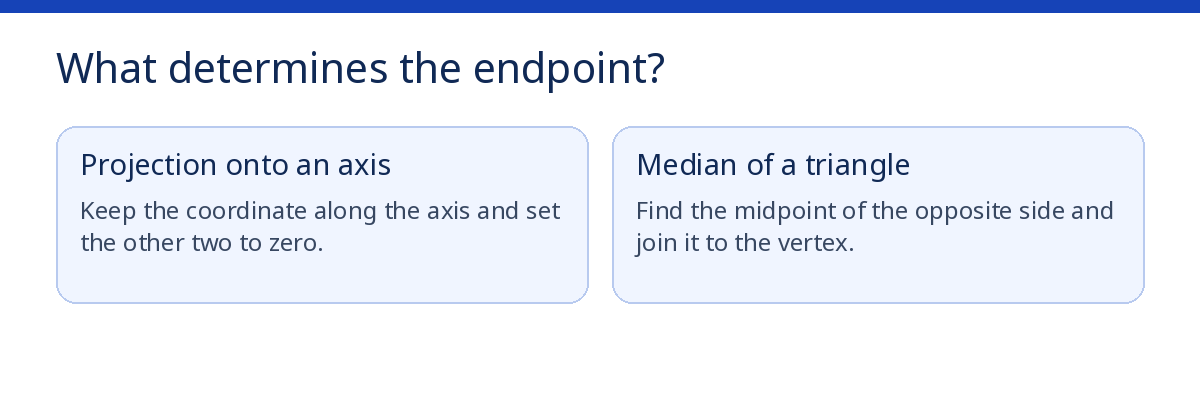
The geometry solutions use coordinates for two different constructions. An orthogonal projection onto an axis keeps the coordinate along that axis and sets the other two to zero. Its geometric check is perpendicularity: the displacement from the original point to its projection has no component along the axis. A median instead joins a vertex to the midpoint of the opposite side. The endpoint is determined by the two ends of that side, not by the coordinate axes.
Before comparing your work with a solution, ask what fixes the endpoint. Can you explain why the displacement in a projection has no component along the axis? For a median, can you identify the two endpoints whose midpoint you need before finding the vector from the vertex?
Keep source caveats separate from your review
The file flags an inconsistency in a linear-programming question’s maximum claim. That item’s worked calculation and intended option are not reproduced here; neither is the answer statement or option for Q8. The rest of the paper can still be used for a timed attempt and topic review.
For linear programming, keep the underlying distinction: two feasible points can have equal objective values without either value being maximal. When reviewing your own work, look for a separate justification of optimality rather than treating equality as evidence of a maximum.
Spotted an error? Report a correction. Practise this in the app: notes, formula sheets and mind maps.





























































































































































Loading comments…