CBSE Class 12 Mathematics 2026 Previous Year Paper
CBSEMathematics2026 Previous Year Paper
Paper code: 65/1/3 · 2026Practise with the complete English-language CBSE Class 12 Mathematics 2026 main examination paper, code 65/1/3. Use the worked solutions after your attempt to check where your reasoning went off track, not just whether you reached the same answer.
This set is one of the year's papers. See every set from 2026, grouped by series.
What this 2026 paper asks you to do
This year-wise resource contains the full paper for one set of the 2026 main examination. It preserves the question layout, options and diagrams and includes a question-number index for navigating the worked solutions. The paper has 38 questions, a three-hour duration and a maximum of 80 marks. Calculators are not allowed.
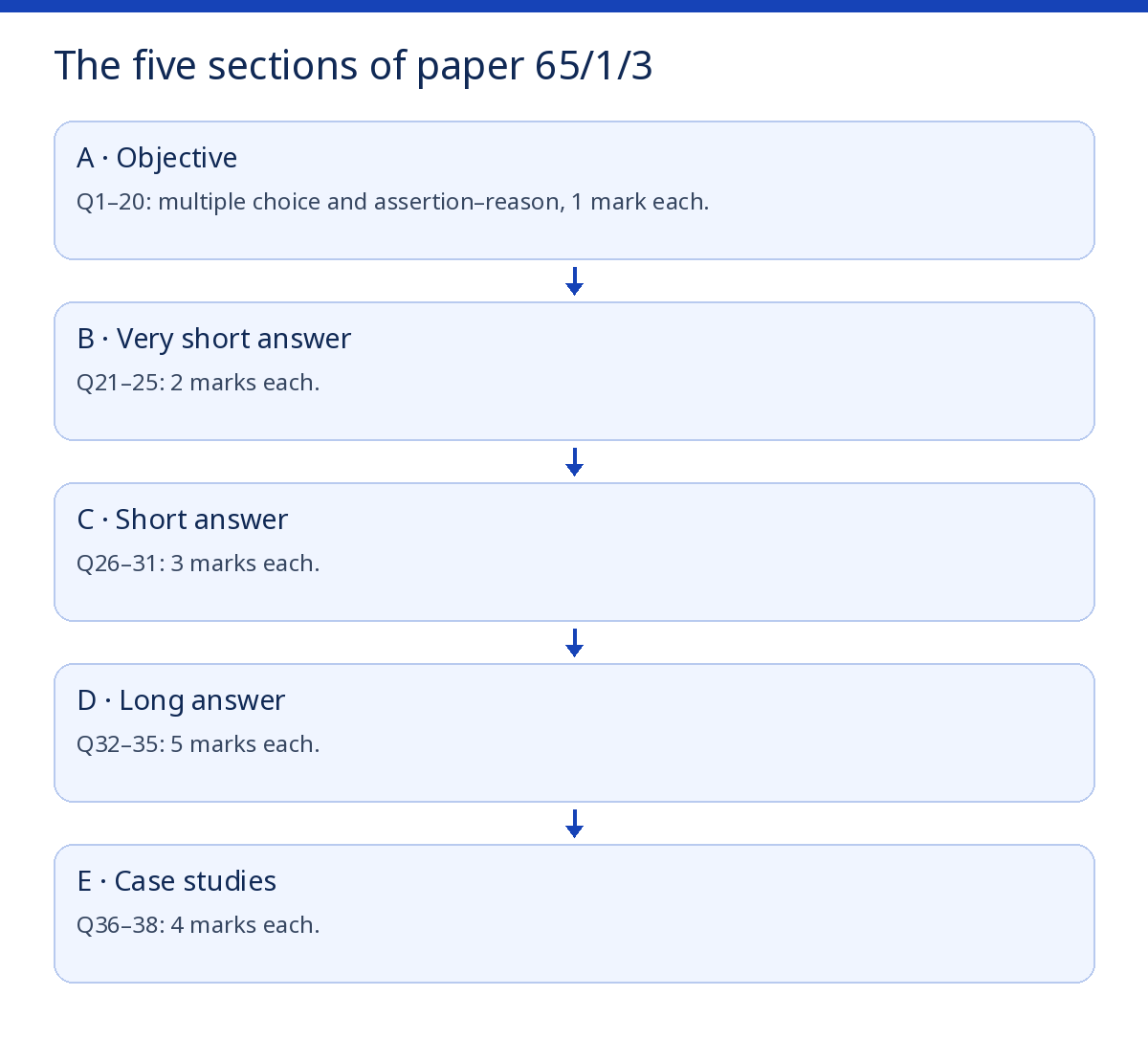
Section A has 18 multiple-choice questions followed by two assertion–reason questions, all worth one mark each. Sections B, C and D contain very short, short and long answers worth two, three and five marks per question, respectively. Section E has three four-mark case studies. There is no overall choice: answer every numbered question, choosing one alternative only where an internal choice is printed. Section A has no internal choices.

Mathematics 2026 | Class 12 | Previous Year Paper | Code 65/1/3
In the StudentCurio app
The complete CBSE Class 12 Mathematics 2026 examination paper (code 65/1/3) includes questions across the syllabus, with worked solutions. It helps students practise the exam format and review solution methods.
Algebra: distinguish a calculation from a proof
The paper tests properties of matrices and determinants as well as using an inverse matrix to solve a system of equations. In a matrix calculation, check that the dimensions permit the operation before doing arithmetic. If you use the inverse method for a square system, the coefficient matrix must be invertible. The key step is not merely finding a matrix inverse but connecting it to the system you were asked to solve.
The questions on relations and functions call for a different kind of justification. An equivalence relation must be reflexive, symmetric and transitive on the stated set. Showing that a function is one-one and onto requires two separate arguments: one about whether distinct inputs can share an output, and another about whether every element of the stated codomain is reached. Neither claim can be established by testing a few values.
Calculus: read the task before choosing the method
The calculus questions range from continuity and differentiation to definite integration and differential equations. The piecewise continuity question is a reminder that the value at a join and the limits from both sides are separate checks. The parametric differentiation question also rewards attention to notation: differentiating with respect to the parameter is not the same as differentiating with respect to the horizontal coordinate.
The integration questions distinguish finding an antiderivative, evaluating a definite integral and measuring a bounded region. Differential equations make a related distinction between a general solution, which can contain an arbitrary constant, and a particular solution selected using a given condition. When comparing methods, check what the question asks you to return: an expression, a value, an area or a function satisfying an initial condition.
Two checks that prevent wrong turns
- Check the principal range in inverse trigonometry. A trigonometric rewrite does not by itself justify cancelling a function with its inverse. For example, only when lies in the principal range . In the paper’s simplification questions, use the given interval to decide whether a rewrite is valid.
- Distinguish signed integral from geometric area. A definite integral counts contributions below the horizontal axis negatively. When finding area between a curve and that axis, split the interval where the curve changes sign or integrate the absolute value of its height. A sketch can help you see which interpretation the question requires before you choose the limits.
Geometry, probability and optimisation in context
The vector and three-dimensional geometry questions use coordinates to describe areas, directions and distances. Keep the roles of a position vector and a displacement vector separate: a direction associated with two points comes from their difference. In the graphical linear programming question, the constraints determine which points are feasible, while the objective determines which feasible points are preferable. For a nonempty bounded polygonal feasible region, an extreme value of a linear objective can be found by checking the vertices.
The case studies involve circular regions, subscription revenue and prize probabilities. Their shared demand is to turn the description into a mathematical setup before calculating. In the revenue case, the fee and subscriber count both depend on the fee increase. In the probability questions, name the event in words first. An event described as “exactly one” excludes the outcome in which both events occur.
Use the worked solutions to locate the first error
For a timed attempt, keep the solution pages closed and follow the printed choices. When you review an objective question, write down the rule you relied on, even if your option was correct. For assertion–reason items, judge the truth of each statement separately before deciding whether the reason explains the assertion. For longer responses, compare your setup as well as your final result.
The worked entries separate the formula used, concept used and explanation in steps. Read those parts in order and identify the first step you cannot justify on your own. Then retry from that point without looking. This guide leaves out the worked answers for Q13 and Q34(b) because the verified pages show errors in those explanations. It also does not reproduce Q2’s line notation or use Q19’s assessment statements as teaching rules.
Spotted an error? Report a correction. Practise this in the app: notes, formula sheets and mind maps.





























































































































































Loading comments…