CBSE Class 12 Mathematics 2025 Paper: Set 65/6/2
CBSEMathematics2025 Previous Year Paper
Paper code: 65/6/2 · 2025Practise the full 2025 CBSE Class 12 Mathematics main-examination paper in its original English layout. Then use the worked solutions to check not only your calculations but also whether the method you chose fits the question.
This set is one of the year's papers. See every set from 2025, grouped by series.
What this year-wise paper contains
This file contains set 65/6/2 of the 2025 CBSE Class 12 Mathematics main examination. The paper carries 80 marks and allows three hours. The file preserves the English question layout, including the printed options and diagrams. It also provides worked solutions for all 38 questions and both printed internal choices, with a question-number index for finding the corresponding explanations.
Because this is a full paper rather than a chapter worksheet, you have to recognise which topic a question draws on before deciding how to begin. The material includes matrices, inverse trigonometric functions, calculus, differential equations, vectors, probability and linear programming. Use this set to practise moving between those topics, not to infer how marks will be distributed in a future paper.

Mathematics 2025 | Class 12 | Previous Year Paper | Code 65/6/2
In the StudentCurio app
Complete CBSE Class 12 Mathematics paper set 65/6/2 from 2025, with worked solutions covering topics including matrices, calculus, probability, vectors, differential equations and linear programming. Useful for practising the board-paper format and reviewing solution methods.
Attempt the paper before opening the solutions
For a board-format rehearsal, set aside three hours, keep the worked solutions closed and follow the printed instructions, including where to choose between alternatives. On this first attempt, make those choices as you would in the examination. Afterwards, try the unused alternatives separately if you want more practice with the methods they test.
During review, use the solution pages' Formula Used, Concept Used and Explanation in Steps labels for different checks. The formula tells you what rule the solution uses; the concept explains why that rule is relevant; the steps let you locate where your reasoning diverged. For an incorrect answer, identify the first decision that needs changing. A matrix product that was never defined calls for a different correction from a valid calculation with a sign error.
Matrix checks to make before calculating
The matrix material gives you two distinct things to check: whether an operation is defined and whether a matrix has a stated property. For multiplication, write the dimensions in the order the factors appear. If a factor is transposed, swap its row and column counts before checking that the inner dimensions match. When a question specifies two products, test each one on its own; knowing that one product exists does not establish that the other does.
For a skew-symmetry check, compare the transpose of a square matrix with the negative of the original. In a real skew-symmetric matrix, entries reflected across the main diagonal are negatives of each other, and the diagonal entries are zero. A zero diagonal on its own is not enough.
Where calculus methods need a condition
The calculus material ranges from reading inverse trigonometric graphs and checking continuity to recognising antiderivatives and setting up an area integral. On an inverse trigonometric graph, check the principal range as well as the curve's shape: a shifted branch can have a similar shape without representing the principal inverse. For continuity at a point, check that the limit exists and equals the function's value there.
In integration, spotting the derivative of a familiar expression can save algebra. Differentiate your proposed antiderivative on an interval where it is defined, and use any supplied function value to determine the integration constant. For area using vertical slices, check which curve is above the other over the interval you chose. If they exchange positions, split the interval at the crossing so the integral measures area rather than cancelling parts of it.
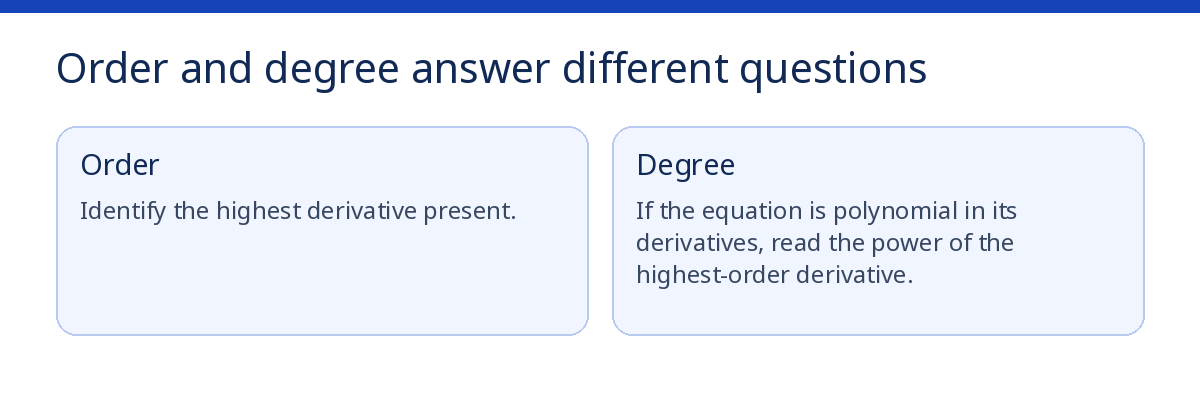
Differential equations: order and degree are separate
Order identifies the highest derivative present. Degree is defined only when the equation can be expressed as a polynomial in its derivatives; it is then the power of the highest-order derivative. In particular, a logarithm that remains applied to an expression involving a derivative prevents you from simply reading off a degree. That does not prevent you from identifying the order.
The worked material also illustrates separation of variables. When reviewing that method, distinguish the rearrangement that puts the variables on separate sides from the integration that follows. If a logarithm appears in the original equation, keep its domain restriction in view when you exponentiate: the original logarithm is defined only for a positive argument.
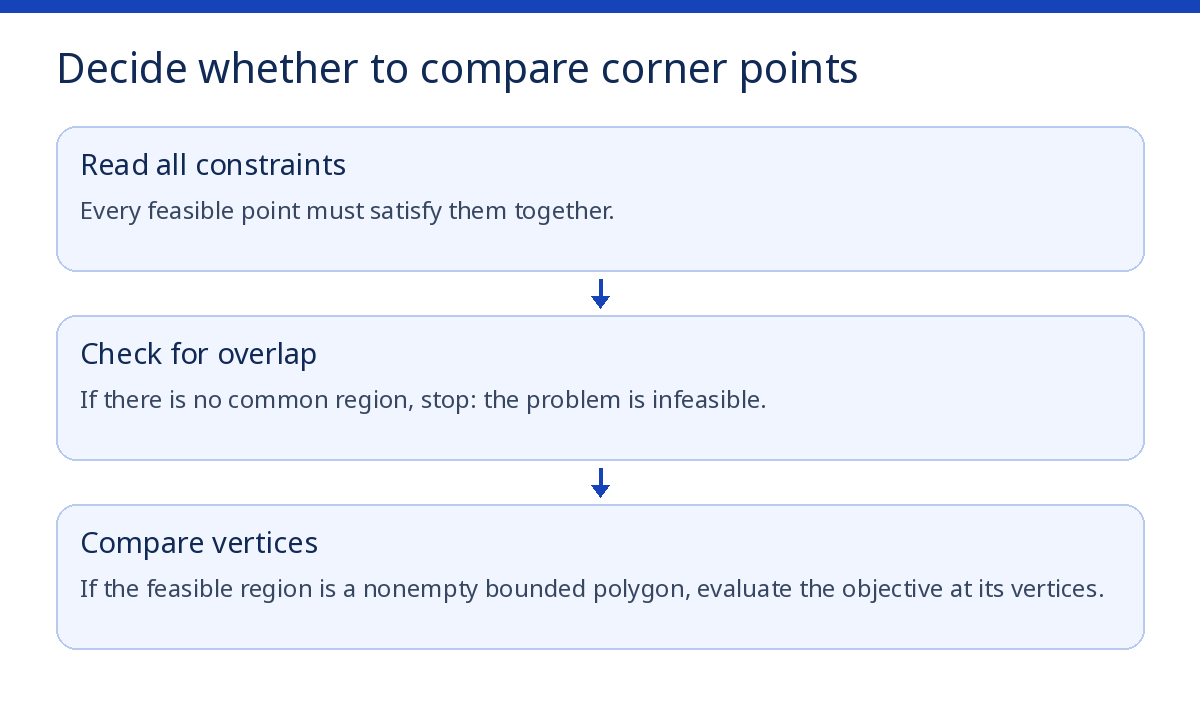
Feasibility, magnitude and independence
In linear programming, look for points satisfying all the constraints before evaluating the objective. Incompatible bounds give an empty feasible region, so there is no feasible point to optimise over. For a nonempty bounded polygonal feasible region, comparing the objective at its vertices is enough to find its minimum and maximum values.
Vector magnitude and probability each reward a different preliminary check. Scaling a vector multiplies its magnitude by the absolute value of the scalar; a negative scalar does not make the length negative. For an “at least one” probability, taking the complement of “none” does not require independence. Multiplying the individual probabilities to find the probability of “none” does require mutual independence if you are using those marginal probabilities alone. The guide omits the disputed vector answer options and the numerical probability result that relies on an independence assumption.
Before you move on: name the decision you missed
Choose a question you found difficult and, without looking at the solution, write one sentence explaining what you needed to establish before calculating. Was it the correct branch of a function, the existence of a matrix product, or whether the constraints shared a feasible point? Then reattempt the question from that decision rather than copying the steps. This checks whether you can recognise when the method applies, not just follow it once the solution has named it.
Spotted an error? Report a correction. Practise this in the app: notes, formula sheets and mind maps.





























































































































































Loading comments…