CBSE Class 12 Linear Programming: Assessment Guide
CBSEMathematicsLinear Programming
This CBSE Class 12 Mathematics assessment contains 36 practice items with worked solutions. Use it to practise drawing feasible regions, finding exact corner coordinates, and deciding when a maximum or minimum is actually attained.
What the assessment covers
The file divides Chapter 12 practice into 14 topic examples and 22 chapter questions. Topic Practice starts with one example on graphing a linear inequality, then moves to 13 examples on graphical linear programming. Chapter Practice contains 10 objective questions followed by 12 Short Answer Type II questions. Some tasks supply the graph or the corner coordinates; others give constraints and ask you to construct the graph yourself.
That difference matters. A supplied diagram lets you focus on interpreting the region and comparing objective values. Starting from inequalities adds another skill: deciding which side of each line to shade and which intersections belong to the region. The two formats help you identify whether a mistake came from drawing the region or reasoning from it.

Linear Programming | Class 12 | CBSE Assessment
In the StudentCurio app
This assessment contains graphical linear programming questions on feasible regions, corner points, and maximising or minimising objective functions, with worked solutions. It helps Class 12 students practise optimisation, including bounded and unbounded cases.
From a boundary line to a feasible region
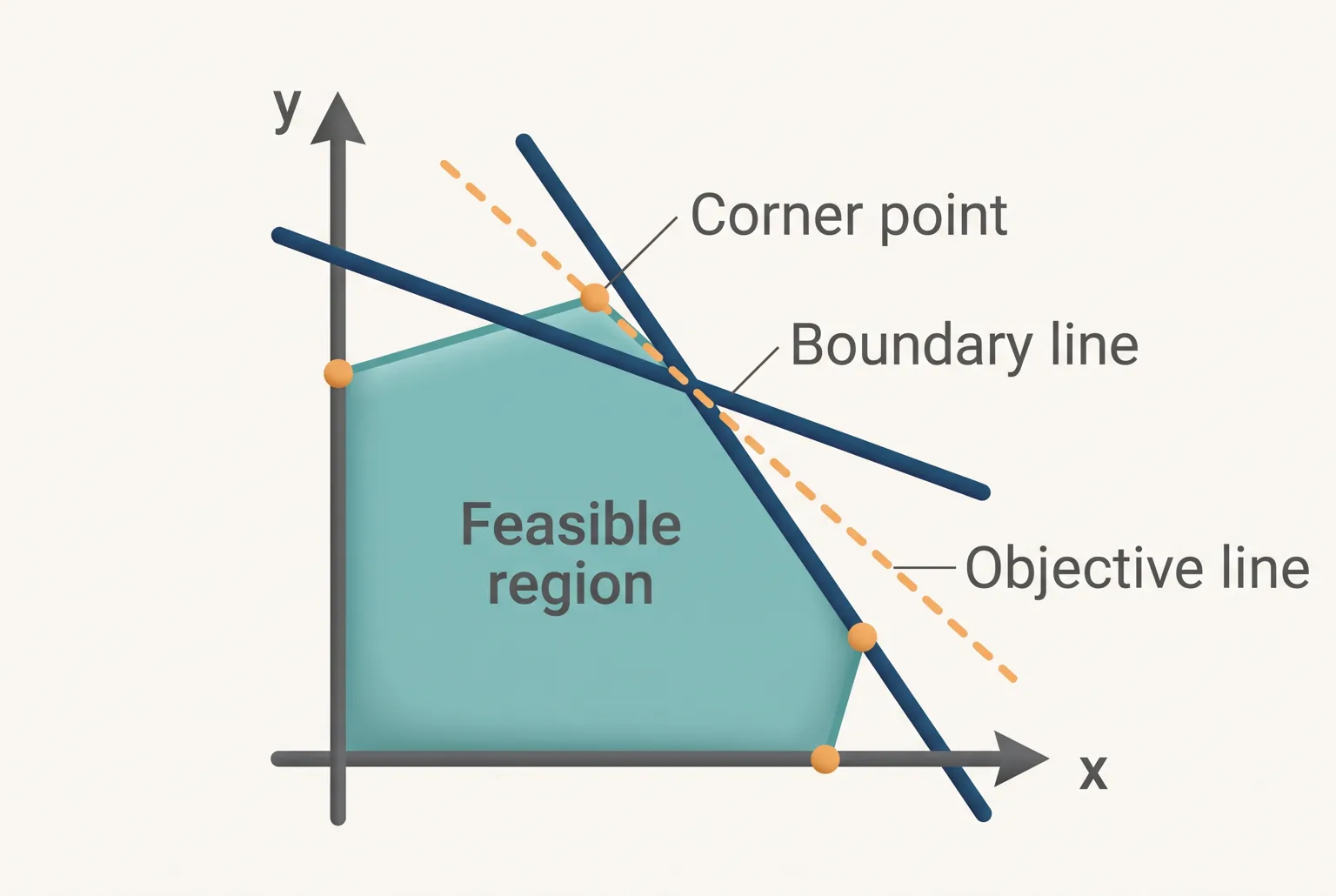
To graph a linear inequality, first replace the inequality sign with equality to draw its boundary line. Test a point off the line in the original inequality to decide which half-plane to shade. The origin is convenient only if it does not lie on that line. A strict inequality excludes the boundary, while a non-strict inequality includes it. An equality constraint, by contrast, keeps only points on the line itself.
The feasible region is the intersection of all the constraints, not the total area shaded by the individual inequalities. Where both variables are required to be nonnegative, keep only the common region in the first quadrant, including any eligible points on the axes. If there is no common point, the problem is infeasible: there is no point at which to optimise the objective.
Common mistake: Counting every intersection as a corner
Drawing two lines and solving their equations gives an intersection, but that point is only a candidate. Substitute its coordinates into every constraint, including any lower bounds on the variables. An intercept on an axis can fail another inequality just as easily as an intersection between two sloping lines. The graph shows where to look; solving the equations gives exact coordinates when the crossing is hard to read.
The worked examples also show why not every plotted line forms a side of the feasible region. A constraint is redundant if the others already imply it. Removing it would leave the same feasible region. This is different from incompatible constraints, which leave no common region at all.
When comparing corner values is enough
For a nonempty, bounded feasible polygon with its boundary included, a linear objective attains both a maximum and a minimum, and at least one corner attains each. Evaluate the objective at the actual feasible corners and compare the results in the direction the question asks for. Keep the objective value and the point that produces it separate: one is a number, the other is a coordinate pair.
A corner table identifies an optimal value, but it does not always tell the whole story about where that value occurs. The objective changes linearly along a segment. If it has the same optimal value at two feasible endpoints, it stays constant between them. Looking at the corresponding objective level line on the graph helps you see why an optimum need not be unique.
Unbounded regions need one more check
An unbounded feasible region extends indefinitely, but that alone does not tell you whether the requested optimum exists. The assessment contrasts examples in which a finite minimum is attained with cases in which the objective keeps improving indefinitely. In this setting, a best corner value is a candidate, not a conclusion.
For a candidate minimum , check whether any feasible point satisfies . For a candidate maximum , check whether any feasible point satisfies . If the relevant strict half-plane has no feasible point, the candidate is optimal. Some worked solutions rule out better values by combining the stated inequalities to establish an objective bound. Others show there is no finite optimum by exhibiting a feasible ray along which the objective increases or decreases without limit.
Connections beyond the corner table
Several topic examples pair optimisation with a separate task. One asks whether a given point belongs to the shaded region before asking for its distance from the origin. Membership is a constraint check: test the coordinates in all the inequalities rather than relying on how close the point appears to a boundary. The distance calculation answers a different question and does not establish feasibility.
Another example asks for the area of the feasible region, which uses the polygon itself rather than the objective values at its corners. The matrix inequality example goes in the other direction: it changes how the constraints are presented. Compare corresponding entries to recover the scalar inequalities before applying the same graphical method.
Use the index to check the step that went wrong
The clickable index has separate entries for questions and worked solutions, with page references matching the printed numbers. Start with a topic example and record your boundary lines, shading choices and candidate corners before opening its solution. Compare those stages in order. If your region differs, recheck the half-planes before recalculating the objective; if your region matches, check the intersections and substitutions.
In Chapter Practice, use a supplied diagram to test whether you can read the feasible boundary without redrawing every line. Then try a short-answer question that starts from constraints only. Before opening the solution, ask yourself: have I justified why no feasible point can improve on the value I found, or have I only compared the corners?
Spotted an error? Report a correction. Practise this in the app: notes, formula sheets and mind maps.





























































































































































Loading comments…