Applications of the Integrals: CBSE Class 12 Case Practice
CBSEMathematicsApplications of the Integrals
This CBSE Class 12 Mathematics assessment uses case studies to practise finding areas with definite integrals. Its questions ask you to interpret graphs, identify the boundaries of a region and choose limits before calculating.
What the assessment covers
The file covers Chapter 8, Applications of the Integrals, through 17 case studies and 81 subquestions, including OR alternatives. It combines multiple-choice and short-answer cases. All questions come before the worked solutions, and the clickable index has separate links to the question and solution pages for each case. Individual subquestions also link to their solutions, with return links for revision.
The cases move between familiar shapes and coordinate models: a parabolic bridge arch, a circular pizza cut by a straight edge, an elliptical mirror crossed by a line, and overlapping circular pieces of cardboard. Other cases work directly with sine and cosine graphs or with straight lines through given points. Across these settings, the recurring task is to identify the region before deciding what to integrate.

Applications of the Integrals | Class 12 | Case-based Assessment
In the StudentCurio app
Case-based assessment questions with worked solutions on using definite integrals to find areas bounded by curves, including trigonometric curves, lines, parabolas, circles and ellipses. Helps Class 12 students practise interpreting regions and setting up area integrals.
Read the boundaries before choosing the limits
Start by naming every boundary that actually closes the region. An equation may describe a whole curve even when the region uses only an arc or a branch. In a circle-and-line case restricted to the first quadrant, for example, an algebraic intersection outside that quadrant is not part of the region. An axis can also complete a boundary, so a limit may come from an axis intercept rather than from the intersection of two non-axis curves.
The bridge-arch case shows why the coordinate picture matters before any integration. The worked example places the origin at the highest point of the arch. In that coordinate system, the road is below the origin and has a negative ordinate. The sign describes position relative to the chosen origin, not a negative physical height. The geometry stays the same if the origin moves, but the coordinates and the equation used to describe it change.
When to use vertical or horizontal strips
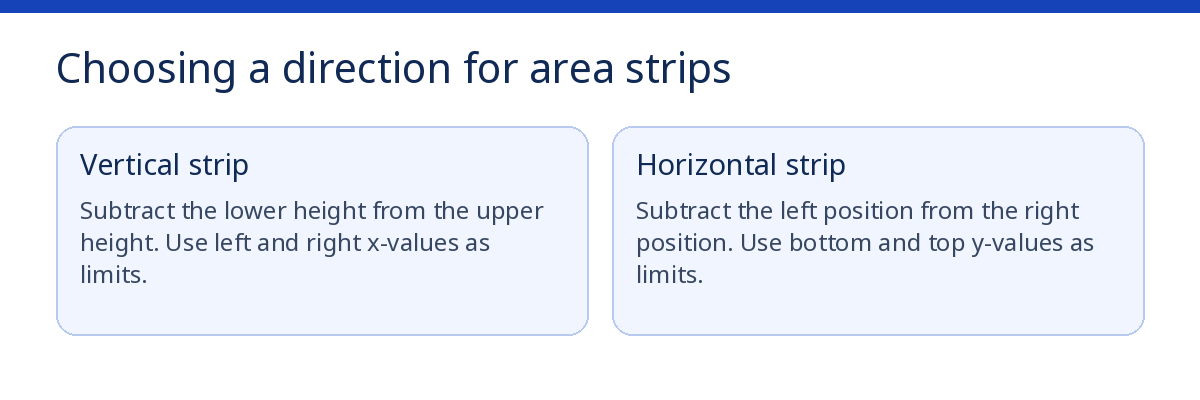
For vertical strips, use the upper boundary minus the lower boundary and integrate with respect to . On an interval where each strip runs continuously from to and , the area is . The limits are the leftmost and rightmost -values for that part of the region.
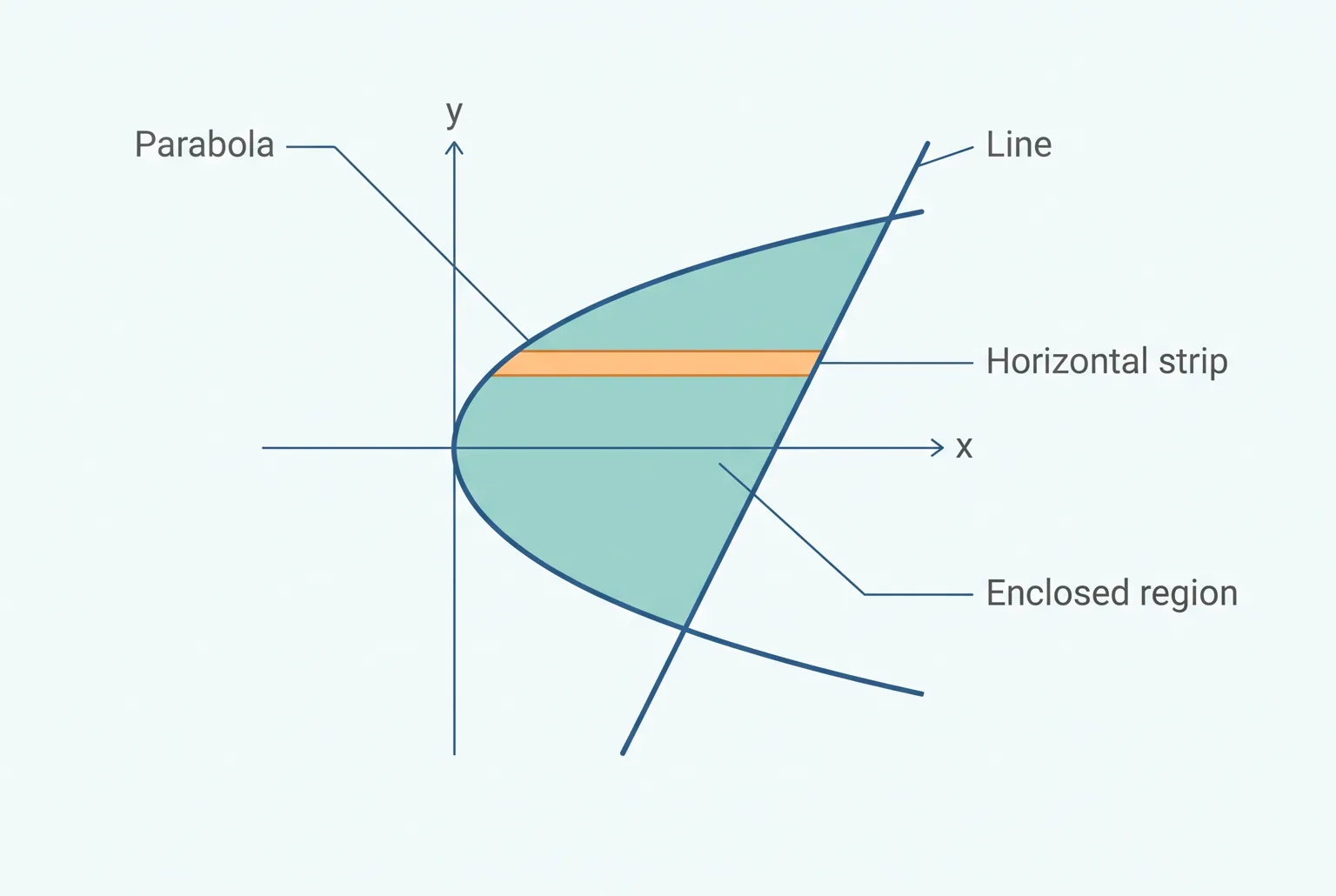
For horizontal strips, subtract the left boundary from the right boundary and integrate with respect to , using the bottom and top -values as limits. The sideways-parabola cases make this choice meaningful: the parabola already gives a single for each , whereas solving for gives two branches wherever both are defined. A horizontal strip lets you compare the parabola and the line at the same height. The better direction is the one that describes the actual strip endpoints more simply.
Signed integrals are not always geometric areas
The trigonometric cases ask you to distinguish a definite integral from the total geometric area between a graph and the -axis. A stretch above the axis contributes positively to the integral; a stretch below it contributes negatively. These contributions can cancel, but the areas of the two stretches cannot. To find total area, split the interval where the graph changes sign and add the magnitudes of the separate contributions. Taking the absolute value only after adding the signed contributions can miss part of the area.
When two curves bound the region, the comparison is between their ordinates, not between either curve and zero. The sine-and-cosine cases bring intersections into the setup: check which curve is higher on each interval you use. A crossing matters for the area calculation when it reverses that order within the requested region.
Quick self-check: does one boundary rule fit?
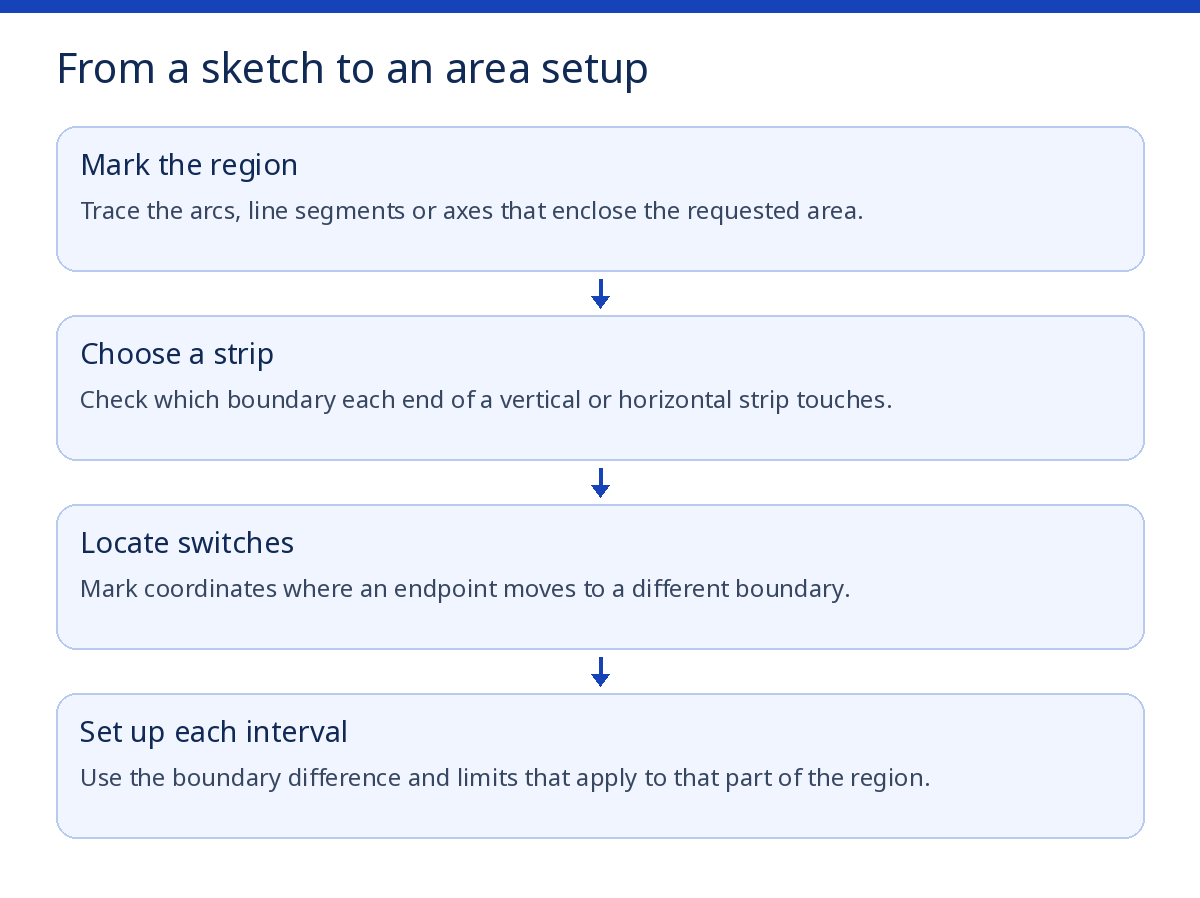
An integral can need splitting even when there is no change of sign. In the three-houses case, the straight edges meet at vertices, so a strip endpoint can switch from one line to another. In the overlapping-circles case, the region must stay inside both circles; an arc that bounds the overlap on one interval need not bound it on the next. In either setting, a single expression works only as long as it describes the same pair of strip endpoints.
Before integrating, imagine moving one strip across your sketch. Where does either endpoint first land on a different curve or line? Mark that coordinate and check the boundaries again on the next interval. This separates a change in the formula for an edge from a change in the sign of an ordinate.
Use the linked solutions to diagnose your setup
Try the short-answer parabola-and-line case before its multiple-choice counterpart. Write the intersection equations and sketch the enclosed region without relying on the pictured options. Then use the multiple-choice version to check whether you can recognise the same region in a diagram and distinguish an integral of a single boundary function from the area between two curves.
When you open a linked solution, compare your region, strip direction and limits before checking the arithmetic. The index notes that verification comments beside solutions flag errors, rounding and assumptions, so read a relevant note along with the working. This guide omits Case Study 17(v) as a standalone example because its printed prompt does not identify which enclosed region to use. The case still illustrates the general skill of splitting an integral when the upper boundary changes.
Spotted an error? Report a correction. Practise this in the app: notes, formula sheets and mind maps.





























































































































































Loading comments…