CBSE Class 12 Mathematics 2022 Supplementary Paper Guide
CBSEMathematics2022 Previous Year Paper
Paper code: 65/6/2 · 2022Use this full 2022 CBSE Class 12 Mathematics supplementary paper to practise under the original two-hour, 40-mark format. The worked solutions help you review why a method fits, from choosing an integration technique to identifying the right condition in a probability problem.
This set is one of the year's papers. See every set from 2022, grouped by series.
What is in the 2022 paper?
This year-wise file contains the English version of the 2022 CBSE Class 12 Mathematics supplementary paper, code 65/6/2, together with worked solutions. It is a full paper rather than a chapter-wise question bank. Section A has six short-answer questions worth two marks each, Section B has four short-answer questions worth three marks each, and Section C has four long-answer questions worth four marks each. All three sections are compulsory, with internal choices in some questions. The final question is a case study with two two-mark parts.
The question pages retain the paper layout, and the solution pages separate the formula, the concept and the explanation in steps. Both alternatives are worked for questions with an internal choice. That lets you follow the printed choice during a timed attempt and come back to the other method afterwards.

Mathematics Supplementary 2022 | Class 12 | Previous Year Paper | Code 65/6/2
In the StudentCurio app
This resource provides worked questions from a 2022 CBSE supplementary Mathematics paper, with substantial coverage of integration methods alongside probability, vectors, differential equations and three-dimensional geometry. It helps Class 12 students practise exam-style problems and review their solutions.
Integration: look for the form a substitution creates
The integration questions give you several different reasons to change the form of an expression. A substitution can simplify a square root involving a linear expression, while integration by parts can help when an inverse trigonometric function appears on its own. The longer alternatives show why a substitution may be only the first step: one transformed integral calls for integration by parts, while another becomes a rational expression suited to partial fractions. When reviewing these solutions, look at the expression immediately after the substitution and ask what feature makes the next technique useful.
The paper also tests integration as a way to find area. For vertical strips, integrate the upper boundary minus the lower boundary over an interval where those roles hold. If the boundaries switch roles, split the interval rather than treating a signed integral as the geometric area. This guide omits the specific worked area results: the extracted circle inequalities are unclear, and the parabola wording does not explicitly select the branch used in the solution.
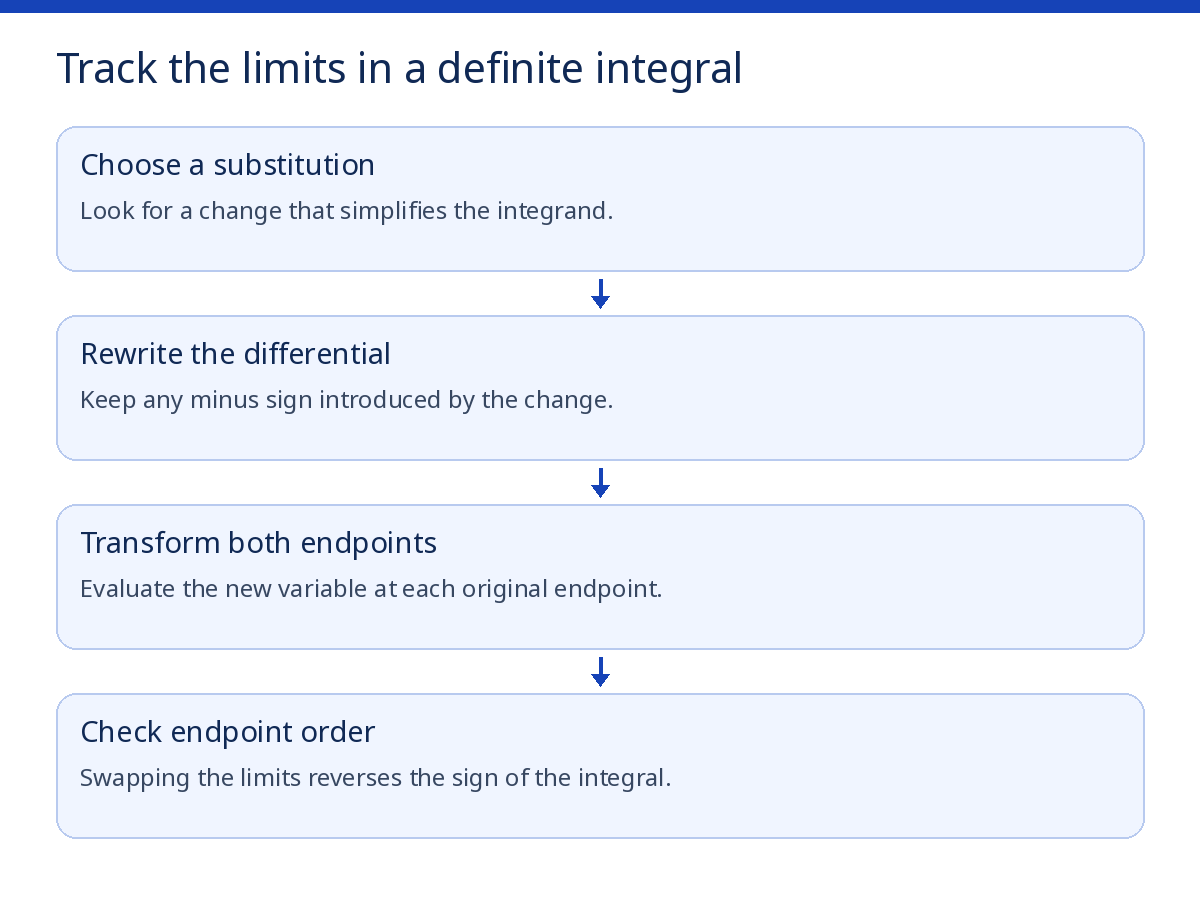
Good to remember: changing variables changes the limits
In a definite integral, once you rewrite the integrand and differential in the new variable, the limits must refer to that variable too. A decreasing substitution can reverse the order of the transformed endpoints. If you swap those endpoints to restore increasing order, account for the resulting minus sign. In an indefinite integral, there are no endpoints to transform: return to the original variable and include the constant of integration.
Inverse trigonometric notation calls for a different check. In this paper, means inverse sine, not the reciprocal of sine. Its real derivative formula applies for . Keep that interval in view when checking an antiderivative by differentiation.
Differential equations: distinguish the method from the condition
The paper contrasts a general solution with a particular solution. A separable equation lets you collect the terms in each variable on its own side before integrating. Another question uses the product rule in reverse: a term involving the derivative and a term involving the original function together form the derivative of a product. In a particular-solution problem, the initial condition fixes the integration constant. The resulting expression must still be valid on an interval containing the initial point; division by a coefficient that vanishes can restrict that interval.
The order-and-degree alternative tests classification rather than integration. Order is determined by the highest derivative present. Degree is the exponent of that derivative when the equation is expressed as a polynomial in its derivatives. It is not necessarily the largest exponent appearing anywhere in the equation.
Vectors and 3D geometry: identify what must be perpendicular
The vector questions distinguish two roles: dot products relate to lengths and perpendicularity, while a nonzero cross product gives a vector perpendicular to both of its factors. In three-dimensional geometry, pay attention to the object that determines the perpendicular direction. For parallel lines, the shortest separation is perpendicular to their common direction. For the foot from a point to a plane, the displacement from the point to the foot is parallel to the plane normal, and the foot itself must lie on the plane.
Other questions use different geometric conditions. A point where a line crosses the ZX-plane must have . A plane through the intersection of two given planes must contain their entire common line, not just one point on it. An additional point then constrains which plane is required.
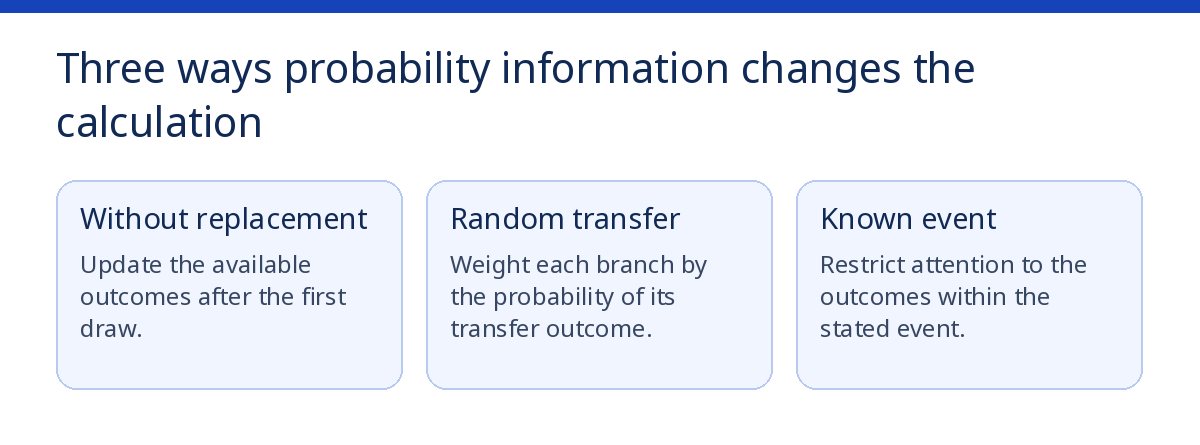
Probability self-check: what changes after the first event?
The probability questions are useful for distinguishing three ways information changes a calculation. In a draw without replacement, the first draw changes what is available for the second. In a transfer between bags, different transfer outcomes lead to different compositions in the receiving bag; combine the conditional probabilities by weighting each one by the probability of its transfer outcome. In the biased-die case study, the face probabilities must first make up a complete distribution, and conditioning then restricts attention to the stated event.
Before opening a solution, ask yourself: am I updating the outcomes after a draw, combining branches of an experiment, or restricting the sample space to an event already known to have happened?
Use the worked pages to find the first gap in your reasoning
Attempt the question pages first using the printed time and section rules. On review, use the formula heading to check what you selected, the concept heading to check why it applies, and the steps to locate the first point where your reasoning diverged. If the issue was method choice rather than algebra, try the unattempted alternative where one is available. Compare what signals the method in each version instead of memorising the order of the written steps.
Spotted an error? Report a correction. Practise this in the app: notes, formula sheets and mind maps.





























































































































































Loading comments…