CBSE Class 12 Vector Algebra: A Guide to the NCERT Notes
CBSEMathematicsVector Algebra
These NCERT revision notes for CBSE Class 12 Mathematics connect vector diagrams and components to the geometry of angles, projections and areas. Use this guide to see how the four topics fit together and when their formulas apply.
Read the arrows before doing the algebra
Chapter 10 begins with the difference between a scalar, which has magnitude but no direction, and a vector, which has both. In a directed segment, the order of the endpoints matters: reversing the arrow gives the negative vector without changing its magnitude. The notes work with free vectors, so arrows need not start at the same point to be equal. What matters is that they have the same magnitude and direction. Parallel arrows, by contrast, can have different lengths or point in opposite directions.
This distinction explains why the two addition diagrams agree. In the triangle law, place the second arrow’s tail at the first arrow’s head. The sum runs from the starting point to the final endpoint. In the parallelogram law, start both arrows at the same point and use the diagonal from that point. Subtraction uses the same addition rule after reversing the vector being subtracted.

Vector Algebra | Class 12 | NCERT Notes
In the StudentCurio app
These revision notes cover vector basics, addition and components, followed by scalar and vector products and their applications to angles, projections, and areas. They help Class 12 students review key concepts and worked examples in Vector Algebra.
Check the denominator before normalising
Component form replaces the drawing with numbers along the three coordinate axes. A scalar component is the signed coefficient along an axis; a vector component is that coefficient multiplied by the corresponding axis unit vector. Add or subtract matching components, but use the square root of the sum of their squares to find the magnitude. A negative scalar multiplier reverses a nonzero vector’s direction, while its absolute value gives the factor by which the magnitude changes.
To get a unit vector in the same direction, divide by the original magnitude. This works only for a nonzero vector: the zero vector has no definite direction. The same normalization turns the scalar components into direction cosines, the cosines of the angles with the positive axes. Their squares sum to one; the squares of the original components, which serve as direction ratios, need not. When testing nonzero vectors for collinearity, check for a common scalar multiplier rather than forming component ratios with zero denominators.
Distinguish a joining vector from a division point
A position vector starts at the origin. A vector joining two points instead describes the displacement from one endpoint to the other. To form it, subtract the initial point’s position vector from the terminal point’s. Reversing the subtraction changes the direction but not the distance between the points.
The section formula answers a different question: it gives the position vector of a point that divides the join. For , the weight goes with the position vector of and with that of . Internal division adds the weighted vectors and divides by . External division subtracts the weighted position vector of from that of and divides by , so the positive ratio terms cannot be equal in that case. The midpoint is the equal-weight case of internal division.
Use the dot product for angles and signed projections
The dot product returns a number. In components, multiply corresponding entries and add the products. Geometrically, that number is the product of the two magnitudes and the cosine of the angle between them. Dividing by both magnitudes therefore gives the cosine, provided neither vector is zero. For nonzero vectors, a zero dot product means they are perpendicular. If either vector is zero, the product is still zero, but there is no angle to infer.
For a projection, the denominator has a different role. To find the scalar projection of one vector onto another, divide their dot product by the magnitude of the nonzero vector you are projecting onto. The result is signed: a negative value indicates that the projection points opposite to the chosen direction. To get the vector projection, multiply the signed result by the unit vector along that direction. The notes also connect this idea to rectangular components: each scalar component is a projection onto a positive coordinate axis.
Use the cross product when direction or area matters
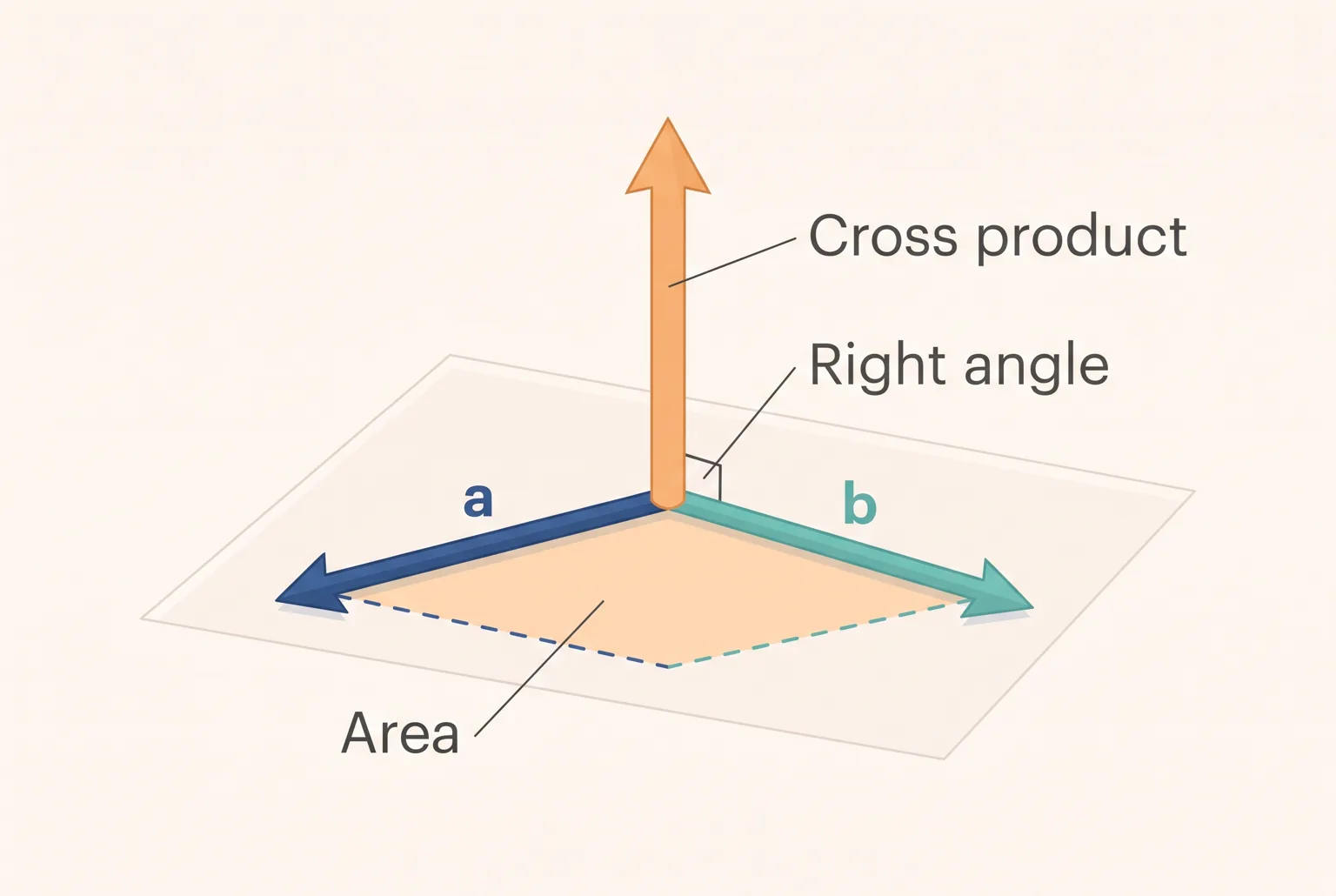
The cross product of two nonparallel vectors points perpendicular to both, with its direction fixed by the right-hand rule. The notes show how to calculate it in component form using a determinant. The order of the input vectors matters: swapping them reverses the result without changing its magnitude. For two nonzero parallel vectors the cross product is zero, so it cannot be normalized to give a unit normal.
Its magnitude uses the sine of the angle rather than the cosine. This matters when recovering an angle: a sine value can correspond to both an acute and an obtuse angle in the interval from zero to pi. Unless the question fixes the angle type or supplies another condition, the acute value alone may not be the complete answer.
Before choosing an area formula, identify the inputs
Check whether the supplied vectors describe sides or diagonals. For two adjacent sides of a parallelogram, the cross-product magnitude is the area. For two sides of a triangle meeting at a vertex, take half that magnitude. If the inputs are the two diagonals of a parallelogram, the area is also half their cross-product magnitude. Swapping the vectors does not alter any of these areas because the formula uses the magnitude, not the direction of the cross product.
When only the vertices of a triangle are given, first form two side vectors from a common vertex. This is where the joining-vector rule from the second topic becomes the starting point for an area calculation.
Find the right worked example in the chapter index
The file’s chapter index links to subtopics and worked examples in all four parts. If a mistake starts with the order of two points, revisit Vector Joining Two Points before returning to an area or plane-normal example. If the difficulty is a sign, compare the projection examples with the cross-product properties: a projection sign describes alignment with a chosen direction, while a cross-product sign changes when you reverse the order of the inputs.
As you revisit an example, identify the intended output before reading the calculation: a signed number, a directed vector, or a nonnegative area.
Spotted an error? Report a correction. Practise this in the app: notes, formula sheets and mind maps.





























































































































































Loading comments…