Inverse Trigonometric Functions: CBSE Class 12 Assessment
CBSEMathematicsTrigonometry
This CBSE Class 12 Mathematics assessment has 20 questions with worked solutions. Use it to practise choosing principal values, checking domains and branches, and interpreting inverse trigonometric functions in a heights-and-distances problem.
What the assessment covers and where to start
The file groups its questions into four formats: objective, very short answer, short answer and case-based. The chapter index also groups them by topic and links each question to its worked solution. That gives you two ways to use the same assessment: work through the formats in order for a chapter review, or use the topic links to revisit a particular skill, such as distinguishing the domain of an inverse function from its principal range.
For a focused attempt, write the condition that justifies your reasoning before opening the solution. In an objective question, that might be why an interval includes or excludes an endpoint. In a short answer, it might be why a restriction makes a trigonometric function invertible. This makes it easier to tell whether an error came from the concept or the calculation.

Inverse trigonometric functions | Class 12 | CBSE Assessment
In the StudentCurio app
A Class 12 assessment on inverse trigonometric functions, covering principal values, branches, compositions, domains and ranges, equations, and an application. Includes practice questions with worked solutions for CBSE assessment preparation.
Why an inverse needs a branch
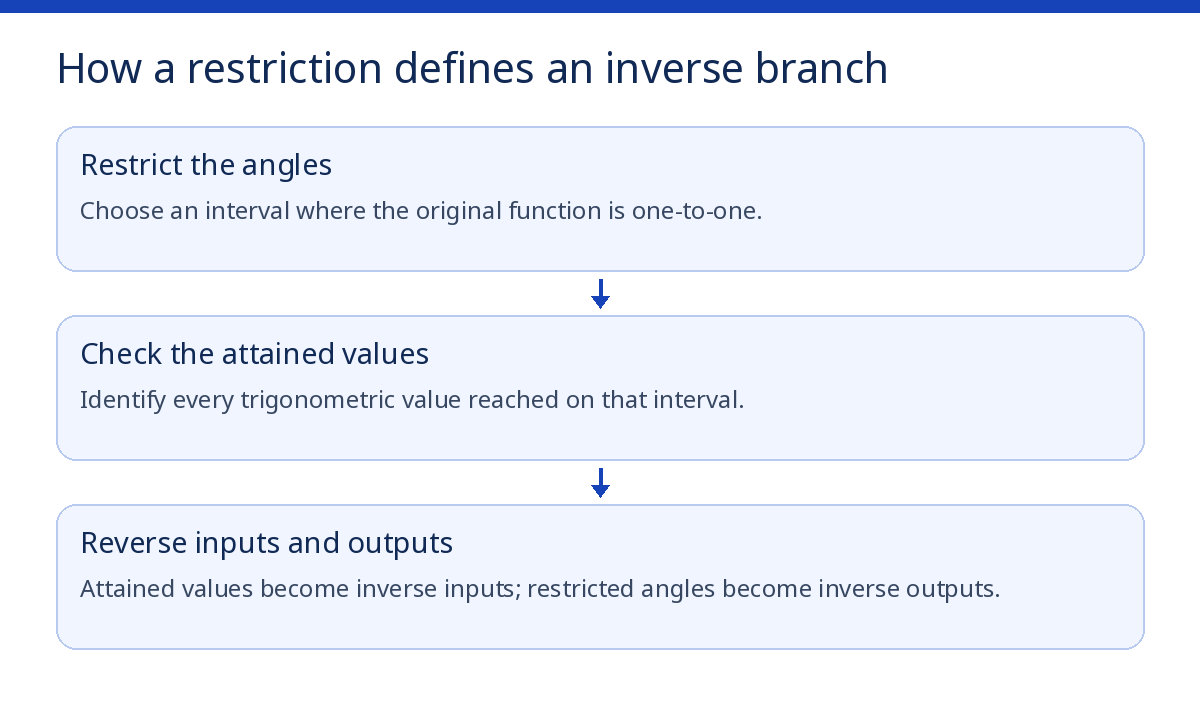
On their full domains, periodic trigonometric functions can return the same value at different angles. An inverse would then have no unique output. To define an inverse branch, restrict the original function to an interval on which it is one-to-one. Strict increase or strict decrease on that interval is enough to establish this. If the branch is meant to accept the full range of the original function, the restriction must also attain every value in that range. A smaller interval can be one-to-one without meeting that second condition.
The principal branch is the standard choice, not the only possible one. After you restrict the original function, its range becomes the inverse branch’s domain, and its restricted domain becomes the inverse branch’s range. Keep those roles separate when a question asks about an interval of original angles rather than an interval of inverse inputs.
Good to remember: Check the input and the angle separately
For a principal-value question, first ask whether the number is an allowed input. Then look for an angle that gives that number under the original trigonometric function and lies in the prescribed principal range. Matching a familiar trigonometric value is not enough on its own, because angles outside the principal range can give the same value. In a sum or difference, check each inverse term against its own range before combining the angles.
The assessment uses for inverse cotangent. It uses for inverse secant and for inverse cosecant. The exclusions reflect where the original functions are undefined: cosine is zero at , and sine is zero at . The omitted angles cannot be returned by those inverse branches.
When tangent and inverse tangent cancel
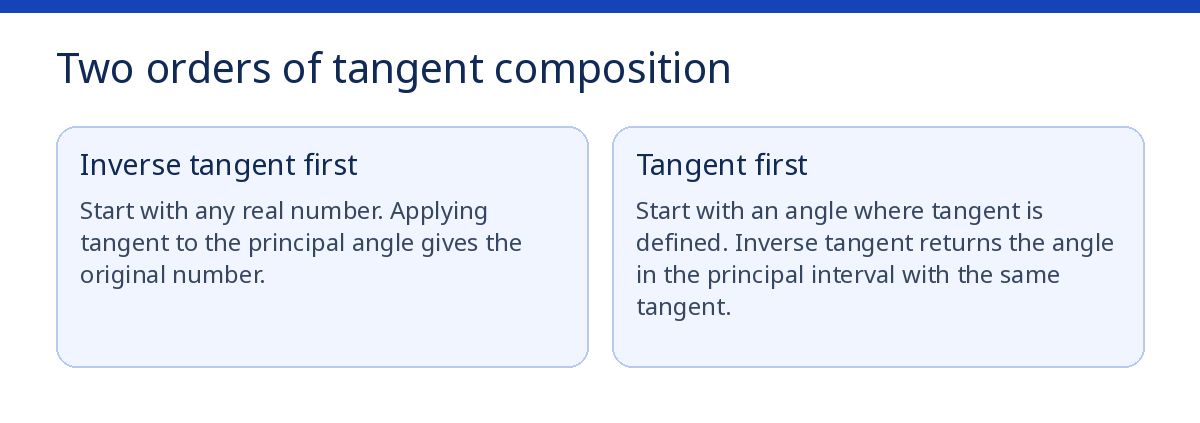
The order of a composition matters. In , the inner function chooses the principal angle for the real input , so taking its tangent returns . In , the inner tangent must first be defined. Even then, the composition returns the original angle only if is already in the principal interval .
For a defined tangent outside that interval, use tangent’s period to identify the angle inside the principal interval with the same tangent. This periodicity also explains why shifting the principal interval by integer multiples of produces other invertible restrictions. Each shifted branch accepts real inputs, but its outputs lie in its own shifted angle interval. When reviewing a composition, check whether you justified the output angle’s interval rather than simply crossing out the two function symbols.
Use domain and range to decide what is possible
In a domain question, apply the inverse function’s input restriction to its whole argument. If the expression is , the requirement is , with also restricted to values for which is defined. The interval describes the allowed values of the argument; it is not automatically the domain in terms of .
An equation calls for the complementary check: is the proposed output possible? If you isolate an inverse cotangent, check that the angle on the other side belongs to before taking cotangent. For a sum of inverse terms, their principal ranges can help you see whether the proposed total is possible and whether reaching a bound would force individual terms to reach their own bounds.
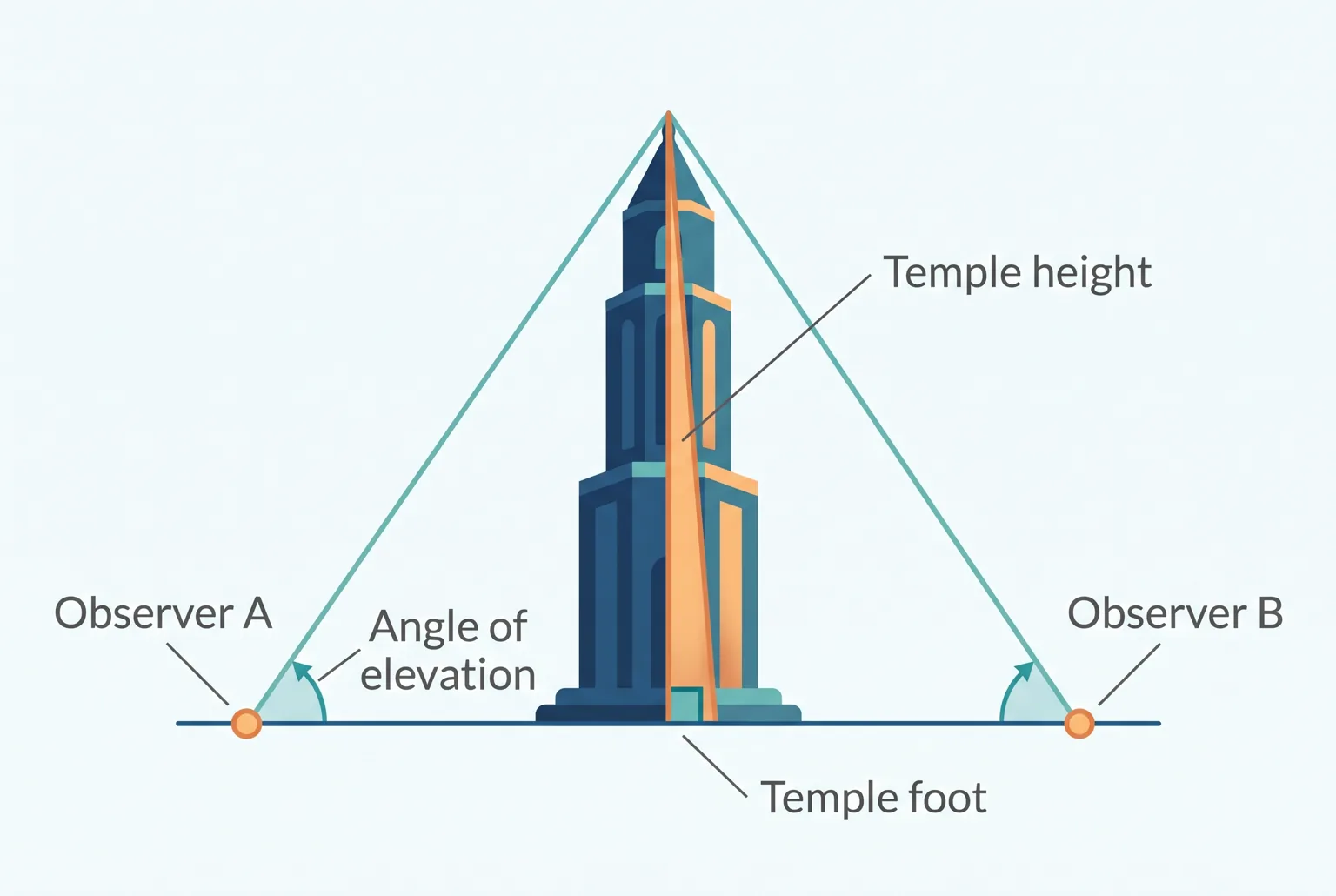
Read the heights-and-distances diagram before using a ratio
The case study places observers on opposite sides of a temple. The diagram and clarification put the temple’s foot on the level line between the observers and neglect observer heights. Under those assumptions, the vertical height and the two horizontal distances form two right triangles. The distance between the observers is not the horizontal leg of either right triangle; identify the segment from each observer to the temple’s foot before choosing a ratio.
For a self-check, point to the angle of elevation in each triangle and name its opposite side, adjacent side and hypotenuse. Which ratio uses the lengths you know? If you represent the same acute angle using two different inverse functions, how can you check that both expressions describe the same angle? This guide omits the printed page 10 worked calculations and final answers for Questions 12–16, as well as the option and answer-key lettering for the first case-study subpart.
Spotted an error? Report a correction. Practise this in the app: notes, formula sheets and mind maps.





























































































































































Loading comments…