CBSE Class 12 Inverse Trigonometry: Case-Based Assessment
CBSEMathematicsTrigonometry
This CBSE Class 12 Mathematics assessment uses four case studies to connect principal values and inverse-trigonometric compositions with angles of elevation. It presents all the questions first, then gives step-by-step solutions so you can check both your calculations and your choice of branch.
What the four case studies cover
The assessment focuses on Chapter 2, Inverse Trigonometric Functions. Its 18 subquestions, including OR alternatives, mix two kinds of reasoning: finding an angle from a trigonometric value and deciding which angle an inverse function is allowed to return. That distinction matters in both the numerical exercises and the geometry cases.
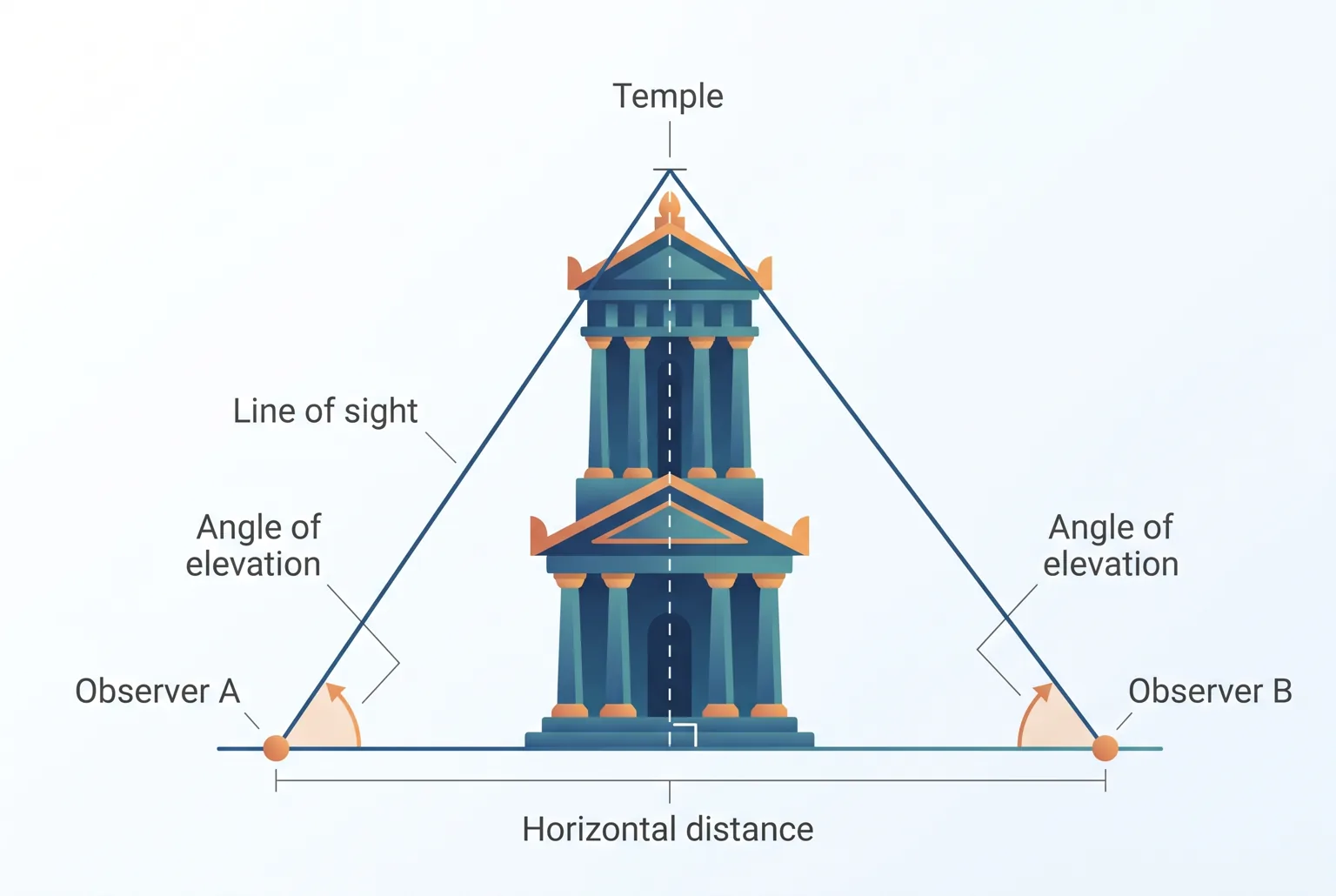
Cases 1 and 2 use multiple-choice questions. The first builds on two observers on opposite sides of a temple; the second asks you to evaluate principal values and simplify compositions. Cases 3 and 4 use short-answer questions and include OR alternatives. The third uses a tower and proposed hoarding positions to link inverse tangent with double- and triple-angle identities. The fourth asks for principal values of inverse sine, cosine, tangent and cotangent. Although Cases 2 and 4 share a topic, the second moves between compositions and direct evaluations, while the fourth focuses on choosing the correct angle from a given input.

Trigonometry | Class 12 | Case-based Assessment
In the StudentCurio app
Four case studies with questions and step-by-step solutions on inverse-trigonometric principal values and branches, compositions, and angle-of-elevation applications. Helps Class 12 students practise inverse trigonometric function properties through CBSE-style case-based questions.
Good to remember: The branch fixes the output
A trigonometric value alone does not generally identify a unique angle. To define an inverse, the original trigonometric function is restricted to an interval on which it is one-to-one. The principal value is the angle in that chosen interval with the required trigonometric value. In an inverse-function question, the ratio is the input and the angle is the output.
Inverse sine and inverse cosine both accept inputs in , but their output ranges differ: for inverse sine and for inverse cosine. Inverse tangent accepts every real input and returns an angle in . The assessment uses for inverse cotangent, which also accepts every real input. Its verification note explains why neither endpoint is included: cotangent is undefined at both. The different ranges also explain why a negative input need not give a negative angle. The sign of the ratio must be interpreted within the range of the particular inverse function.
Common mistake: Cancelling a composition too soon
An expression such as returns only when already lies in the principal range of inverse sine. Outside that interval, look for an angle inside the range that has the same sine. The equivalent angle is not necessarily the familiar acute reference angle: it must preserve the sign of the original trigonometric value as well.
Case 2 brings out why the identity you choose depends on the function. Sine has the same value at supplementary angles, cosine satisfies , and tangent repeats after a shift of wherever it is defined. These facts help you move to the correct branch without changing the input to the inverse function. When a question combines two inverse-trigonometric terms, settle each principal value separately before adding or subtracting. Checking only the final sum or difference cannot show whether both terms were evaluated on their proper branches.
From the temple diagram to an inverse ratio
Case 1 uses the same vertical height in two right triangles, one for each observer. The horizontal legs are different. Because the foot of the temple lies between the observers, the distance from one observer to the foot is found by subtracting the other observer's distance from their total separation. That subtraction depends on the order of the points; being given two distances is not enough by itself to justify it.
Once you identify the right triangle, choose a ratio according to the sides involved. Tangent relates the vertical rise to the horizontal run, whereas sine and cosine each use the line of sight as the hypotenuse. The case asks you to recognise that different inverse ratios can describe the same acute angle when the ratios come from the same triangle and the angle lies in the relevant principal ranges. It also distinguishes the observer's angle of elevation from the interior angle at the top of the larger triangle.
When the tower's angle identities apply
Case 3 keeps the viewer fixed while changing the target on the tower. The stated relationships are between the angles of elevation, not the heights. Doubling an angle does not in general double its tangent, so the double-angle and triple-angle identities are needed to express the new tangent values in terms of the original one.
For these rational forms, the original tangent must be defined and the relevant denominator must be nonzero: for the double-angle identity and for the triple-angle identity. There is then a separate branch check. Even when an identity gives a finite tangent, taking inverse tangent returns the actual multiple of the angle only if that multiple lies in . The solutions connect this check to the geometry: in the right triangles shown, the angles of elevation are positive and acute.
Use the links to check your reasoning
The clickable index lets you jump to the questions or solutions for each case. Each subquestion links directly to its solution, and a return link takes you back to the prompt. In a multiple-choice case, write down the ratio or principal-range condition that supports your choice before opening the solution. In a short-answer case, compare the line where you turn a ratio into an angle, not just the final expression.
As a quick self-check, ask yourself what would still need to be verified if two angles had the same tangent. Then, for either diagram, identify which distance is horizontal and which segment is the line of sight. These checks separate a branch error from a diagram-reading error, even when both lead to a plausible-looking angle.
Spotted an error? Report a correction. Practise this in the app: notes, formula sheets and mind maps.





























































































































































Loading comments…