Class 12 Three-Dimensional Geometry Case-Based Assessment
CBSEMathematicsThree-Dimensional Geometry
This CBSE Class 12 Mathematics assessment uses cable layouts, glass boxes and other spatial settings to practise direction cosines, equations of lines, angles and distances. The file includes multiple-choice and short-answer cases, with linked step-by-step solutions for checking your reasoning after an attempt.
What the assessment covers
The file lists 17 case studies and 79 subquestions, including OR alternatives. All questions come before the solutions. Cases 4–7 are short-answer sets; the other cases are multiple choice. The clickable index lets you open either the questions or the solutions for a case, and individual subquestions link to their corresponding solutions.
A case gives you a shared diagram, coordinate set or pair of equations, then asks you to use that information in several ways. The glass-box cases connect vertices, edges, diagonals and faces. The cable cases use endpoints to build displacement vectors, find lengths and combine vectors. The file also includes applications of planes, such as perpendicular distance and reflection.

Three-Dimensional Geometry | Class 12 | Case-based Assessment
In the StudentCurio app
Case-based questions apply spatial coordinates, direction ratios and cosines, equations and angles of lines, and perpendicular or skew-line distances to contextual scenarios. Includes multiple-choice and short-answer practice with worked solutions for Class 12 students preparing for CBSE assessments.
From two points to a line
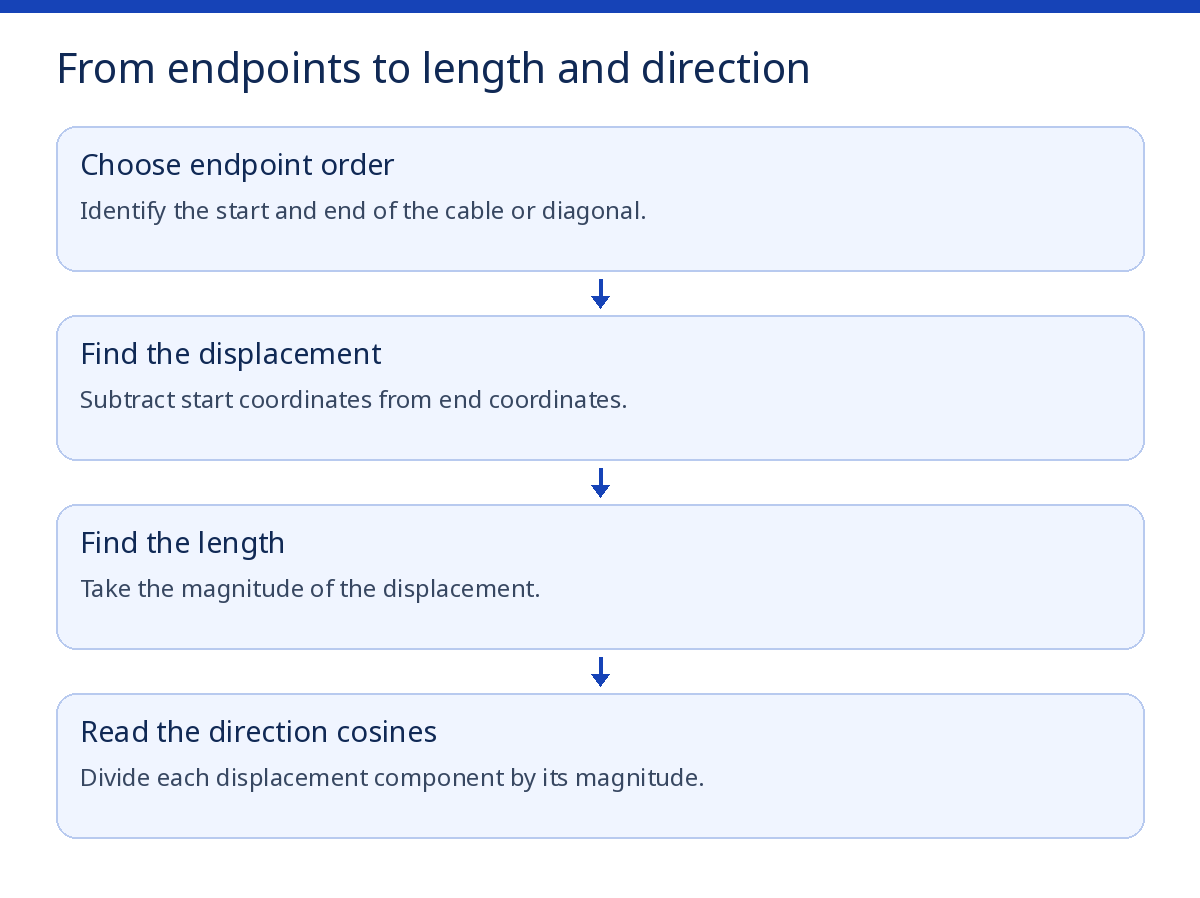
When a case gives the endpoints of a cable or a diagonal, begin by deciding which point is the start and which is the end. Subtracting the start coordinates from the end coordinates gives the displacement vector. Its magnitude is the length of the segment, and its components give a set of direction ratios for the line. Dividing those components by the vector’s magnitude gives the direction cosines for the chosen orientation. Reversing the endpoints changes the signs of all three components but leaves the length unchanged.
A vector equation of a line combines a fixed point with a nonzero direction vector: . The fixed point tells you where the line passes; the parameter lets you move along it. This distinction helps when converting between vector, parametric and Cartesian forms.
Common mistakes when comparing lines
Do not test parallel directions by dividing corresponding components if any denominator is zero. Instead, check whether one nonzero direction vector is a scalar multiple of the other. The same caution applies when writing a line in symmetric Cartesian form: a zero direction component means the corresponding coordinate stays fixed, not that you should put zero in a denominator.
A zero dot product tells you that two directions are orthogonal. It does not show that the lines meet. To check for an intersection, give each line its own parameter and look for values that satisfy all three coordinate equations together. Distinct nonparallel lines that do not intersect are skew. If the directions are proportional, a separate point check tells you whether the lines are distinct or coincide.
When the shortest-distance method applies
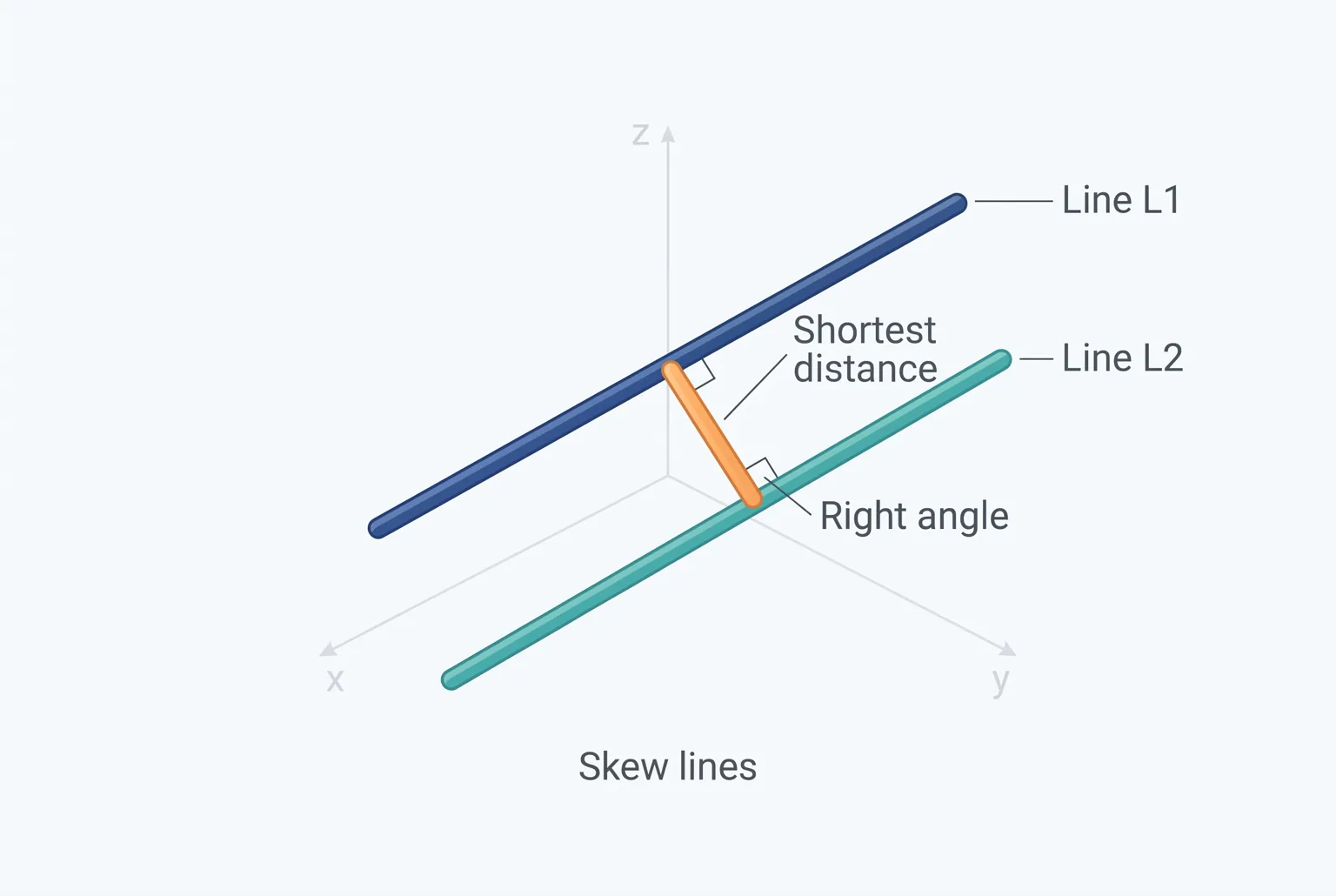
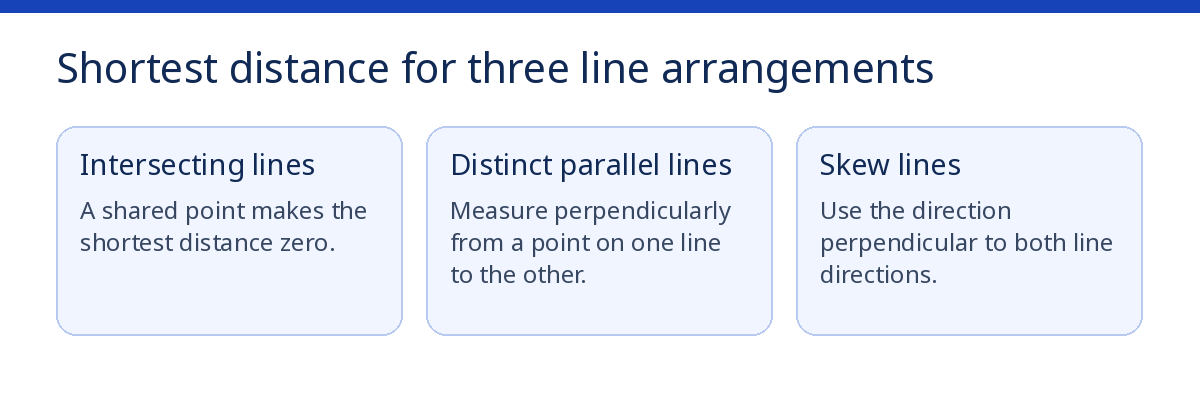
Classify the lines before choosing a distance method. For intersecting lines, the shortest distance is zero. For skew lines, the shortest joining segment is perpendicular to both directions. The cross product of the direction vectors gives a nonzero vector along that common perpendicular direction, so the distance is the magnitude of the projection of a vector joining points on the two lines onto that direction.
That cross-product method does not apply to parallel directions: their cross product is zero, so it cannot be normalised. For distinct parallel lines, use the perpendicular distance from a point on one line to the other. If a question asks for the foot of a perpendicular rather than the distance, it wants the coordinates of the point on the line, not just the length of the perpendicular segment.
What a plane’s normal tells you
The box and tower cases let you compare two ways of identifying a plane. For a face parallel to a coordinate plane, one coordinate is fixed across the face. For a plane through three noncollinear points, two displacement vectors from a shared vertex lie in the plane, and their cross product supplies a normal. The magnitude of that same cross product is twice the area of the triangle formed by the three points. If the points are collinear, they do not determine a unique plane.
In the plane-distance and reflection cases, the normal gives the direction of perpendicular movement. The foot must lie on the plane, and the segment from the original point to that foot must follow the normal. For a reflection, the foot is the midpoint between the original point and its image. This is why a coordinate difference alone does not generally give the distance to a sloping plane.
Quick self-check before opening a solution
Try a glass-box case and a line-comparison case without opening the linked solutions. For the box, ask: What in the coordinates distinguishes an edge from a space diagonal or a face? For the lines, ask: Have I established only a relationship between their directions, or have I also checked whether they share a point?
For multiple-choice practice, write down the condition that justifies your choice. For short-answer practice, keep the equation or geometric check that connects your setup to your conclusion. Then open the linked solution and compare the first step where your reasoning diverges, rather than looking only at the final result. The index notes that some solutions include verification notes on errors, rounding or assumptions. This guide omits flagged wording about the Case 9 box and the inconsistent ground-plane detail in Case 4; it does not reproduce worked answers.
Spotted an error? Report a correction. Practise this in the app: notes, formula sheets and mind maps.





























































































































































Loading comments…