CBSE Class 12 Probability: Case-Based Assessment Guide
CBSEMathematicsStatistics and Probability
This assessment covers Chapter 13, Probability, through 27 case studies with separately linked questions and worked solutions. Use it to practise identifying what is given, what is being asked, and which probability rule connects the two.
What the assessment covers
Although the resource listing says Statistics and Probability, the PDF is labelled Chapter 13: Probability for CBSE Class 12 Mathematics. It contains case-based multiple-choice and short-answer questions, with OR alternatives in two short-answer cases. All the questions appear before the worked solutions, which follow the same case order. The clickable index lets you open either section for a particular case, and subquestion links let you check a specific solution without navigating through the entire file.
The file is organised around scenarios rather than separate topic drills. Use the topic labels in the index to find cases on conditional probability, independence, sampling, or distributions. This lets you compare how the same rule appears in different contexts.

Statistics and Probability | Class 12 | Case-based Assessment
In the StudentCurio app
Case-based questions with worked solutions cover independent events, conditional and total probability, Bayes’ theorem, and probability distributions, including scenarios involving dice and game outcomes. These materials help Class 12 CBSE students practise applying probability rules and interpreting contextual questions.
Quick self-check: What comes after ‘given’?
Before choosing a formula, name the event you want and the event you already know has occurred. In , is the event of interest and is the condition. When , the definition is . The numerator describes both events occurring; the denominator restricts attention to cases where the condition holds. Reversing the events changes the denominator and generally changes the probability.
The insurance and seed-germination cases are useful for comparing the two directions of conditioning. Before opening a solution, ask: Am I starting with a group and considering an outcome, or starting with an observed outcome and asking which group it came from? Write the probability in symbols before putting in any numbers.
When to use total probability and Bayes’ theorem
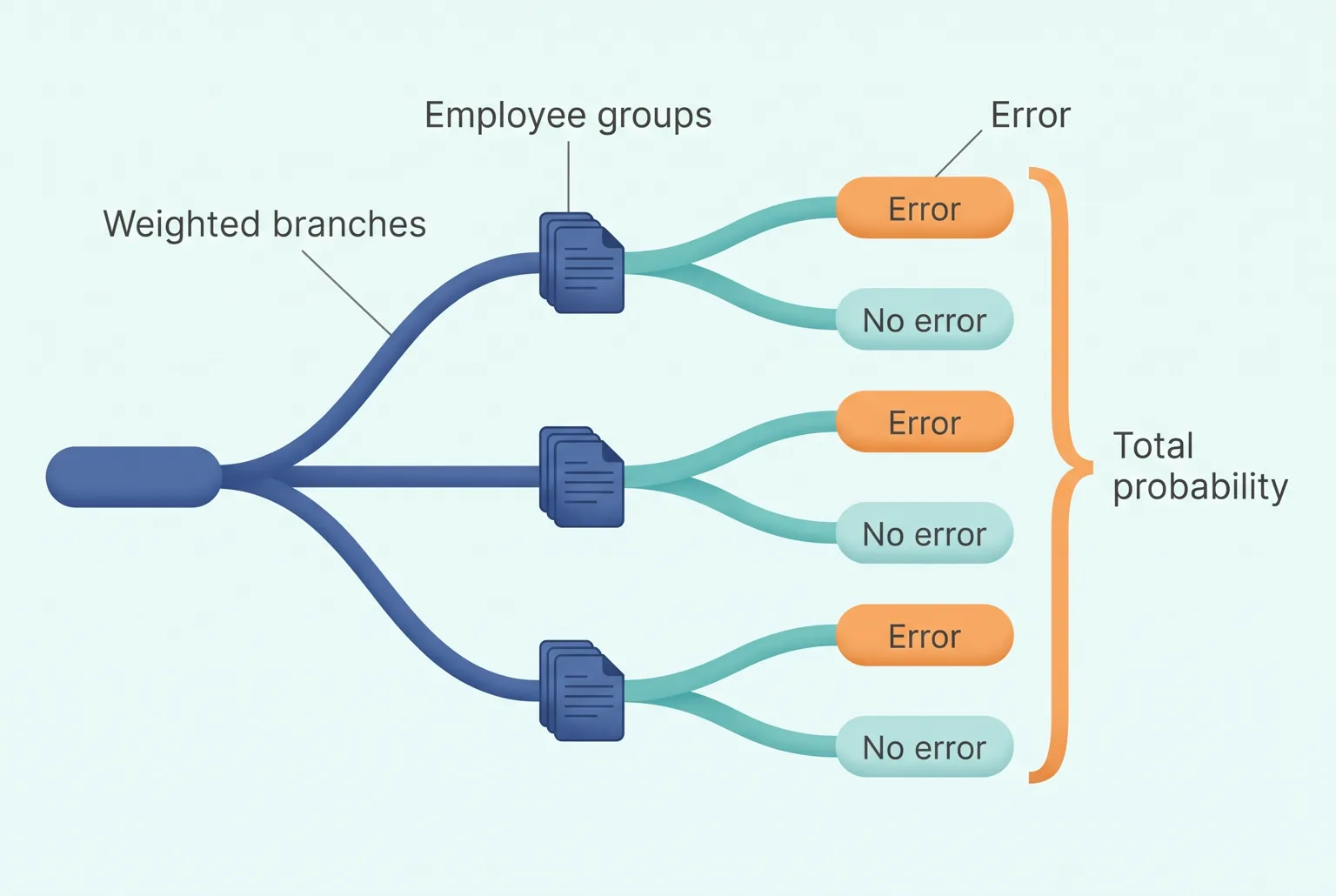
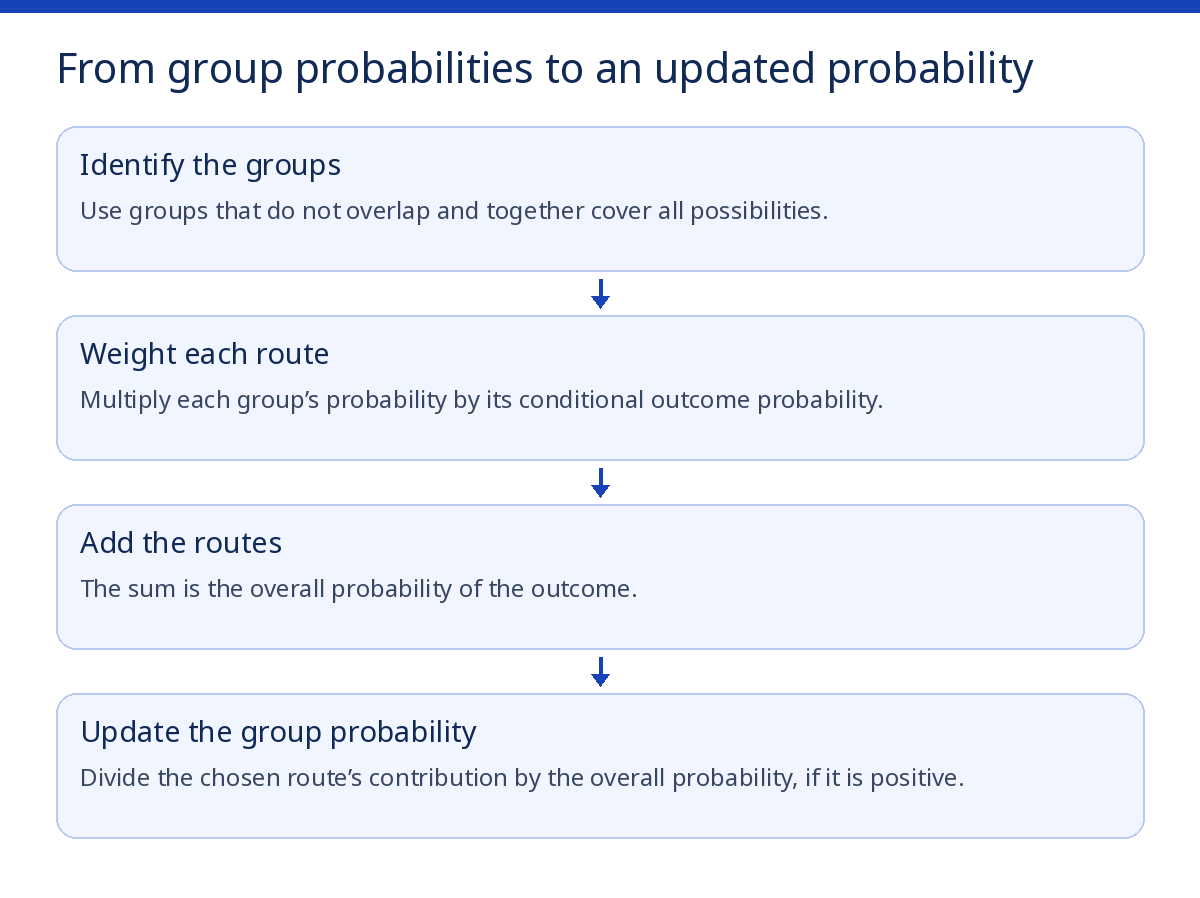
Total probability combines different routes to the same outcome. In a case about forms processed by different employees, the routes are the employee groups and the outcome of interest can be a processing error. When the groups are mutually exclusive and exhaustive, weight each group’s conditional outcome probability by the chance of being in that group, then add the contributions. An unweighted average can give the wrong result when group sizes differ.
Bayes’ theorem answers a different question: given that the outcome occurred, how likely is a particular group? For a group with positive probability, use its joint probability with the outcome as the numerator and the overall outcome probability as the denominator, provided the latter is positive. The seed mixture offers another context for recognising this shift from group to outcome and back.
Common mistake: Treating independence as no overlap
Two events are independent if . If the conditioning event has positive probability, this means knowing it occurred does not change the probability of the other event. Mutually exclusive events, by contrast, cannot occur together. Two events with positive probabilities cannot be both independent and mutually exclusive: their product is positive, but their intersection has probability zero.
The online practice test and puzzle cases let you practise reading event language alongside independence. ‘At least one’ includes the possibility that both occur; ‘exactly one’ excludes it. ‘Neither’ is the complement of ‘at least one’. These translations apply whether or not the events are independent. Independence affects how you calculate a joint probability, not what the wording means.
Replacement and order are separate decisions
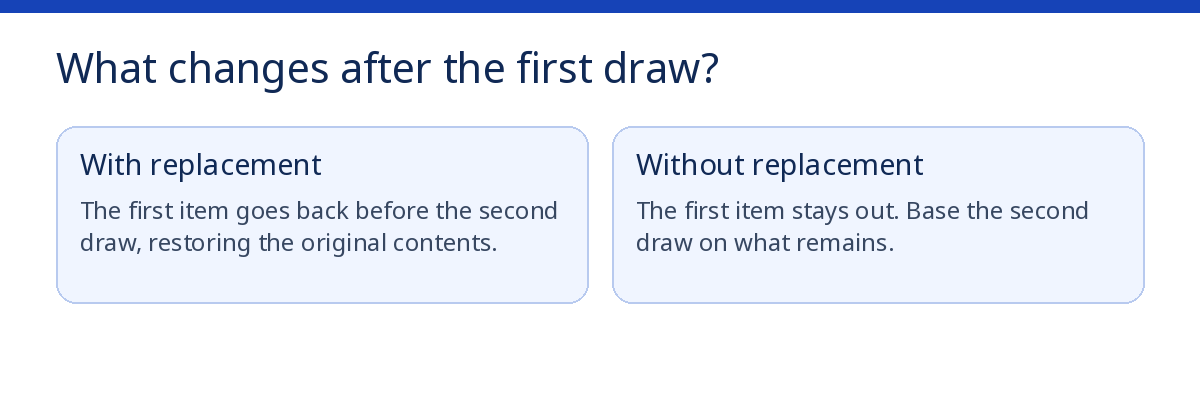
The crane game uses successive draws without replacement. The first draw changes what is available for the second: the total falls, and the count for a relevant colour may change. With replacement, the contents are restored before the next draw; under the same random selection procedure, the first result then does not change the probabilities for the second draw.
When a question names a first and second outcome, keep that order in your event description and use the multiplication rule with the appropriate conditional probability. When it describes an unordered selection, combinations can count the selections if they are equally likely. The card and ticket contexts give you a reason to decide what counts as an outcome before choosing a counting method.
Read a discrete distribution before calculating
The study-hours survey gives a piecewise discrete probability distribution with an unknown constant. Read each line as a rule for the values named beside it, not as a formula that applies to every value. A valid distribution assigns non-negative probabilities that add to one across all possible values. That normalisation condition is what lets you set up an equation for the unknown constant.
Keep the random variable separate from its probabilities: a value of the variable represents study time, while the probability attached to it is unitless. For an event described by a range, identify which listed values belong to it before adding their probabilities. ‘At least’ and ‘not more than’ both include the stated endpoint.
Use the solution links to check your reasoning
Attempt a case from the questions section before opening its solution. For multiple-choice questions, write the event and your setup before comparing options. For short-answer questions, make clear whether a figure represents a group probability, a conditional rate, or a joint probability. Then use the subquestion link to compare the setup, not just the final result. If yours differs, check first whether you used the same condition, counting convention, and assumptions.
The assessment includes verification notes beside solutions. This guide omits Case 10(v), its options, and its numerical answers because the verified note documents a mismatch between the written question and the supplied answer.
Spotted an error? Report a correction. Practise this in the app: notes, formula sheets and mind maps.





























































































































































Loading comments…