CBSE Class 12 Relations and Functions: Case-Based Assessment
CBSEMathematicsSets, Relations and Functions
This CBSE Class 12 Mathematics assessment uses nine case studies to practise testing relation properties, counting relations and functions, and classifying mappings. A separate, linked solutions section lets you attempt each case before checking your reasoning.
What the nine cases cover
The file covers Chapter 1, Relations and Functions, through both everyday settings and questions stated directly in mathematical language. The student-group, Ludo and race cases use finite sets to explore ordered pairs and mappings. Other cases examine the square function and rational expressions, connect a sapling-row setting to a linear function, or ask you to classify relations on finite sets and on the natural numbers.
Cases 1–4 and 8–9 use multiple-choice questions, while Cases 5–7 use short-answer questions. Case 6 includes an OR alternative. The clickable index gives separate links to the questions and solutions for each case. Since all nine cases appear before the solutions, you can work through the file in order or select a topic without first seeing its explanation.

Sets, Relations and Functions | Class 12 | Case-based Assessment
In the StudentCurio app
Case-study questions and solutions cover relation properties and equivalence relations, counting relations and functions, and function classification including one-one, onto and bijective mappings. For Class 12 students practising CBSE case-based assessment questions.
Good to remember: Each relation property has its own test
A relation on a set is a subset of . That underlying set matters: reflexivity requires the pair for every element of , not just for elements that appear in the listed pairs. Symmetry requires the reverse of every pair in the relation. Transitivity requires whenever both and belong to the relation. An equivalence relation satisfies all three conditions.
Cases 7 and 8 let you practise these tests on relations given by a list or a rule. On a finite set, a pair list lets you check for missing diagonal pairs, missing reverses and missing links between composable pairs. For a rule-defined relation, use the rule to justify why the required pairs belong, or give a counterexample using elements of the stated set.
Common mistake: Looking for a chain that need not exist
To disprove transitivity, it is not enough to find a pair missing from the relation. You must first find two pairs that compose: the second coordinate of the first pair must match the first coordinate of the second. Only then does the absence of the required third pair count as a counterexample.
If there are no composable pairs at all, transitivity holds vacuously: there is no instance in which the hypothesis is true and the conclusion fails. This distinction is especially useful in the rule-defined cases, where a restriction on one coordinate can prevent pairs from linking. Before drawing a conclusion, ask whether a pair’s second coordinate is ever eligible to be the first coordinate of another pair.
When a counting formula applies
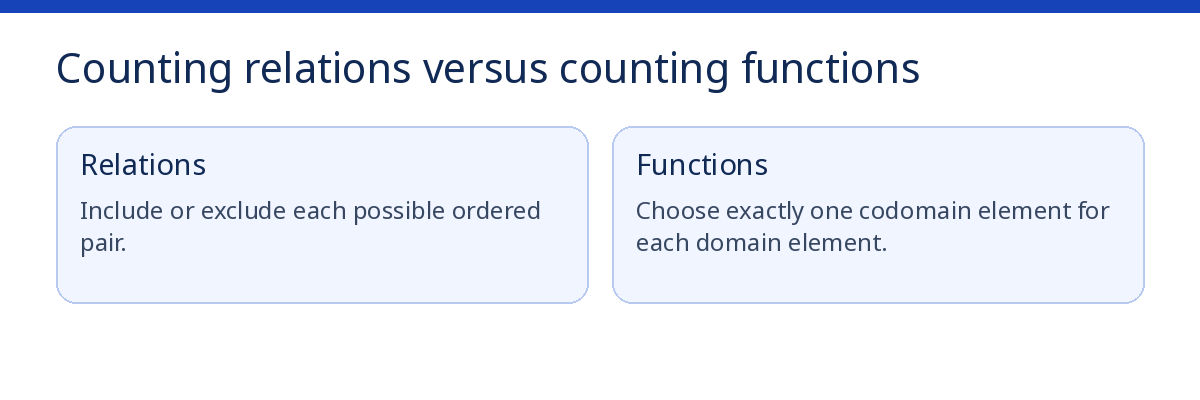
For finite nonempty sets and with and elements respectively, a relation from to is any subset of . Each possible pair can be included or excluded, giving relations. A function instead assigns exactly one image to each element of . There are choices for each input, giving functions. These formulas count different objects even when the two sets are unchanged.
A property can change which choices are independent. On a single set, reflexivity forces all diagonal pairs to be included. Symmetry does not force those pairs, but it ties each off-diagonal pair to its reverse. For onto functions, every codomain element must be used, so the unrestricted function count includes mappings that do not qualify.
Why the same formula can give a different classification
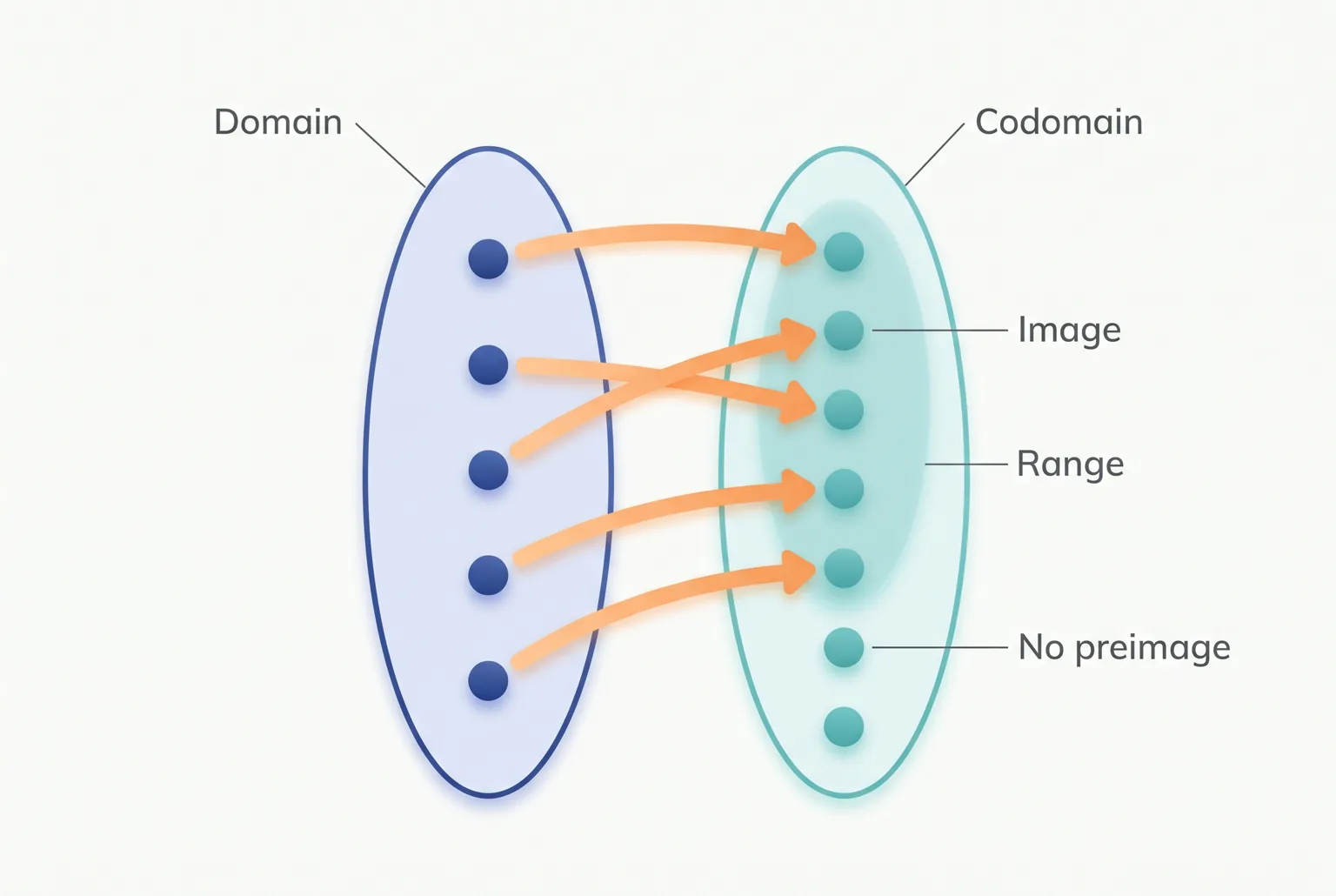
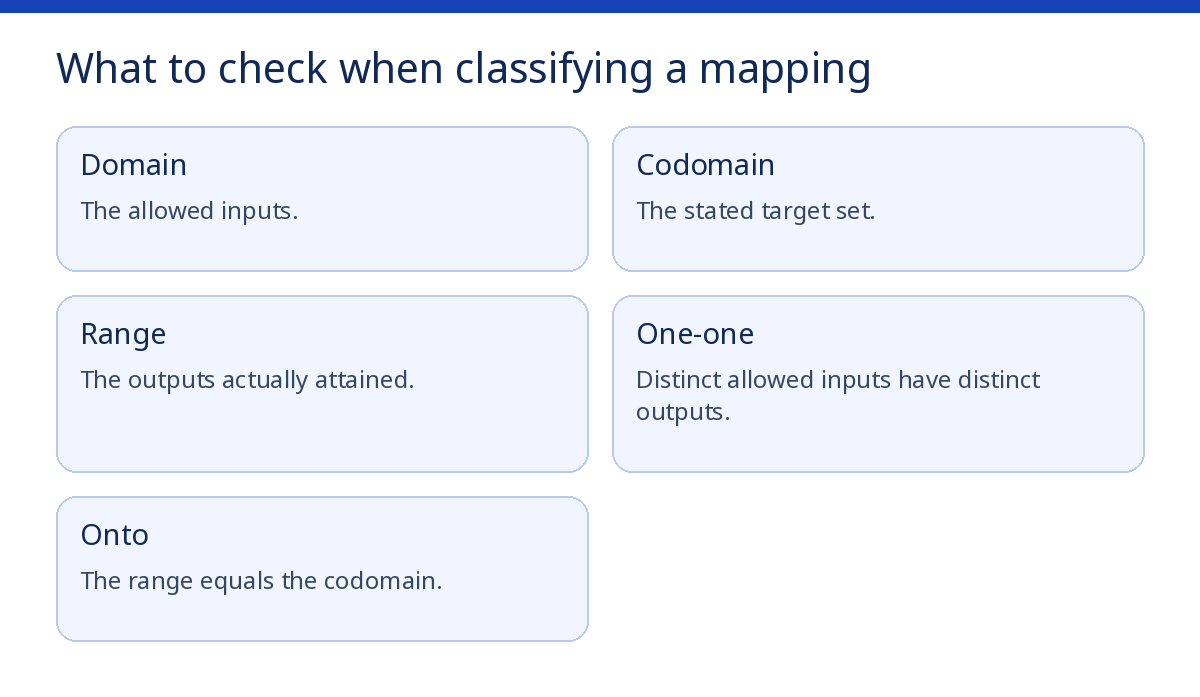
The square-function case changes the sets while keeping the rule . The domain gives the allowed inputs, the codomain gives the stated target set, and the range consists of the outputs actually attained. The assessment uses the positive natural numbers, beginning at one, in its square-function discussion; keep that convention when comparing its mappings.
To test whether a function is one-one (injective), ask whether two distinct allowed inputs can give the same output. To test whether it is onto (surjective), ask whether every member of the stated codomain has a preimage in the domain. It is bijective only if both tests pass. Changing the domain can alter which outputs occur or which inputs share an output. With the rule and domain fixed, changing the codomain can change whether the function is onto without changing its range.
Rational mappings: Keep input and output restrictions separate
The rational-mapping cases connect algebraic simplification with domain, range and classification. For a rational expression over the reals, start the natural-domain check by identifying values for which the original denominator vanishes. If you simplify the expression, retain those exclusions: a shorter formula does not make an originally undefined input valid. If the question specifies a domain, use that set rather than assuming every input allowed by the formula is in play.
Finding the range is a separate task. Ask which proposed outputs can come from an allowed input, then compare the resulting set with the stated codomain when testing surjectivity. For a related function defined in terms of the original one, check its stated domain and codomain before transferring any conclusion about the original mapping.
Use the links to check the reason, not just the option
Attempt a case from the question section, then follow a subquestion’s solution link and use the return link to continue. For a multiple-choice question, write the condition that decides your choice before opening the solution. For a short-answer proof, distinguish a general argument that establishes a property from a single counterexample that disproves it. Cases 7 and 8 present closely related material in both formats, so you can practise turning a classification into a justification.
Use the highlighted verification notes when reviewing the worked explanations. This guide omits Case 3 Q3 because two printed options have the same meaning, and Case 5 Q2 because the stated set of lines does not support the requested conclusion. Use the other items in those cases for practice.
Spotted an error? Report a correction. Practise this in the app: notes, formula sheets and mind maps.





























































































































































Loading comments…