Relations and Functions: Class 12 CBSE Practice Guide and Key Ideas
CBSEMathematicsSets, Relations and Functions
This guide to the CBSE Class 12 Mathematics chapter Relations and Functions explains how to test reflexive, symmetric and transitive properties, and how equivalence relations split a set into equivalence classes. It also covers one-one, onto and bijective functions, case-based items, and how the 66 practice questions with worked solutions are arranged.
Testing reflexive, symmetric and transitive properties
Most of the Relations set (Topic Practice 1, 29 questions) asks you to check three properties of a relation on a set .
- Reflexive: for every , not just for some elements.
- Symmetric: whenever , the reverse pair .
- Transitive: whenever and , the pair .
The set the relation lives on matters. Reflexivity on ℕ, where this chapter's ℕ starts at 1, requires every natural number to be related to itself. A relation that only mentions a few numbers can fail this test.
The questions use many kinds of sets: small finite sets such as , real numbers under conditions like or , points in a plane, triangles, and ordered pairs from . In each case, translate the defining condition into a precise statement before testing any property.

Relations and Functions | Class 12 | CBSE Assessment
In the StudentCurio app
Assessment questions cover relation properties and equivalence relations, equivalence classes, function mappings, and one-one and onto functions. Includes objective, short-answer, long-answer and case-based practice with worked solutions for Class 12 CBSE students.
Proving a property versus breaking it with a counterexample
Proving a property and disproving it need different kinds of argument. To prove symmetry or transitivity on an infinite set, start from general elements and use the defining condition. For example, symmetry of a relation built from follows because .
To show a property fails, one concrete counterexample is enough. The worked solutions model this. They name two pairs and that lie in , then show that does not.
Transitivity can also hold vacuously. The condition only needs checking when a chain actually exists. If no second coordinate ever reappears as a first coordinate, there is nothing to check.
Several questions ask for the minimum pairs to add so that a relation becomes reflexive, symmetric or transitive. Two steps help here:
- Add only the pairs that a property forces, such as a missing diagonal pair, a missing reverse pair, or the pair that closes a chain.
- Then check that the enlarged relation creates no new chain that still needs closing.
Equivalence relations and the classes they create
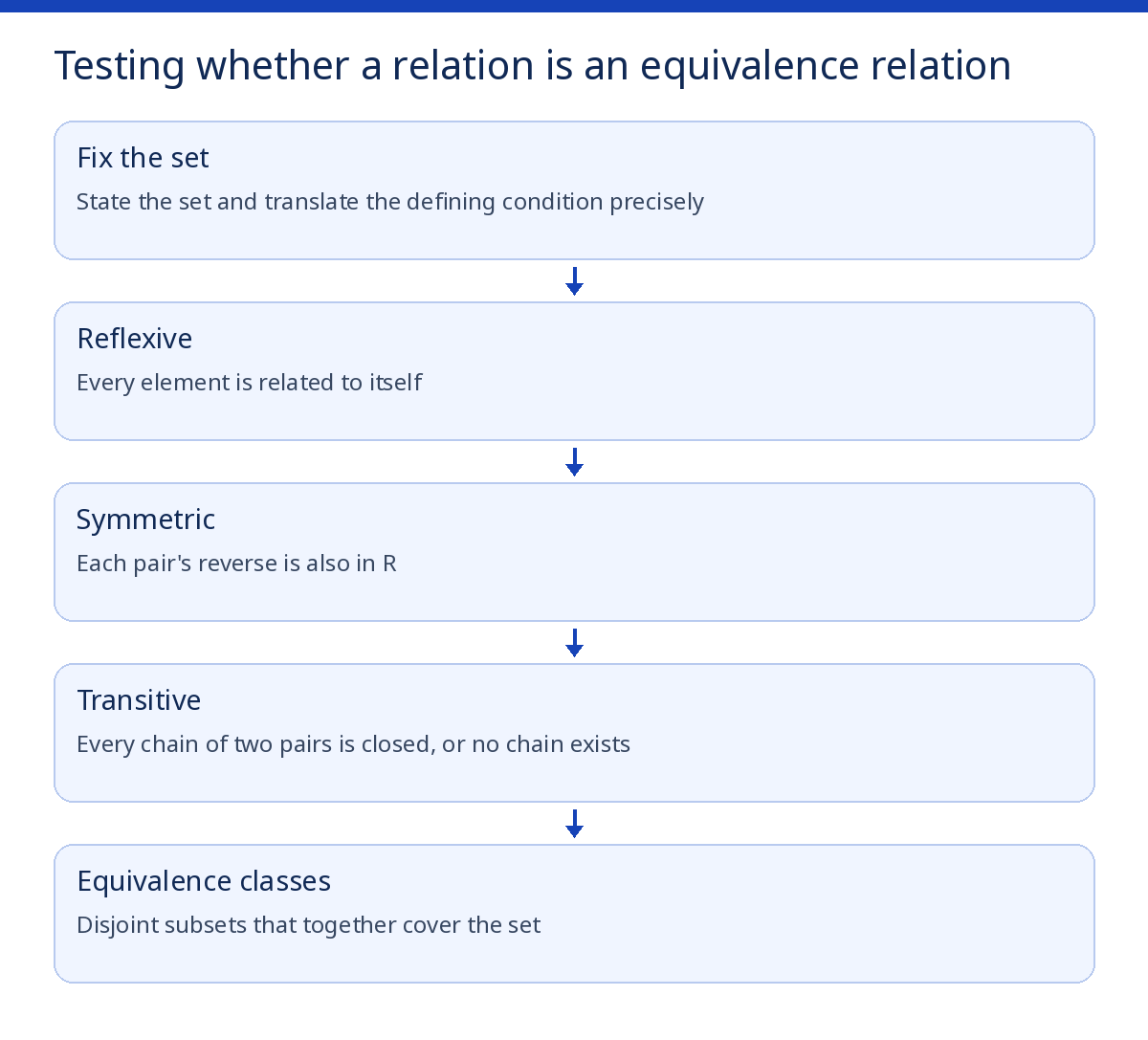
A relation that is reflexive, symmetric and transitive is an equivalence relation. The source returns repeatedly to a few families:
- divisibility conditions, such as divisible by 5, or divisible by a fixed positive integer on ℤ
- parity conditions, such as even
- leaving the same remainder on division by 5
- similarity of triangles
- points at equal distance from the origin
The equivalence class is the set of all elements related to . Equivalence classes are pairwise disjoint, and together they cover the whole set.
The long-answer items ask you to describe these classes explicitly. Examples include the disjoint subsets produced by remainders on division by 5, or the circle centred at the origin through a point .
One question compares combinations of relations. It asks why the intersection of two equivalence relations is again an equivalence relation, while their union need not be. The usual weak point of a union is transitivity.
Why domain and codomain decide one-one and onto
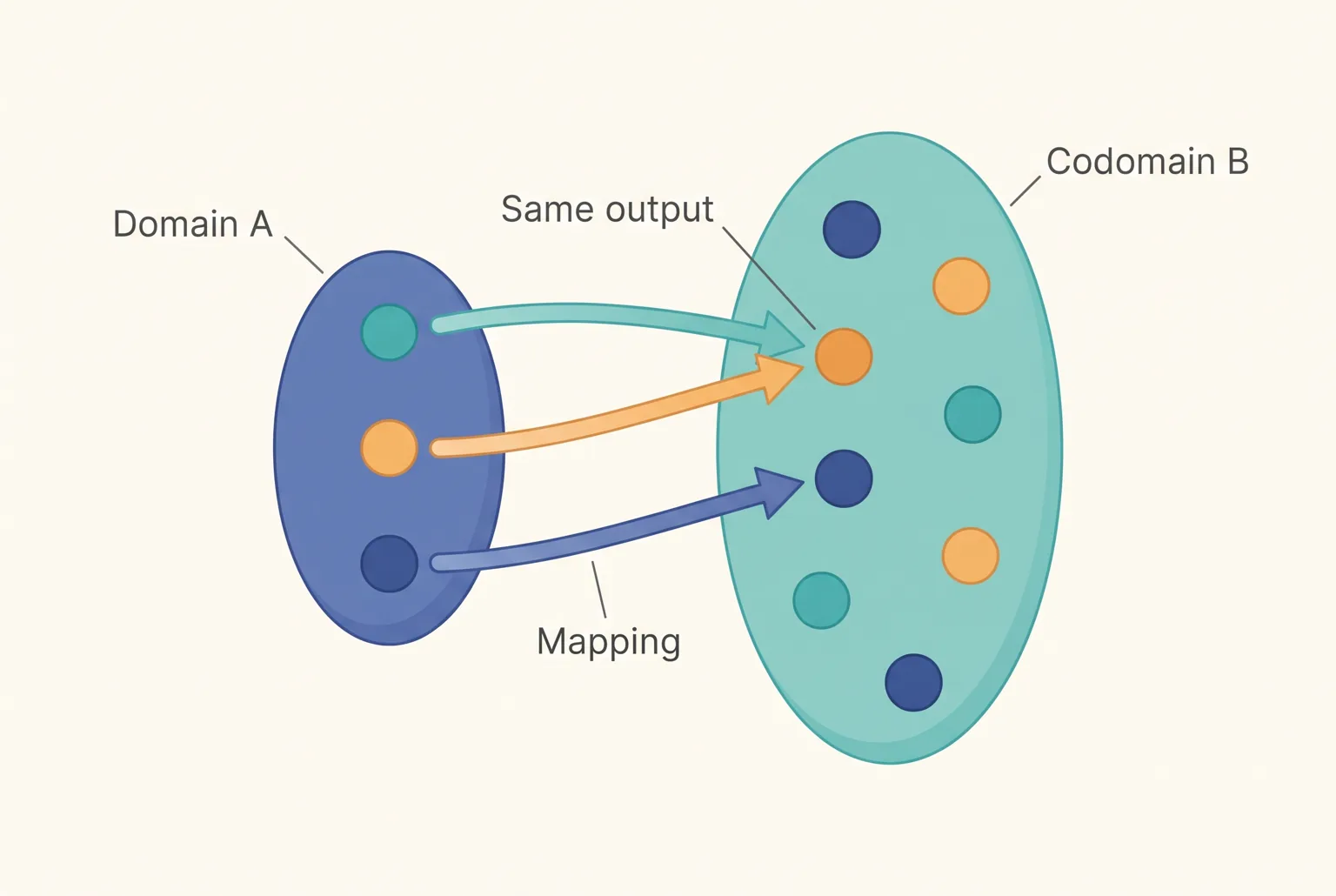
The cover diagram shows sending both and to the same output. That is the picture of a function that is not one-one.
The two definitions give two standard tests.
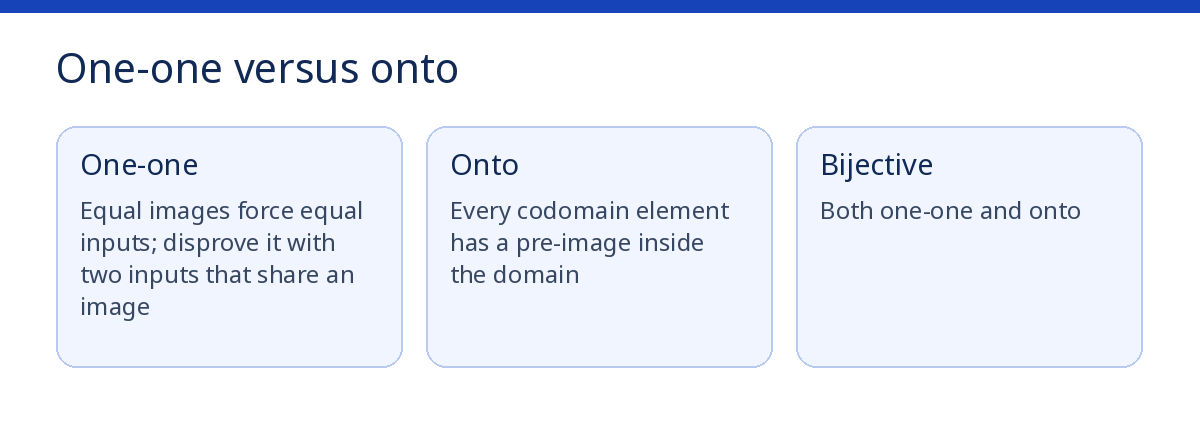
- One-one (injective): show that . To disprove it, find two different inputs with the same image.
- Onto (surjective): every element of the codomain must have a pre-image in the domain. A typical method is to solve for , then check that this really lies in the domain.
A function that is both is bijective.
Topic Practice 2 (20 questions) changes the domain and codomain deliberately. Examples include and on , functions from to , and with codomain .
The same formula can change status when its domain or codomain changes. Always state both before reaching a conclusion.
Piecewise functions on ℕ and counting mappings
Several functions on ℕ are defined separately for odd and even inputs. One example sends to when is odd and to when is even. The source also clarifies that another function swaps and .
For these, split every argument into cases:
- both inputs odd
- both inputs even
- one input of each parity
The mixed case is where two different inputs most often collide. For onto, check each target value and find an odd or even input that reaches it.
Objective and case-based items also ask how many relations, functions, injections or surjections exist between finite sets. Reason element by element: decide how many images each element of the domain may take, and which choices an injectivity or surjectivity condition rules out.
Reading the voting and bike-race case studies
The Chapter Practice ends with two case-based questions, each with five parts.
The voting relation is defined on all eligible voters, including those who did not vote. Keep that clarification in mind when you test reflexivity, because the property has to hold for every member of the set.
The bike-race case builds sets of boys and girls who reached the final. It then asks about relations defined by belonging to the same category, functions between the two sets, and injectivity.
In both cases, write the set and the defining condition in symbols before you choose an option.
Common slips and a practice order for the three sets
Common mistakes
- Checking reflexivity only for elements that appear in the listed pairs, rather than for every element of the set.
- Forgetting that ℕ starts at 1 in this chapter.
- Claiming a function is onto without confirming that the pre-image lies in the stated domain.
Practice order
The question types run from objective to very short answer, short answer type I and II, and long answer. Work through Topic Practice 1 first, then Topic Practice 2, and finish with the 17-question Chapter Practice, which mixes both sub-topics and adds the case-based items.
Attempt each question before you open its worked solution. Then compare your argument with the step-by-step reasoning, especially the counterexamples.
Quick self-check
Can you explain why one counterexample is enough to disprove transitivity, while proving it needs a general argument?
Frequently asked questions
How is this Relations and Functions assessment organised?
It has 66 questions with worked solutions. Topic Practice 1 covers Relations (29 questions), Topic Practice 2 covers Functions and Their Types (20 questions), and the Chapter Practice has 17 mixed questions, including two case-based items.
Does ℕ include 0 in this chapter?
No. The source states that ℕ denotes the natural numbers starting at 1.
Spotted an error? Report a correction. Practise this in the app: notes, formula sheets and mind maps.





























































































































































Loading comments…