Probability: CBSE Class 12 PYQs and Solutions
CBSEMathematicsStatistics and Probability
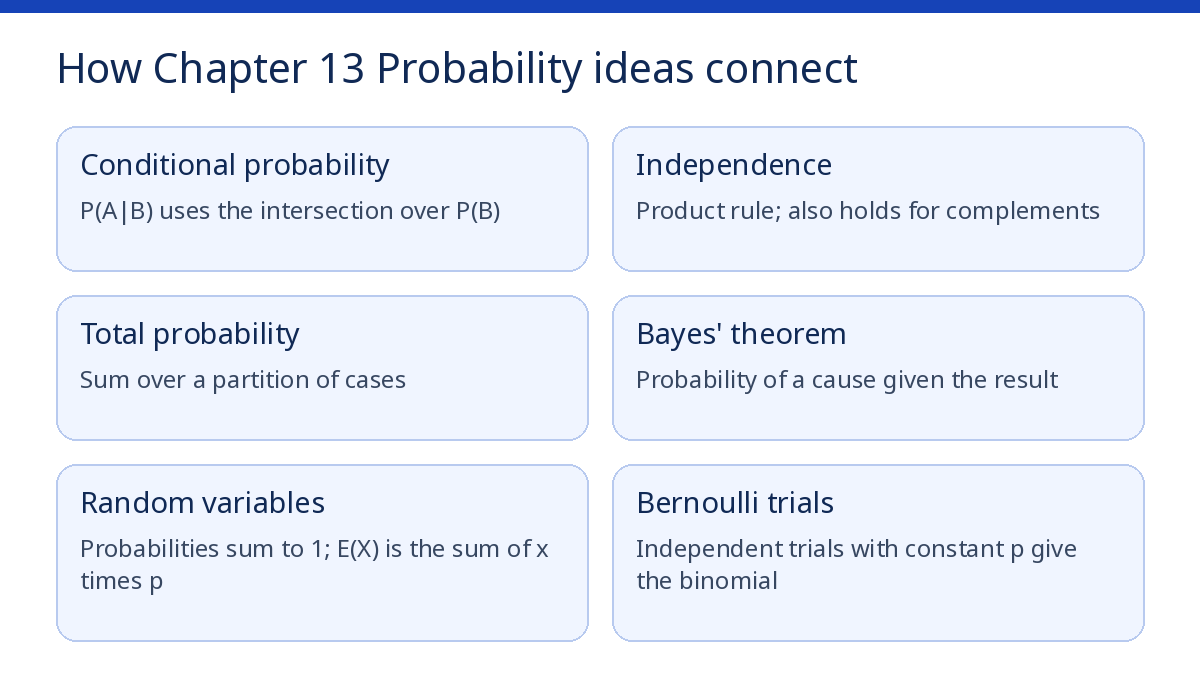
Chapter 13 Probability is tested in CBSE Class 12 board papers through conditional probability, independence, total probability and Bayes' theorem, random-variable distributions and Bernoulli trials. This guide explains each idea, the conditions it needs and how this collection's 129 previous-year questions from 2022–2026 frame them.
Six sub-topics in the Chapter 13 topic index
The collection gathers 129 CBSE Class 12 previous-year questions on Probability. The exam years printed are 2022–2026. Questions keep their original serial order and exam labels, such as Delhi, Outside Delhi, compartment and set codes.
A topic index sorts them into six groups: - Conditional probability (35 questions) - Independent events and complements (20) - Total probability and Bayes' theorem (20) - Random variables and probability distributions (22) - Bernoulli trials and binomial probability (8) - Applications and case studies (24)
Conditional probability is the largest group. It also underpins Bayes' theorem and many case studies, so it is the natural place to begin. Each question links to a numbered worked solution, and the file ends with source review notes.

Probability | Class 12 | Previous Year Paper
In the StudentCurio app
A collection of solved CBSE Class 12 previous-year probability questions covering conditional probability, total probability, Bayes’ theorem, independent events and random-variable distributions. Helps students practise exam-style questions and review worked solutions.
Conditional probability: shrinking the sample space
For events A and B with , the conditional probability is . Stems often state assumptions such as or . These conditions ensure that the conditional probabilities in the question are defined.
Board questions use the idea in two ways. - Formula-driven MCQs give some of , , , or a conditional value and ask for another. You link them with the addition rule and the multiplication rule . - Experiment-driven questions describe dice, coins or families. One stem asks for the chance that both children are girls, given that the elder child is a girl. Here, conditioning restricts the outcomes to those of the given event, and you count favourable outcomes within that set.
A useful companion result is . The complement applies to the event before the bar, while the condition B stays fixed.
Independence, mutual exclusion and 'at least one'
Events A and B are independent when . Equivalently, when . Mutually exclusive events satisfy , which means they cannot occur together. These are different definitions. Several items, including an assertion-reason question, check whether learners keep them apart. If A and B are independent, then and , and , and and are also independent.
The most frequent pattern is 'at least one'. Stems ask about rain in at least one of three cities, an item available in at least one of three shops, or at least one of three people going to market. When the events are independent, find the probability that none of them occurs as a product of complements, then subtract it from 1. One stem reverses the logic: a meeting is cancelled if any member is absent, so cancellation is the complement of everyone attending.
Total probability versus Bayes' theorem
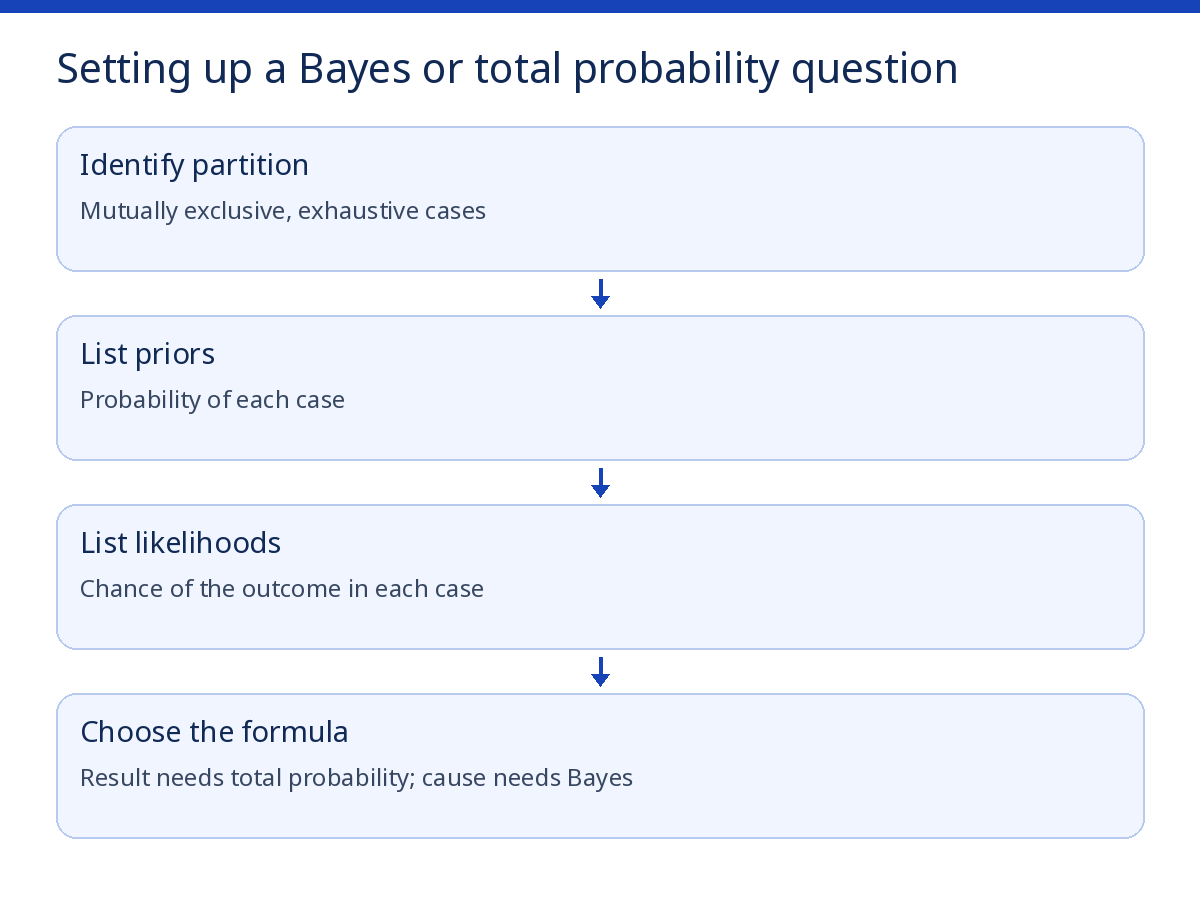
Suppose an outcome A can arise through mutually exclusive, exhaustive cases , each with non-zero probability. The theorem of total probability gives . Bayes' theorem reverses the direction: .
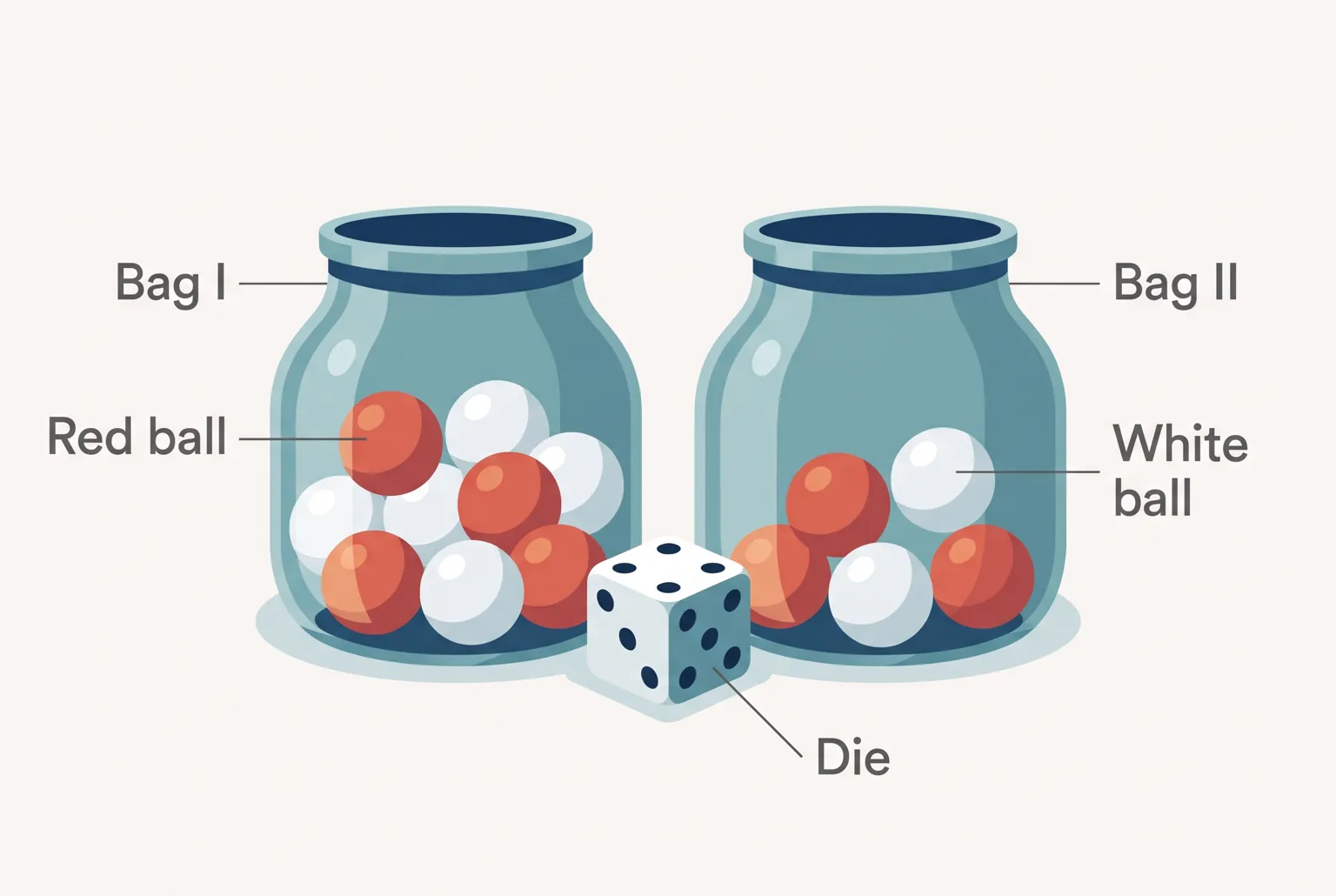
CBSE frames these ideas in a few recurring settings: - a ball drawn from one of two bags, with the bag chosen by a die throw; - construction companies with different chances of poor-quality work; - a survey of dropout and regular students who qualify at different rates.
In the survey case study, a later part asks for the chance that a student who qualified is not a dropout. To set up any of these, identify the partition and list the prior and conditional probabilities. Then decide what is being asked. A probability of the result needs total probability, while a probability of the cause, given the result, needs Bayes. Watch the wording as well. A building 'found to be strong' is the complement of poor quality, so each likelihood becomes 1 minus the stated chance.
Random variables: completing a distribution and finding E(X)
A probability distribution lists the values of X with probabilities . Each , and . When a table contains an unknown such as or , use the sum-to-one condition to find it first. Then answer the question, for example by finding .
The expectation is . X may take negative values, so keep the signs when you multiply. Case studies extend the idea. The online jackpot item first asks for the possible winning amounts, which are the values of a random variable. It then asks for the probability of winning at least a stated amount, or of winning nothing.
Bernoulli trials: why replacement matters
Trials are Bernoulli trials when four conditions hold: - the number of trials is fixed; - each trial has only two outcomes, success or failure; - the trials are independent; - the probability of success p is the same each time.
A marble or pen is drawn, its colour noted and then returned, so p stays constant. This is why such stems specify replacement. The knee-surgery item states independence explicitly. For n trials, , where . 'At least one success' is often quickest as , and an 'at most' count can be handled through its complement.
Common mistakes in Chapter 13 working
- Wrong numerator: the numerator of is , not .
- Complementing the condition: equals , not or .
- Confusing two definitions: test independence with the product rule, not with .
- Skipping the sum-to-one step: find any unknown constant before computing .
- Inconsistent data: can never exceed or . If printed values seem to break this, check the source review notes rather than forcing an answer.
How MCQ, assertion-reason and case-based items are framed
Questions are grouped by format: - MCQs have a single correct answer. - Assertion-reason items (Q6, Q13, Q30, Q35) use the standard four options. - Subjective questions often offer internal choice, for example '(a) … OR (b) …'. - Case-based questions, such as Q51, Q53 and Q55, set a scenario with parts (i)–(iii) and sometimes an OR within a part.
A practical order is to start with conditional and independence MCQs, then move to the assertion-reason items. After those, work through distributions and Bernoulli trials, and finish with Bayes and the case studies. Attempt each question before opening its solution.
Quick self-check: can you explain why two events with non-zero probabilities cannot be both mutually exclusive and independent?
Frequently asked questions
Which years and how many questions does this Probability collection include?
It prints 129 previous-year questions, with exam-year coverage of 2022–2026, kept in their original source order.
Are solutions included?
Yes. Every question links to a complete, numbered worked solution, and the file ends with source review notes.
Spotted an error? Report a correction. Practise this in the app: notes, formula sheets and mind maps.





























































































































































Loading comments…