Matrices: CBSE Class 12 PYQs, Question Patterns and Solutions
CBSEMathematicsMatrices and Determinants
This guide explains the ideas that CBSE Class 12 Matrices (Chapter 3) previous-year questions test: orders and conformability, matrix types, non-commuting products, transpose-based symmetry tests, matrix equations for inverses and the matrix method for linear systems. It also shows how a 151-question collection from 2023–2026, with added worked solutions, groups these ideas for board revision.
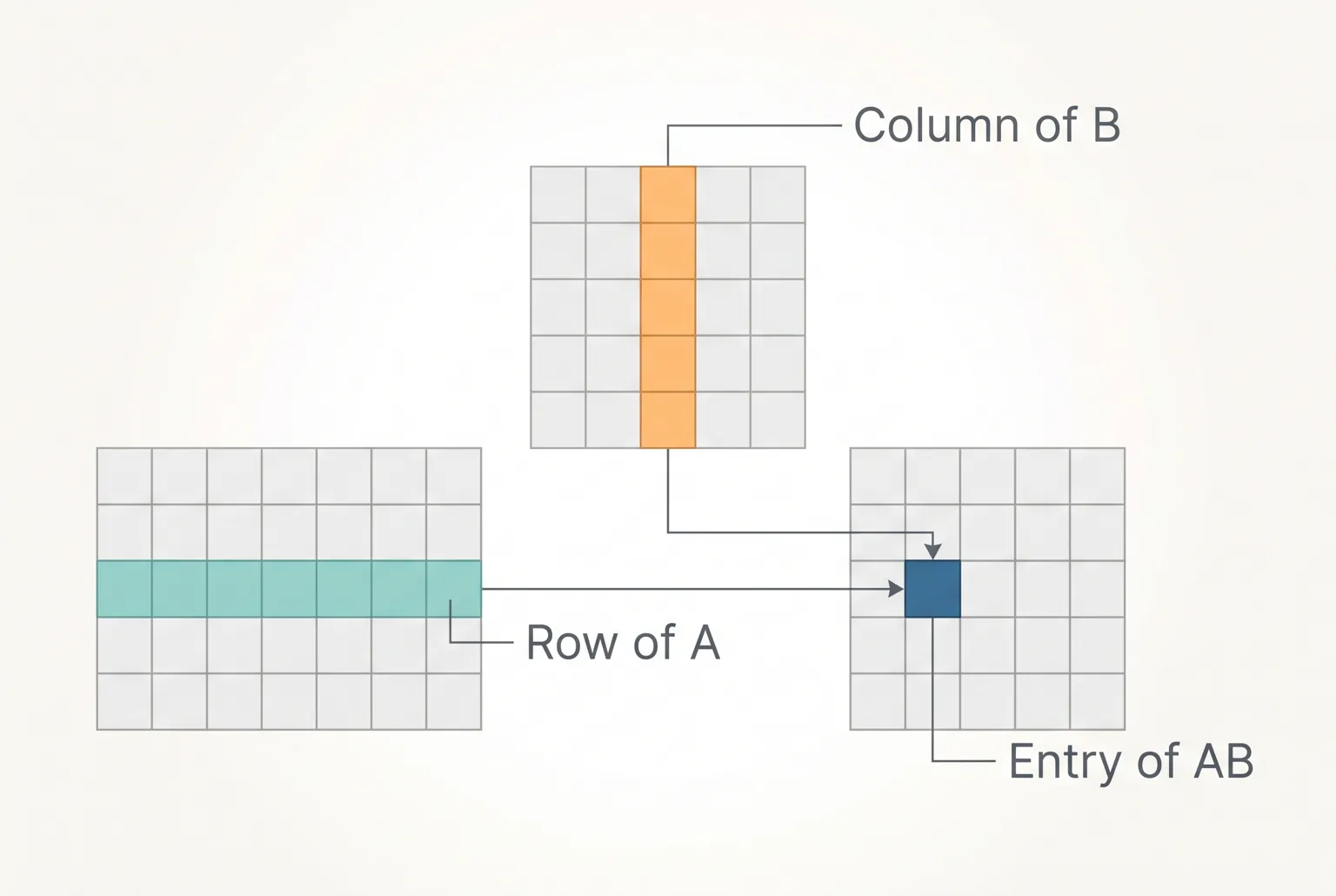
Reading the order of a matrix before you multiply
Many questions in this collection are settled by orders, not arithmetic. A matrix of order has rows and columns. A product is defined only when the number of columns of equals the number of rows of . An matrix times an matrix gives an matrix.
The papers use this in two directions. Some ask which of , or is defined for given matrices. Others work backwards. A typical stem gives a product equation with one unknown matrix and asks for that matrix's order. Write the known orders around the unknown and match inner dimensions. Questions that require both and to be defined use the same reasoning, with transposed orders.
Another common pattern defines by a formula. Keep as the row index and as the column index. Build the matrix entry by entry. If the question asks for , swap rows and columns only after the matrix is built correctly.

Matrices | Class 12 | Previous Year Paper
In the StudentCurio app
A collection of CBSE Class 12 previous-year questions on matrices, covering matrix types, operations, transposes, powers, inverses and matrix-based solutions of linear systems. Worked solutions help students practise exam-style problems and review methods for board exams.
Telling row, column, diagonal and scalar matrices apart
The topic Orders, entries and types of matrices is the second-largest group in the index. It rests on precise definitions:
- Row matrix: exactly one row, order .
- Column matrix: exactly one column, order .
- Diagonal matrix: a square matrix with whenever .
- Scalar matrix: a diagonal matrix whose diagonal entries are all equal.
- Identity matrix: a scalar matrix whose diagonal entries are all .
These types are nested, so one matrix can belong to several categories at once. Questions on types reward reading each option against the definition, not against a remembered example. One assertion-reason item tests exactly how a scalar matrix is defined.
Common mistake: confusing the pattern with the pattern. The first number always counts rows.
Why AB and BA must be kept separate
Matrix multiplication is not commutative in general. Even when both and are defined, they need not be equal. This one fact drives a whole family of questions under Matrix operations and products.
When you expand or , multiply term by term and preserve the order: . You may not merge and into unless the question gives you . Items that list several identities and ask which are "always true" test whether you assume commutativity without justification. One question frames this as four students simplifying an expression in and , so you must judge which simplification is legitimate.
For equations between matrices, two matrices are equal only when they have the same order and every corresponding entry is equal. Questions that equate two matrices with unknowns become small simultaneous equations once you compare entries.
Using the transpose to classify symmetric and skew-symmetric expressions
Transpose questions form a large group in the index. A square matrix is symmetric when and skew-symmetric when . The source writes the transpose with a prime, , and its solutions also use for the same thing.
The reliable method is mechanical. Take the transpose of the whole expression, simplify it, and compare the result with the original. Three rules make this work:
- The transpose of a product reverses the order,
Then substitute what the question tells you, such as or . If the simplified transpose equals the original, the expression is symmetric. If it equals the negative, the expression is skew-symmetric.
For a printed matrix with unknown entries that is declared symmetric, set and solve. In a skew-symmetric matrix, for every pair. Applying this to forces each diagonal entry to be zero.
Matrix equations, powers and inverses without cofactors
This is the largest group in the index. Many of its items never require a full inverse calculation.
A typical stem gives a relation such as written in terms of and , then asks you to express in the form . If is invertible, multiply the relation by . Use and , then rearrange to isolate . Other items give a condition such as and ask you to simplify a power like . Expand carefully, replacing each higher power of using the given relation.
Trigonometric matrices appear repeatedly with conditions such as or . Add the matrix to its transpose, compare entries with the right-hand side, and solve the resulting trigonometric equation. Then keep only solutions inside the printed interval. In this collection those intervals include and .
Good to remember: these manipulations need the identity and zero matrices to have the orders the equation requires, a convention the collection states explicitly.
Solving linear systems by the matrix method
The final index group, Linear systems and applications, has 15 questions near the end of the source order. Here the subjective section does most of the work. A system of linear equations is written as . When is non-singular (), the unique solution is .
According to the collection's notes, the added solutions show numbered steps for determinant and inverse calculations and for substituting into the system. In practice, set out these stages separately:
- Write , and .
- Evaluate and confirm it is non-zero.
- Find .
- Multiply to get .
- Check the values in the original equations.
Some printed questions offer an OR alternative, and the collection solves both sides of every one.
Quick self-check: before computing anything, can you explain why the method needs ?
Working through the 151 questions and their review notes
The compilation keeps 151 questions in their original serial order: 120 single-answer MCQs, then 31 subjective questions. There are four assertion-reason items and ten printed OR alternatives. Each question header carries its CBSE year (2023–2026) and set label, and some are marked as compartment papers. Marks are not printed, so do not assume weightage from this file.
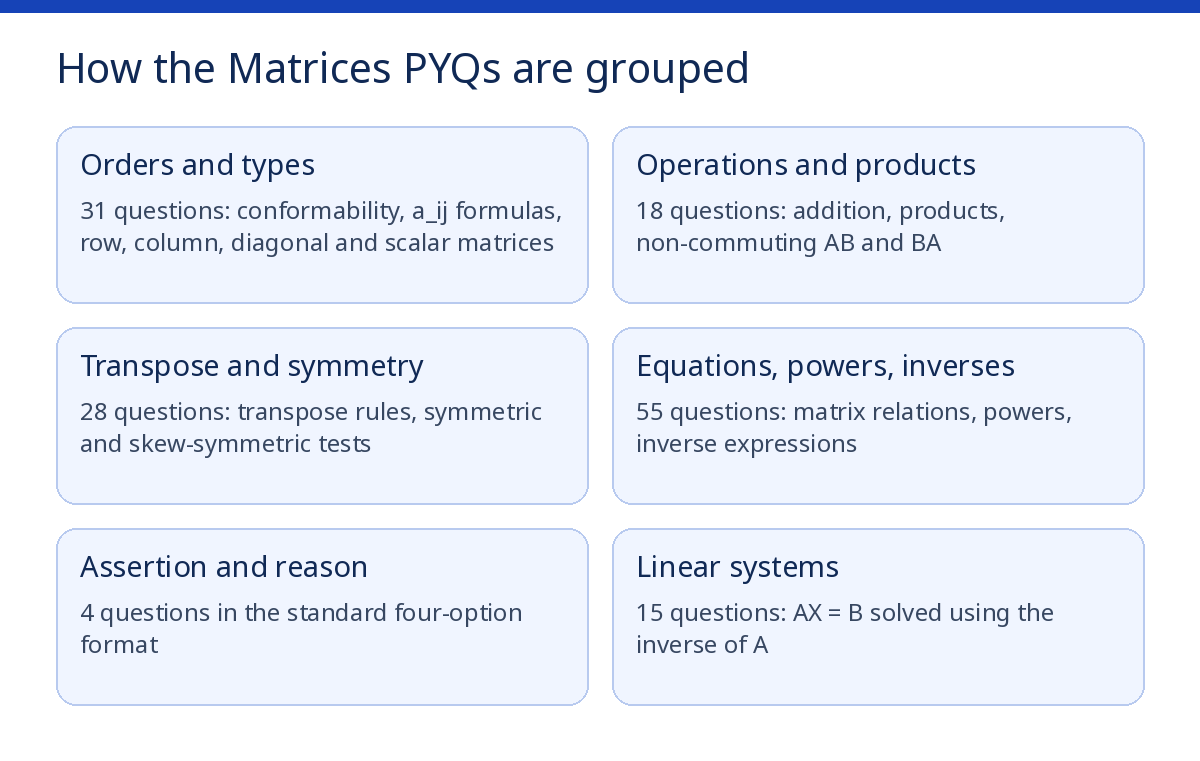
A practical order follows the topic index. Start with orders and types, then operations, then transpose and symmetry, then equations and inverses, and finish with linear systems. Attempt each question before following its View Solution link.
The solutions are added by the publisher rather than taken from CBSE. The source supplies only an MCQ answer key. Some printed questions contain inconsistent equations or overlapping options. In those cases the solutions separate the literal statement from any intended reading, and the final review notes collect these issues. Read those notes before treating any key as settled.
Frequently asked questions
What notation does this collection use for the transpose?
The questions use a prime, such as A′, wherever the original source does. The added solutions also use A^T as equivalent notation.
Are the worked solutions official CBSE solutions?
No. The source provides only an MCQ answer key. Every worked solution is labelled as an added solution, and discrepancies in the supplied key are noted locally and in the review notes.
Does the collection show marks for each question?
No. Marks are absent from the supplied question labels, so the collection omits them.
Spotted an error? Report a correction. Practise this in the app: notes, formula sheets and mind maps.





























































































































































Loading comments…