CBSE Class 12 Matrices: A Guide to the NCERT Notes
CBSEMathematicsMatrices and Determinants
These CBSE Class 12 Mathematics notes cover the NCERT chapter on Matrices, from reading entries to working with products, transposes and inverses. Use the worked examples to practise choosing the right operation and checking when it is defined.
Read the order before reading the entries
A matrix is an ordered rectangular array. Rows run horizontally and columns run vertically. A matrix of order has rows, columns and entries. In , the first index names the row and the second names the column. The notes explain that entries can be numbers or functions and restrict the chapter’s treatment to real numbers and real-valued functions.
The examples use sales tables and coordinates to show why position matters. In a table, a row can represent a time period and a column can represent a product; an entry makes sense only if you know both labels. The same set of points can also be arranged with one point per row or one point per column. If you are given only the number of entries, look for ordered factor pairs: exchanging unequal row and column counts gives a different order.

Matrices | Class 12 | NCERT Notes
In the StudentCurio app
These revision notes cover matrix types and equality, addition and scalar multiplication, matrix products and their properties, transpose, symmetric and skew-symmetric matrices, and invertible matrices. Worked examples help Class 12 students review matrix algebra and practise NCERT-style problems.
Recognise matrix types and test equality
A row matrix has one row, a column matrix has one column, and a square matrix has the same number of rows and columns. A zero matrix has zero in every position and need not be square. For a square matrix, the main diagonal consists of entries whose row and column indices agree.
The notes distinguish three nested types. A diagonal matrix has zeros outside the main diagonal; its diagonal entries need not be equal or nonzero. A scalar matrix is diagonal with all its diagonal entries equal. An identity matrix is the special case where that common value is one.
For equality, matching orders are necessary but not sufficient. Every pair of corresponding entries must also match. This is why a matrix equation can give several ordinary equations: each position supplies its own equality, even when some entries are expressions rather than numbers.
Add, subtract and scale without changing the order
Addition and subtraction require matrices of the same order, not merely the same total number of entries. Both operations pair entries in the same position. Scalar multiplication is different: it takes just one matrix and multiplies every entry by the same number. In particular, , so subtraction can be written as .
The notes use sales data to illustrate the distinction. Adding two monthly tables combines amounts for each matching farmer and rice variety. Subtracting the later table from the earlier one measures the decrease in that order, while multiplying one table by a percentage expressed as a scalar applies the same rate to each entry. When you revisit the example, check that the row and column labels are aligned before you compare amounts. Matching dimensions alone do not tell you whether two entries represent the same category.
When a matrix product is defined
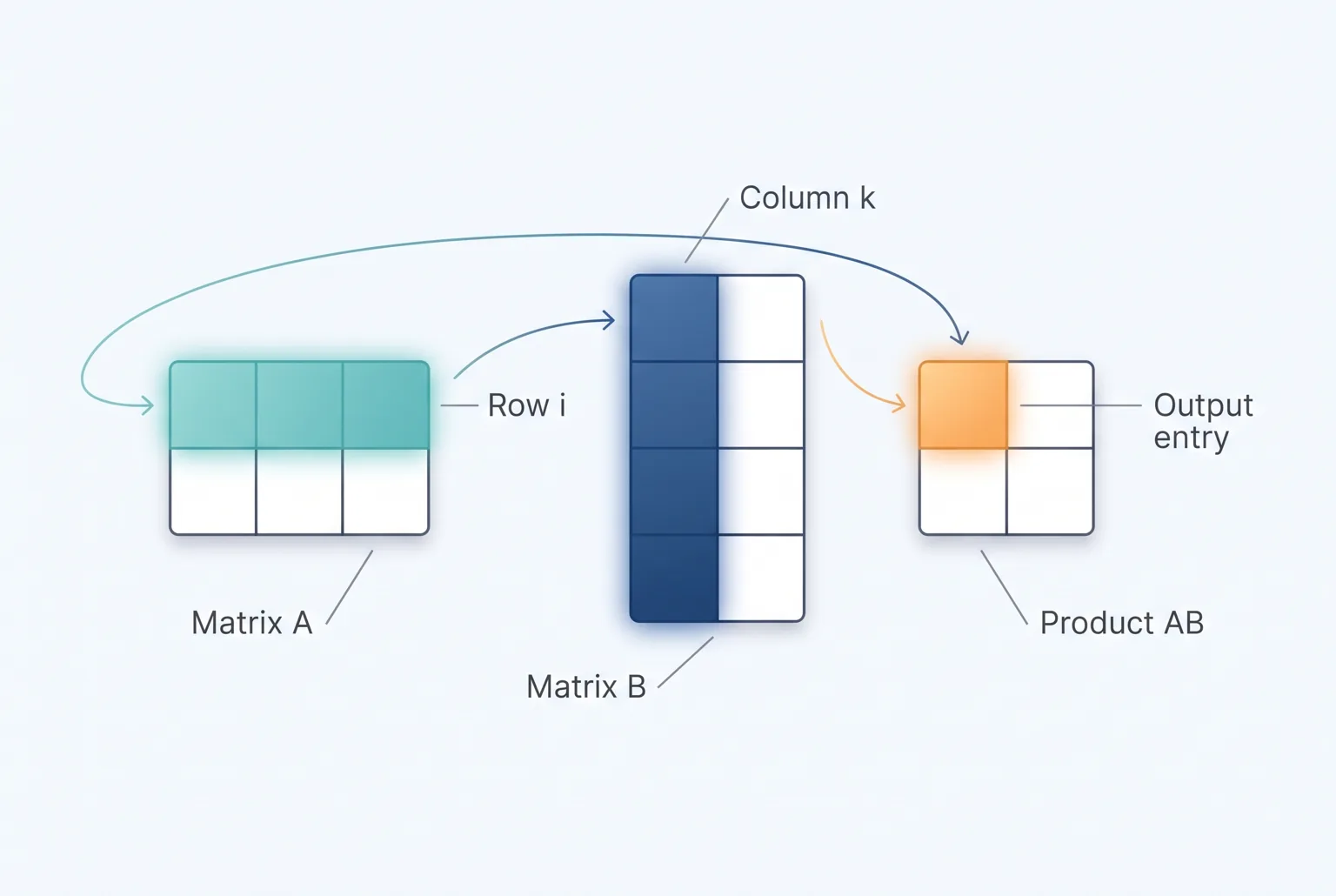
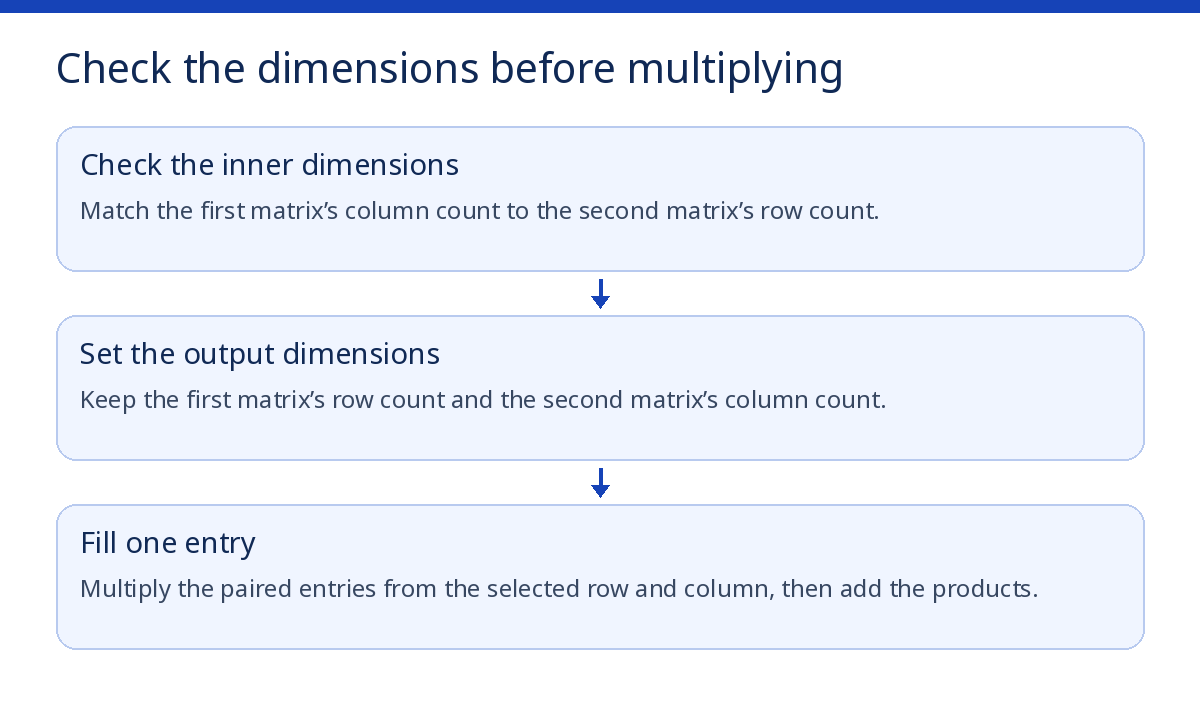
For , compare the number of columns of the first matrix with the number of rows of the second. If these inner dimensions agree, an matrix times an matrix gives an matrix. The outer dimensions tell you how many rows and columns to leave space for in the result.
To find the entry in row , column of the product, take row of and column of . Multiply their entries in corresponding positions, then add those products to obtain a single number. This is not the position-by-position rule used for addition. When following a worked product, trace one output entry back to its row and column before doing the full calculation. That separates a mistake in choosing entries from an arithmetic slip.
Common mistake: swapping factors instead of regrouping
Matrix addition is commutative, but matrix multiplication generally is not. The existence of does not guarantee that exists. Even when both products exist, they need not be equal. The notes also illustrate associativity and distributivity. Associativity allows you to change the grouping from to for compatible matrices; it does not let you change the order of the factors. Distributivity lets you expand a product over a sum when the operations are defined, keeping each factor on its original side.
The chapter index also lists matrix powers and matrix polynomials. For ordinary positive integer powers beyond the first, the repeated factor must be square so that it can multiply itself. Read this part after the product rules, since evaluating a power uses repeated matrix multiplication, not separate powers of the entries.
A useful connection: transpose and diagonal symmetry
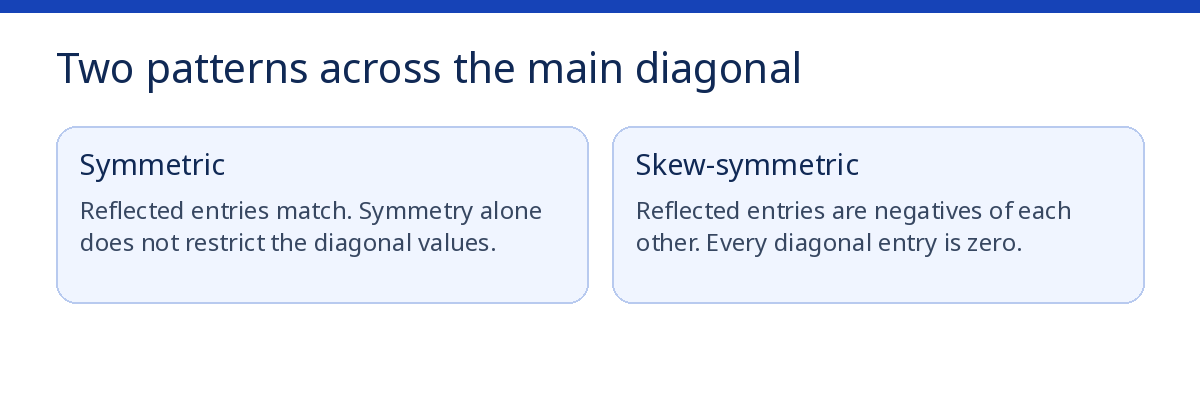
The transpose exchanges rows and columns: an entry at moves to , and an matrix becomes an matrix. The index then moves from transpose to symmetric and skew-symmetric matrices. Both comparisons require a square matrix. Symmetry means , so entries reflected across the main diagonal are equal. Skew-symmetry means , so reflected entries have opposite signs. Over the reals, each diagonal entry of a skew-symmetric matrix must therefore be zero: it is its own reflection and must equal its own negative.
The final listed topic is invertible matrices. For a square matrix, an inverse is a matrix satisfying with the identity of the same order. This is different from the additive inverse , which gives the zero matrix when added to .
Use the chapter index to target your revision
Use the index to go back to the rule behind a mistake. If you mix up entry positions, revisit matrix formation and equality. If you get the wrong shape for a product, go straight to the multiplication method. Try setting up a worked example before reading its solution, then compare the choice of operation and the placement of entries before checking the arithmetic.
The chapter summary gives you a place to review the rules after working through the examples. Although the broader topic label pairs Matrices with Determinants, this file’s index is for Matrices. This guide omits worked assessment answers, including the example on printed page 22.
Spotted an error? Report a correction. Practise this in the app: notes, formula sheets and mind maps.





























































































































































Loading comments…