Class 12 CBSE Matrices: Case-Based Assessment Guide
CBSEMathematicsMatrices and Determinants
Practise turning case data into labelled matrices, choosing operations and interpreting results. This Class 12 CBSE assessment pairs multiple-choice and short-answer questions with linked step-by-step solutions.
What this assessment covers
Although the resource listing uses the broader topic name Matrices and Determinants, the PDF is labelled Chapter 3: Matrices. Its focus is matrix representation, order, operations, transpose and selected matrix properties. Use it for matrix practice rather than as a guide to determinant techniques.
The case studies range from sales, production and campaign costs to bond investments, family nutrition and stationery purchases. Other cases start directly with matrices and ask what can be done with them. This contrast is useful: in a data-based case you must decide how to represent the information before calculating, while in an algebraic case the main decision may be whether an expression is defined at all.

Matrices and Determinants | Class 12 | Case-based Assessment
In the StudentCurio app
Case-based questions practise matrix representation, dimensions, operations, and identities in contexts including sales, costs, investments, family nutrition, and stationery purchases. Includes multiple-choice and short-answer practice with step-by-step solutions for Class 12 CBSE assessment preparation.
Read the labels before the entries
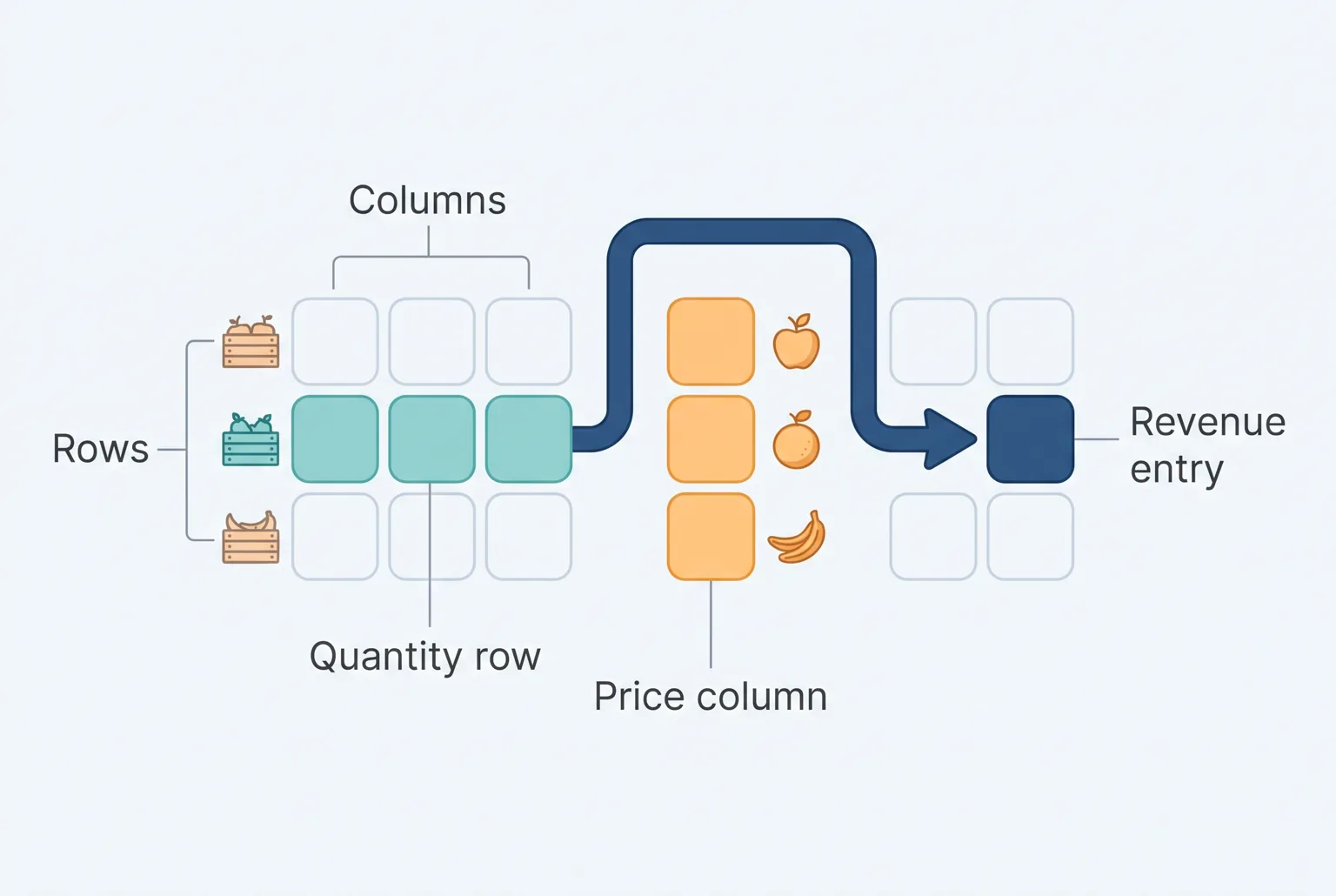
In the farm-sales and sports-clothing cases, a value makes sense only when you can name both categories it belongs to. Before copying a table, write what the rows represent, what the columns represent and what unit each entry uses. The order of a matrix is the number of rows followed by the number of columns. In , the first index identifies the row and the second identifies the column.
For a comparison across months or factories, keep corresponding categories in the same positions. Two matrices can have the same order even when their labels are arranged differently. Equal order makes entrywise arithmetic possible, but matching labels and units make it meaningful. This matters even for a square table: swapping the roles of rows and columns can leave the order unchanged while changing how every off-diagonal entry should be read.
Before you calculate: check which operation fits
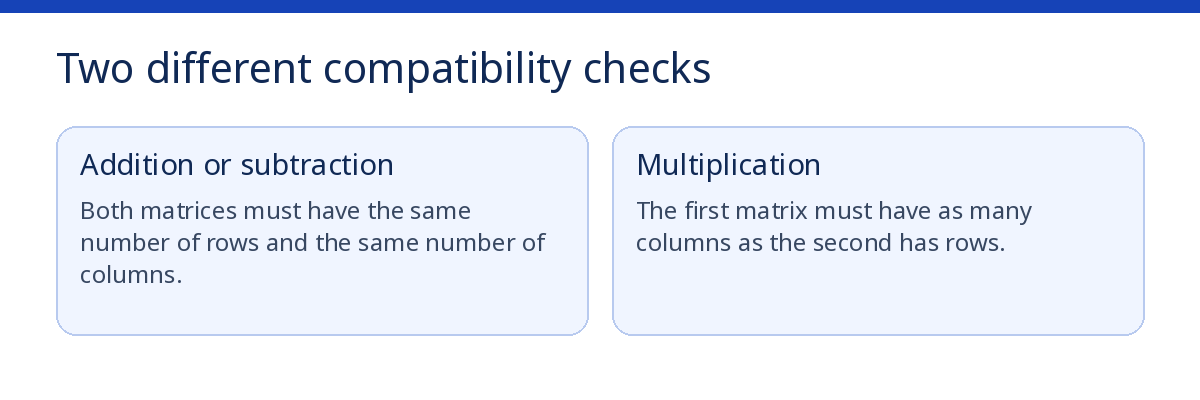
Addition and subtraction work entry by entry and require matrices of the same order. When comparing periods, decide whether the question asks for a combined total or a change. For a change, identify the reference period before subtracting; reversing the subtraction reverses the signs. Scalar multiplication scales every entry without changing the order. A percentage applied uniformly to the sales entries under consideration is a scalar, expressed as a decimal before multiplying.
Matrix multiplication has a different condition. If the first factor has order , the second must have rows. With columns in the second factor, the product has order . In the short-answer case on orders, a useful habit is to check each product separately before checking whether the resulting matrices can be added or subtracted. A valid product does not guarantee a valid sum.
What a row-by-column product tells you
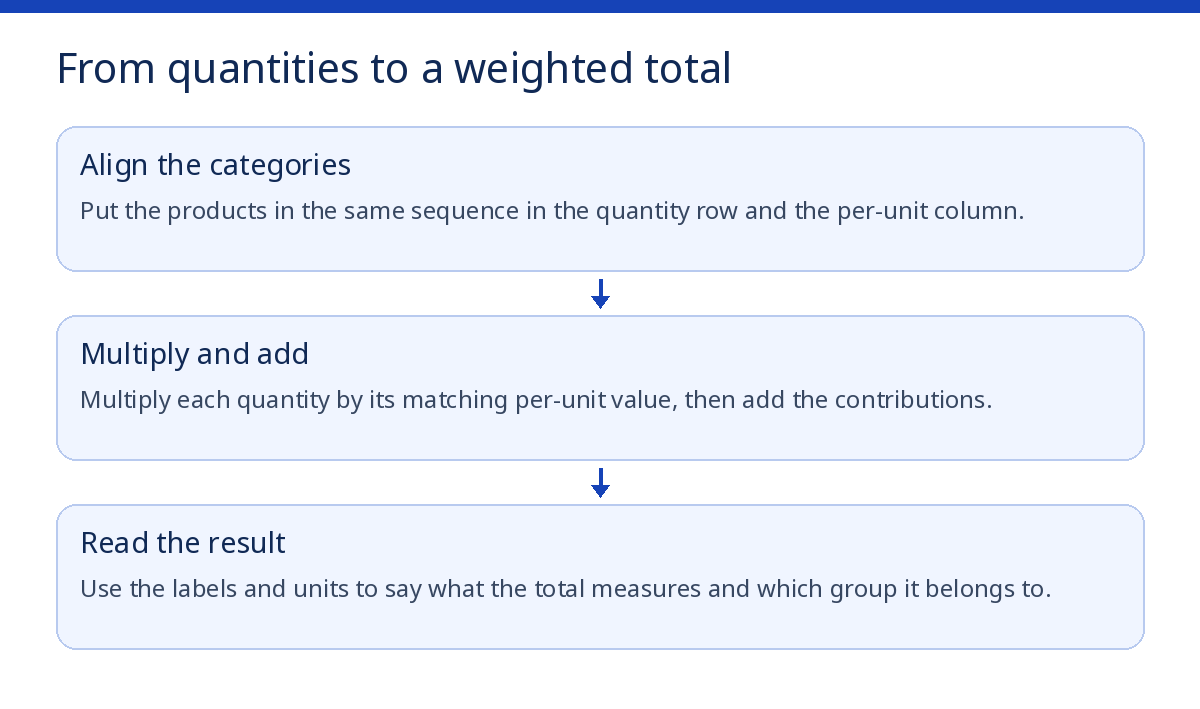
The sales and cost cases show why matrix multiplication is useful: a row of quantities can be paired with a column of per-unit values to produce one weighted total. The shared categories must appear in the same sequence. Matching dimensions alone will not catch a price attached to the wrong product. To interpret the product, look at the row label from the first factor and the column label from the second.
The unit of the result also helps you check what you have calculated. Quantities multiplied by selling prices per unit contribute to revenue; the same quantities multiplied by costs per unit contribute to cost. Profit is the difference between those totals when they refer to the same sales. The investment case uses the same pairing idea with amounts and annual interest rates, while the campaign cases distinguish monetary costs from expected outcomes.
Keep transpose and matrix identities distinct
A transpose interchanges rows and columns, so an matrix becomes an matrix. In a labelled production table, this changes which direction you read the categories, not the quantity associated with each category pair. Transposing a scalar multiple leaves the scalar unchanged, whereas transposing a product reverses the order of the factors as well as transposing them.
For a square matrix, symmetry means , while skew-symmetry means . Compare entries reflected across the main diagonal: the first condition requires equal values, the second opposite values. The index also lists idempotence and commuting matrices in the stationery-purchase case. Those are multiplication properties, not transpose tests: idempotence compares a matrix squared with itself, and commutation compares two products taken in opposite orders.
Quick self-check before turning to the solutions
Pick a case from the clickable index and attempt its questions before following the individual solution links. For a multiple-choice item, write the expected order and describe what an entry should mean before looking for a match among the options. For a short-answer item, write the compatibility condition or state the matrix property you are using, so your reasoning is visible even if a calculation goes wrong.
When you open the worked solution, compare the setup first: did you make the same choices about labels, units and factor order? Then use the return link to revisit the question and identify the first step you would change. The main Q3 in Case Study 7 is omitted from this guide because of a verified issue in the printed prompt; the OR alternative is separate.
Spotted an error? Report a correction. Practise this in the app: notes, formula sheets and mind maps.





























































































































































Loading comments…