Determinants: CBSE Class 12 NCERT Notes Guide
CBSEMathematicsMatrices and Determinants
These CBSE Class 12 Mathematics notes connect determinant calculations with triangle area, collinearity, matrix inverses and systems of linear equations. Use the chapter index to revisit a method or follow the sequence from evaluating a determinant to deciding what its value tells you.
Start with what a determinant measures
A determinant is a number associated with a square matrix, not another matrix. The notation means the determinant of , not its modulus. Rectangular matrices do not have determinants. The notes focus on evaluating determinants of orders one, two and three with real entries, beginning with rules that carry over into later calculations.
For a matrix of order one, the determinant is the entry itself, including its sign. For order two, multiply the entries on the main diagonal and subtract the product of the other two entries: . Keep the sign of each entry when substituting. This rule also matters for order three, because a cofactor expansion breaks the larger calculation into second-order determinants.

Determinants | Class 12 | NCERT Notes
In the StudentCurio app
These revision notes cover determinants and their applications, including triangle areas, minors and cofactors, adjoints, inverse matrices, and solving systems of linear equations with consistency checks. Useful for Class 12 CBSE students reviewing the chapter’s methods and worked examples.
Choose a row or column, then match the cofactors
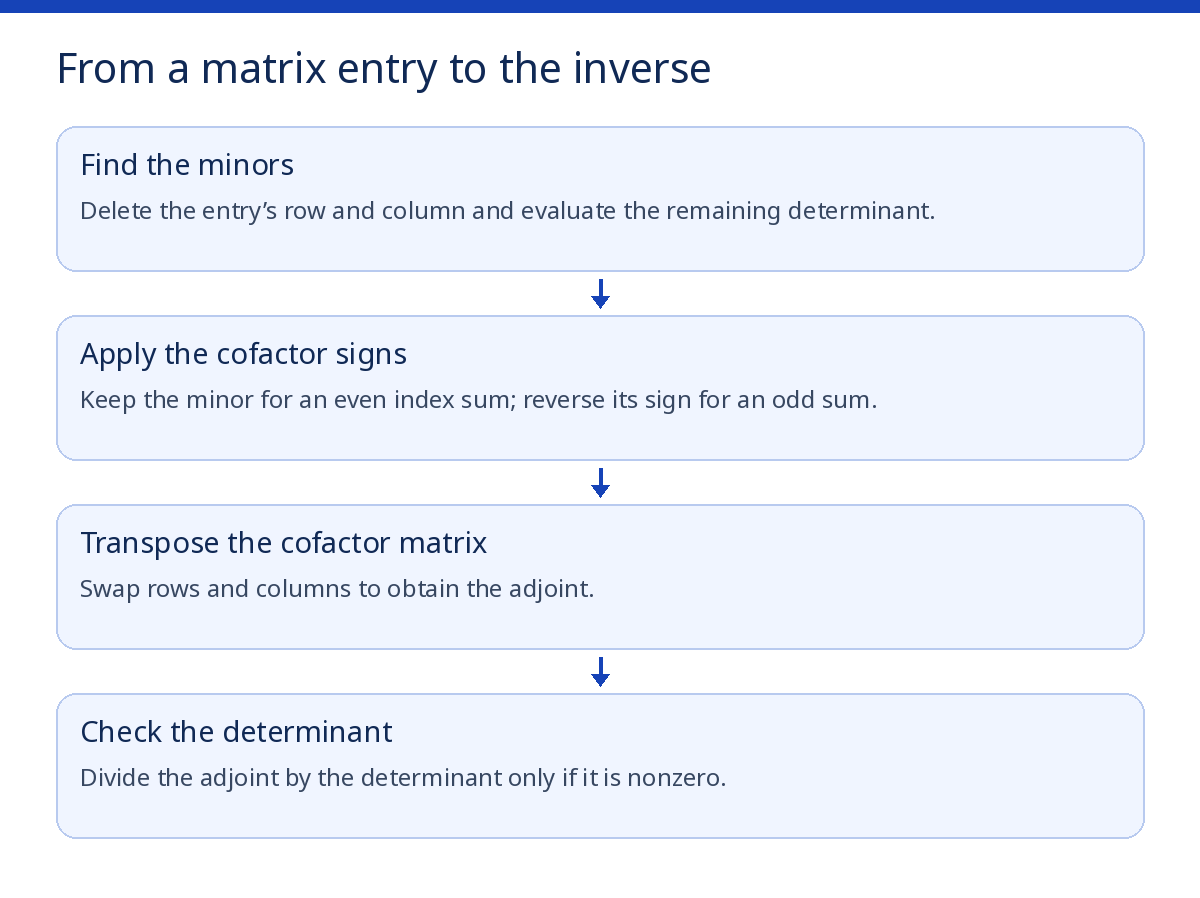
For an entry in row and column , delete that row and column. The determinant of what remains is the minor . The cofactor is . An even index sum leaves the minor unchanged; an odd sum reverses its sign. This factor depends on the position of the entry, not on whether the entry itself is positive or negative.
To expand, choose one row or column, multiply each entry by its own cofactor and add the products. The notes set out expansions along the first row and first column to show how two different calculations reach the same determinant. Any row or column is valid, so favour one with the most zeros: each zero entry makes its whole term vanish. When comparing your work with an example, check which row and column were deleted before checking the arithmetic.
When to take the absolute value in coordinate geometry
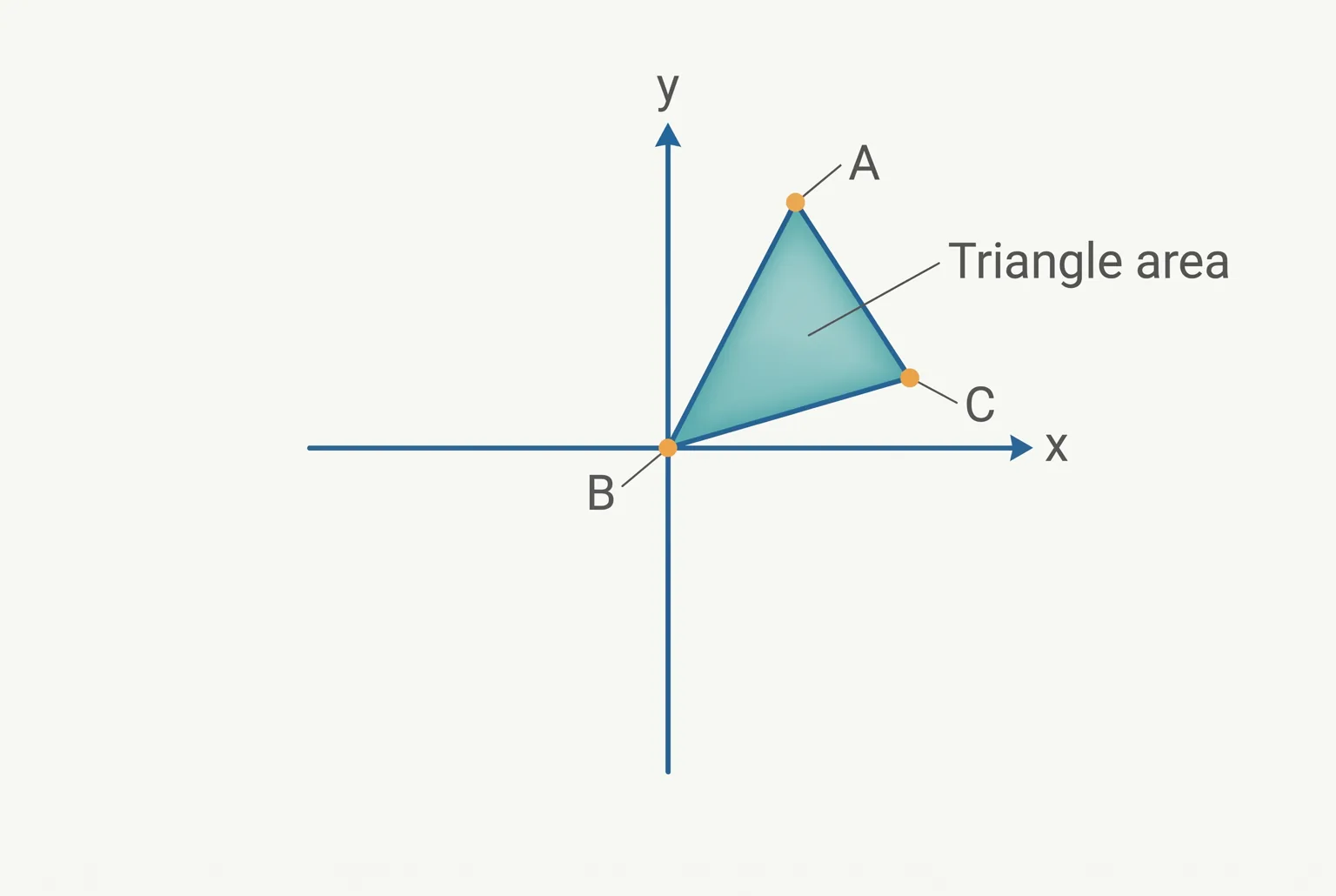
To find a triangle’s area, form a third-order determinant with one row per vertex. Put the two coordinates in the first two columns and a one in the last column. The area is half the absolute value of that determinant. The signed determinant can change sign when two vertices exchange places, but the area cannot. If a positive area is given and a coordinate is unknown, consider both signs of the determinant rather than assuming it is positive.
The same setup tests collinearity: the points lie on a straight line exactly when the determinant is zero. To find the equation of a line through two distinct points, use those two points and a variable point as the three rows, then set the determinant to zero. Unlike an area calculation, this setup does not need the factor of one half: it asks whether the determinant vanishes, not how large it is.
From the cofactor matrix to the inverse
The adjoint is the transpose of the cofactor matrix. First place each signed minor in the position of its original entry; only then swap rows and columns. For order two, the notes give a shortcut: interchange the main diagonal entries and change the signs of the off-diagonal entries. This gives the adjoint, not yet the inverse.
The connection is the identity , where is the identity matrix of the same order. It applies even to a singular matrix, whose determinant is zero. The inverse formula applies only when the determinant is nonzero. In that case, dividing by the determinant makes the product on either side the identity. That is also a way to check a proposed inverse.
Read the determinant as a test for a unique solution
The chapter index lists consistency and the matrix method for solving linear systems. In , the entries of are the coefficients, is the column of unknowns, and is the column of constants in the same equation order. If the coefficient matrix is square and has a nonzero determinant, multiplying on the left by its inverse gives the unique solution .
If the determinant is zero, the inverse method stops, but the consistency question does not. A singular square coefficient matrix cannot give a unique solution. The equations may be consistent, with infinitely many solutions over the reals, or inconsistent, with none. The determinant alone does not distinguish those cases. The key is to keep the test for an inverse separate from the test for whether the equations can all be satisfied.
Quick self-check with the chapter index
Use the index to return to the first step you find hard to explain. If a third-order expansion goes wrong, revisit the row and column expansions or the section on minors and cofactors. If you can compute the determinant but are unsure what follows from it, go to the relevant application: geometry, matrix inverses or consistency. The file also lists a chapter summary for a final review.
Before comparing your method with a worked example, name what the question asks for: a signed determinant, a nonnegative area, a test for invertibility or a conclusion about a system. Then ask yourself: what would a zero determinant let me conclude here, and what would it leave undecided? Numerical answers from the worked examples are not reproduced in this guide.
Spotted an error? Report a correction. Practise this in the app: notes, formula sheets and mind maps.





























































































































































Loading comments…