CBSE Class 12 Matrices and Determinants: Case-Based Assessment
CBSEMathematicsMatrices and Determinants
This CBSE Class 12 Mathematics PDF contains 18 case studies with worked solutions. Use it to practise turning written conditions into matrix equations, choosing determinant properties, and interpreting determinant values in coordinate geometry.
What the assessment covers
The PDF is labelled Chapter 4: Determinants, but its cases also require matrix methods. Some start with an everyday situation, such as test scoring, purchases or the dimensions of a plot. Others begin with a matrix or a set of coordinates and ask you to connect several ideas. The central skill is deciding what a determinant tells you: it might be a value to calculate, a test for whether an inverse exists, or a way to check whether three points lie on one line.
Cases 5–8 are short-answer; the other cases are multiple-choice. Cases 5, 7 and 8 include OR alternatives. In either format, write down the rule or condition you are using before checking an option or opening the worked solution.

Matrices and Determinants | Class 12 | Case-based Assessment
In the StudentCurio app
Case-based assessment questions with worked solutions on determinant evaluation and properties, triangle areas, and related matrix applications such as adjoint and inverse methods. Helps Class 12 CBSE students practise contextual questions from Matrices and Determinants.
Good to remember: a minor is not a cofactor
The expansion cases separate two operations that are easy to combine by mistake. To obtain the minor of an entry, delete its row and column and take the determinant of what remains. To obtain its cofactor, apply the position-dependent sign: . The sign depends on the indices, not on whether the original entry is positive or negative.
To evaluate a determinant by expansion, choose one row or one column and add the products of its entries with their corresponding cofactors. A row or column containing zeros can save work because those entries contribute nothing to the sum. When reviewing an expansion, check the deleted row and column first, then the cofactor sign, then the multiplication by the original entry.
From written conditions to a matrix equation
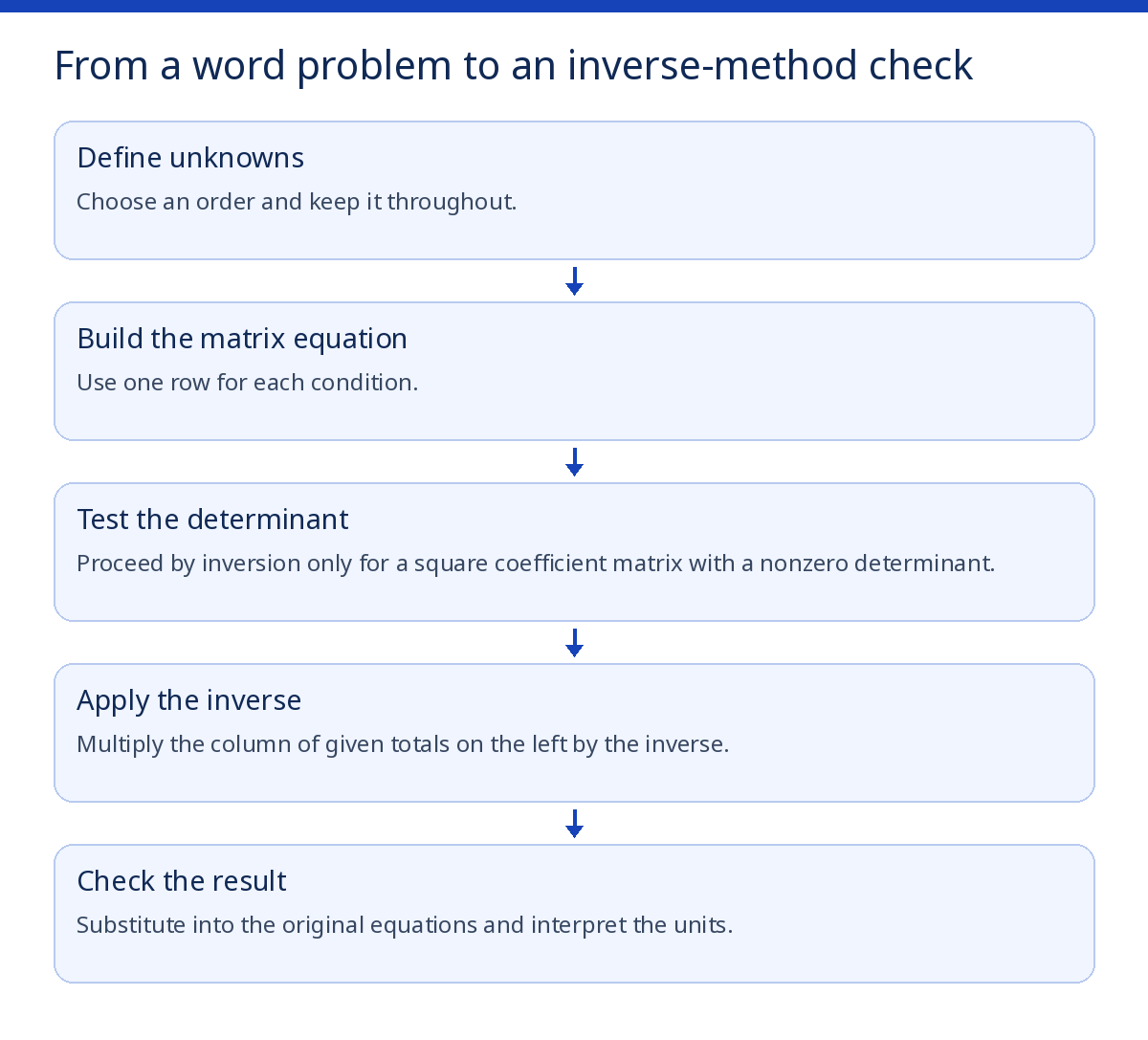
The scoring, shopping and carry-bag cases practise the move from a description to simultaneous equations. Define each unknown before recording the coefficients. In a purchase problem, for instance, quantities bought and unit prices play different roles: the quantities are coefficients, the unit prices are unknowns, and the total expenditure belongs on the right-hand side. Each transaction gives one row of the coefficient matrix.
Once you write , read each row back as an equation. Does it describe the original condition, and do the columns follow the same order as the unknowns in ? This check can catch a swapped column or a missed minus sign before it affects the determinant and everything that follows.
When the inverse method applies
The inverse method in the worked solutions requires a square coefficient matrix with a nonzero determinant. The adjugate, also called the adjoint in this context, is the transpose of the cofactor matrix. For an invertible matrix, . Dividing the cofactor matrix by the determinant without first transposing it does not in general give the inverse.
In , the inverse multiplies on the left, giving . If the determinant is zero, this method is unavailable; that fact alone does not tell you whether the equations are inconsistent or have infinitely many solutions. For a contextual case, finish by checking the proposed values in the original equations and interpreting each value in the units the question asks for.
One coordinate determinant, two geometry uses
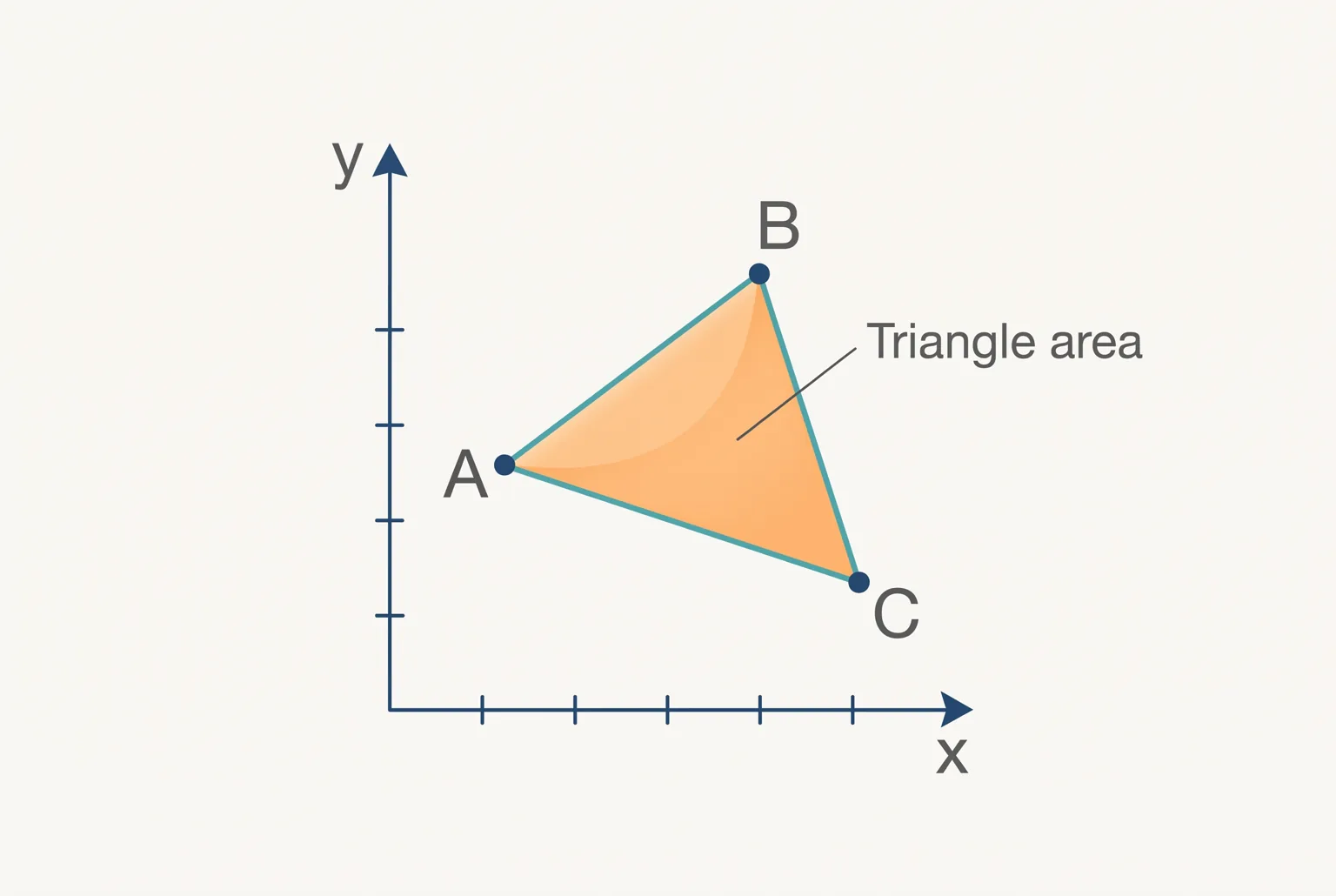
In the coordinate cases, each point contributes a row containing its two coordinates followed by a one. Half the absolute value of the resulting determinant gives the area of the triangle in square units. The determinant itself can change sign when two vertex rows are swapped, but the geometric area cannot. Keep the absolute value in the area formula even if a particular ordering gives a positive result.
For collinearity, you only need to test whether the determinant is zero. That same test gives a way to form a line equation: use two distinct fixed points and a variable point, then set the determinant to zero. The distinction is useful when reading a question: an area problem asks for a magnitude, while a line problem asks for the condition that the variable point must satisfy.
Matrix powers: identify what you need to find
The matrix-power cases define positive integer powers by repeated matrix multiplication, not by raising each entry to a power. If the task is to justify a formula for the entire matrix power by induction, check the case at exponent one and then show how multiplying by the matrix takes the proposed expression from one exponent to the next.
If you need only the determinant of a power, there is a shorter route. For square matrices of the same order, the determinant of a product is the product of their determinants. Repeated application gives for positive integers . This rule gives a scalar; it does not determine the individual entries of the matrix power.
Use the linked solutions to trace your first error
The PDF puts all the questions before the worked solutions. Open a case through the clickable index, attempt it without the solution, then use the subquestion link to compare your reasoning. Use the return link to try the next part independently. If several parts depend on the same setup, compare that setup first rather than treating every wrong result as a separate calculation error.
For a focused revision session, pair a direct cofactor case with a contextual inverse case. Check whether you can recognise the same cofactor calculation when it is part of finding an adjugate rather than the final quantity requested.
Editorial note: Case 11(iv) and Case 14(v) are omitted from this guide because their printed wording or choices do not establish a unique answer.
Spotted an error? Report a correction. Practise this in the app: notes, formula sheets and mind maps.





























































































































































Loading comments…