2023 CBSE Class 12 Maths Supplementary Paper with Solutions
CBSEMathematics2023 Previous Year Paper
Paper code: 65/C/3 · 2023Practise with the full English-medium 2023 CBSE Class 12 Mathematics supplementary paper (65/C/3). Use the worked solutions after your attempt to check not just your results, but also the conditions and reasoning behind each method.
This set is one of the year's papers. See every set from 2023, grouped by series.
What this year-wise resource contains
This file pairs the question paper from the 2023 supplementary examination with worked solutions. It is organised by exam year rather than by chapter, so it lets you practise recognising which part of the syllabus a question draws on without a chapter heading to guide you. The paper preserves the English question layout, options and diagrams, and the opening question index lets you go directly to an item you want to revisit.
The solution layout distinguishes the formula used, the concept used and the explanation in steps. Those are three different things to check: whether you recalled the right rule, whether you recognised why it applied, and whether you carried it out correctly. That distinction is especially useful when two questions look different on the page but call for the same underlying idea.

Mathematics Supplementary | Class 12 | Previous Year Paper | 2023 | Code 65/C/3
In the StudentCurio app
A complete 2023 CBSE Class 12 supplementary Mathematics paper covering topics across the syllabus, with worked solutions. It helps students practise the board-paper format and review solution methods.
How the 80-mark paper is organised
The paper allows three hours, contains 38 questions and does not permit calculators. Section A has 18 multiple-choice questions followed by two assertion–reason questions, all worth one mark each. Section B has five very short-answer questions worth two marks each, Section C has six short-answer questions worth three marks each, and Section D has four long-answer questions worth five marks each. Section E has three case studies worth four marks each.
There is no overall choice: all questions are compulsory, but where an internal OR is printed, you attempt one alternative, not both. For a timed attempt, keep to that distinction. In review, use the worked solution for the other alternative as a separate practice opportunity. In assertion–reason items, judge each statement on its own before deciding whether the reason actually explains the assertion.
Where calculus changes from technique to interpretation
The calculus questions move between continuity, differentiation, integration and differential equations. A continuity question about a piecewise function tests whether the left-hand limit, right-hand limit and assigned value agree at the joining point. A question about decreasing intervals instead asks you to connect the sign of the derivative to behaviour on intervals within the function’s domain. Do not join intervals across a point at which the function is undefined.
Integration also appears in different roles. An indefinite integral asks for a family of antiderivatives, whereas an area question first requires you to identify the region, choose bounds and determine which curve or line is above the other on each interval. In the differential-equation questions, distinguish finding a general solution from finding a particular solution: the given condition is what lets you determine the arbitrary constant in the general solution.
When a rule applies: matrices, vectors and functions
The matrix questions cover multiplication, determinants, the adjugate and the use of an inverse to solve a system of equations. When isolating a matrix, multiplication order matters: if the invertible coefficient matrix is on the right of the unknown, multiply both sides on the right by its inverse. That step requires a square coefficient matrix with a nonzero determinant.
In vectors and three-dimensional geometry, keep the task in view. A scalar projection gives a signed component along a nonzero vector, whereas testing whether two lines intersect requires a point that satisfies both lines. The relations and functions questions call for a different kind of precision: whether a function is onto depends on its stated codomain, and showing that a relation is an equivalence relation requires checking reflexivity, symmetry and transitivity separately.
What the case studies ask you to model
The swimming-pool case links a fixed-volume constraint to a cost function and then asks you to justify a minimum. The plant-growth case starts with a given function and asks you to analyse it over a stated interval. In either setting, a critical point is a candidate, not a conclusion. A first-derivative sign change from negative to positive establishes a local minimum; when seeking an absolute minimum on a closed interval, also check the endpoints.
The student-age case shifts the focus to probability. When students are equally likely to be chosen, distinct ages are not necessarily equally likely: repeated ages contribute more than one outcome to the same value of the random variable. In a conditional-probability subpart, first restrict attention to the students who meet the stated condition. This is a different task from constructing the full age distribution.
Quick self-check before opening a solution
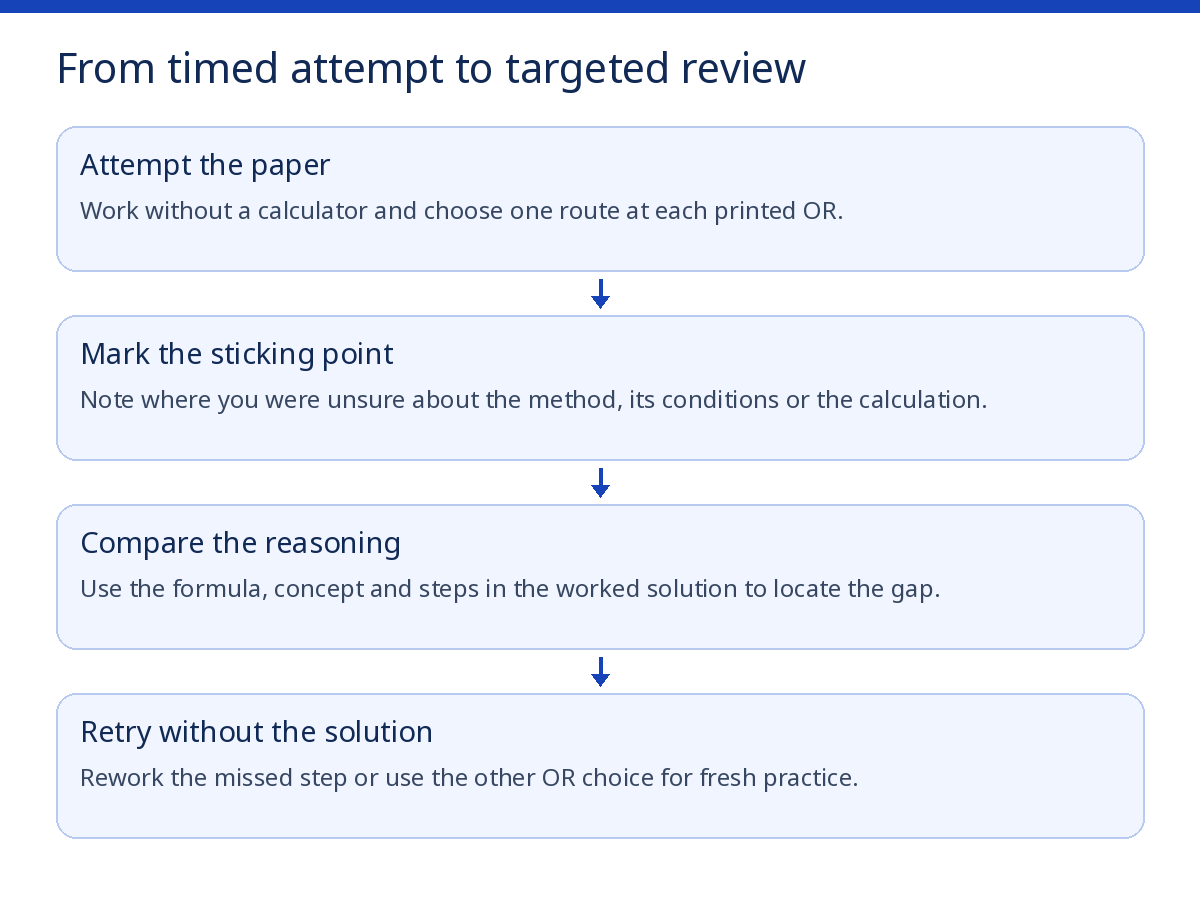
After a first attempt, revisit a question you left unfinished and name the first decision you were unsure about. In graphical linear programming, for example, ask whether you had finished identifying the feasible region before trying to optimise the objective. The inequalities determine which points are allowed; the objective determines how allowed points are compared. A point on one boundary line need not satisfy the other constraints.
Then compare your reasoning with the corresponding worked solution. If you chose a sound method but made an algebra or sign error, redo the calculation from the last valid line. If the method itself was wrong, write down the condition you missed before trying again. This guide leaves out the determinant-equality item’s worked result and option label because the option signs are unclear in the supplied text extract.
Spotted an error? Report a correction. Practise this in the app: notes, formula sheets and mind maps.





























































































































































Loading comments…