CBSE Class 12 Mathematics Supplementary Paper 2025
CBSEMathematics2025 Previous Year Paper
Paper code: 65/S/1 · 2025Use this full, year-wise CBSE Class 12 Mathematics paper for a three-hour practice attempt, then review the worked solutions to see where your reasoning diverged. The guide explains what each section asks of you and highlights conditions to check before applying a method.
This set is one of the year's papers. See every set from 2025, grouped by series.
Paper 65/S/1: format, marks and choices
This English-language supplementary examination is worth 80 marks and contains 38 questions across five sections. Section A has 18 multiple-choice questions and two assertion–reason questions, all worth one mark each. Sections B, C and D contain very short, short and long answers worth two, three and five marks per question, respectively. Section E contains three case studies worth four marks each.
The paper has no overall choice: an internal choice lets you select an alternative within a question, not skip the question. For a timed attempt, follow the printed choices and work without a calculator, as the instructions require. Save the unattempted alternatives for a second round of practice rather than doing both during the three hours.

Mathematics Supplementary 2025 | Class 12 | Previous Year Paper | Code 65/S/1
In the StudentCurio app
A complete CBSE Class 12 Mathematics supplementary examination paper for 2025, with worked solutions across topics including calculus, matrices, vectors, probability, differential equations and linear programming. It helps students practise board-exam questions and review solution methods.
Functions: distinguish the rule from the sets
The paper tests inverse trigonometry through domains, principal values and an identity with a stated interval. For a real inverse cosine, the argument must belong to . When that argument is an expression rather than a single variable, apply the restriction to the whole expression and then determine which inputs are allowed. A principal value is the output from the chosen range of the inverse function, not just any angle with the required trigonometric value.
The function case study keeps the same squaring rule while changing the sets in the mapping. That makes it useful for separating two tests: injectivity asks whether distinct inputs have distinct outputs, whereas surjectivity asks whether the range equals the stated codomain. In the assertion–reason questions, judge the statements separately before deciding whether the reason explains the assertion.
Calculus: choose the method before computing
Differentiation appears in parametric and implicit forms, as well as in questions on slope, monotonicity and related rates. For a parametrically defined curve, taking a second derivative with respect to requires more than differentiating the first derivative with respect to the parameter. You must also divide by the rate of change of with respect to that parameter, where that rate is nonzero. In the ladder problem, distinguish the signed rate of change of the height from the positive magnitude of its decrease.
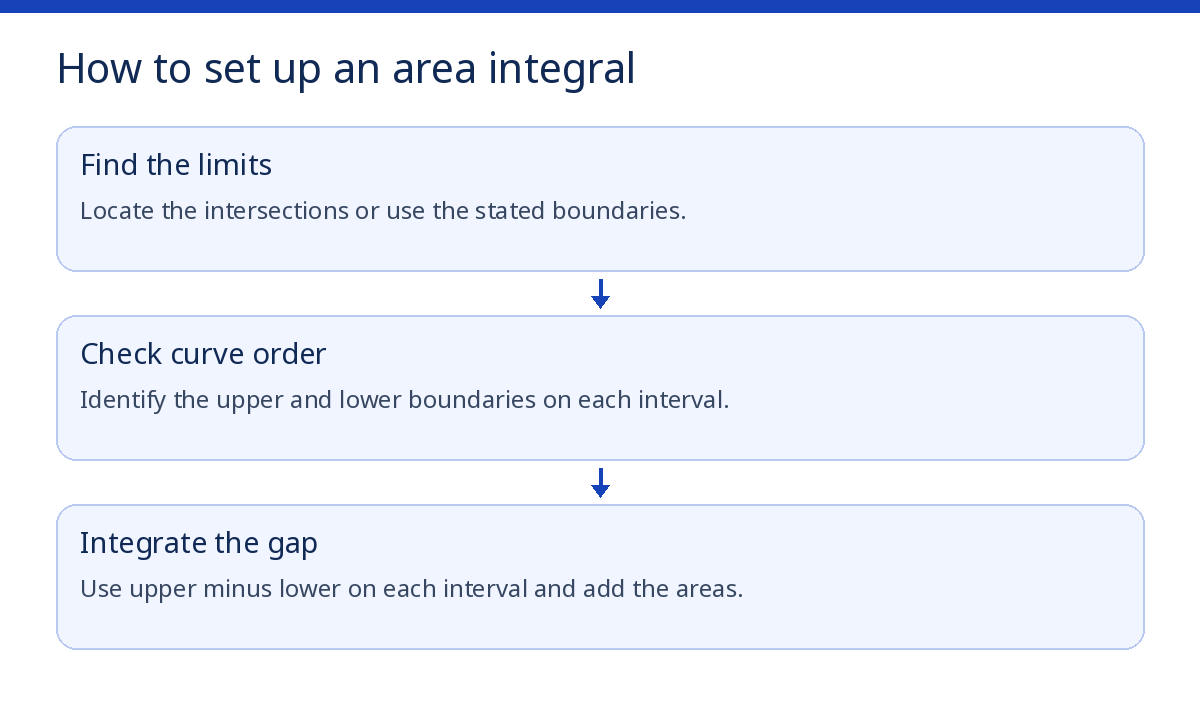
Integration is tested both as a technique and as a way to find area. In a bounded-region question, identify the intersections that determine the limits and decide which curve lies above the other before writing an integral with respect to . If the upper boundary changes, split the interval at that change instead of using one difference throughout.
Common mistakes: order, degree and invertibility
In a differential equation, order is determined by the highest derivative present. When the equation is polynomial in its derivatives, degree is the exponent of that highest-order derivative, not the largest exponent anywhere in the equation. The paper also tests separation of variables: keep the arbitrary constant in a general solution, and check that the expressions are defined before using any supplied condition to determine a particular solution.
For matrices, distinguish a minor from its signed cofactor. The minor is the determinant left after deleting the relevant row and column; the cofactor includes the sign determined by their indices. An inverse-matrix method for a system requires a nonsingular coefficient matrix. Before multiplying by an inverse, check that the rows of the coefficient matrix match the equations in the order you have written them.
Vectors, feasible regions and probability events
The vector and three-dimensional geometry questions connect algebraic operations to geometric tasks. Use direction vectors to reason about the angle between lines, and check whether lines are parallel before choosing a shortest-distance formula. For a parallelogram, the magnitude of the cross product of adjacent side vectors gives the area; the dot product instead relates their lengths to the cosine of the included angle.
In graphical linear programming, the constraints determine which points are feasible, while the objective function determines how to compare feasible points. For a nonempty bounded feasible polygon, a linear objective attains its extrema at vertices. The paper includes both short objective-value questions and a graphical task, so practise identifying the feasible region as well as comparing its corners.
For the probability questions, translate verbal limits before calculating: “at most one” includes zero, while “at least two” includes two. When combining probabilities for independent events, distinguish a joint outcome from a collection of mutually exclusive outcomes.
Case-study self-check: carry the model forward
In the window case study, the earlier parts develop a perimeter relation and an area expression before one branch asks for a maximum. Before attempting that branch, ask: which edges form the outside boundary, which length is shared by the rectangle and triangle, and what restriction on the dimensions keeps the window physically meaningful?
Use the subparts to check where an error starts. If an expression in one part is wrong, later differentiation can be correct algebraically and still describe the wrong model. Revisiting the diagram or the definition of a variable can be more useful than repeating the calculation.
Review with the worked-solution pages
After your attempt, use the question-number links to compare your work with the resource’s Formula used, Concept used and Explanation in steps blocks. Start with the concept: did you choose the wrong approach, omit a condition, or make a calculation error after a sound setup? Then redo the question from the paper without looking at the worked steps. For longer responses, check whether your written reasoning makes the link between the setup and the conclusion clear.
Review note: this guide leaves out Q29(b) and Q38 as worked examples and does not use Q32’s printed matrix-system pairing or reproduce assessment answers.
Spotted an error? Report a correction. Practise this in the app: notes, formula sheets and mind maps.





























































































































































Loading comments…