2025 CBSE Class 12 Maths Supplementary Paper with Solutions
CBSEMathematics2025 Previous Year Paper
Paper code: 65/S/2 · 2025Use the full 2025 CBSE Class 12 Mathematics supplementary paper (65/S/2) for a three-hour board-format practice attempt. The worked solutions help you review the rule you chose, the conditions it needs and the steps that connect it to your answer.
This set is one of the year's papers. See every set from 2025, grouped by series.
Know the five-section paper before you start
This English-language, year-wise paper contains 38 questions for 80 marks, with a three-hour time limit and no calculator. Section A contains 18 multiple-choice questions and two assertion–reason questions, all worth one mark each. Sections B, C and D move from two-mark very short answers to three-mark short answers and five-mark long answers. Section E contains three four-mark case studies.
There is no overall choice. Where an internal choice is printed, attempt one alternative in that question rather than treating the question itself as optional. Use the original question layout for your timed attempt and leave the linked solutions closed. For assertion–reason items, test each statement independently before deciding whether the reason actually explains the assertion.

Mathematics Supplementary 2025 | Class 12 | | Code 65/S/2
In the StudentCurio app
Complete 2025 CBSE Class 12 Mathematics supplementary paper with worked solutions, covering questions across the syllabus, including function mapping properties and Bayes’ theorem. Helps students practise the board-paper format and review solution methods.
Common mix-ups: mapping properties and principal values
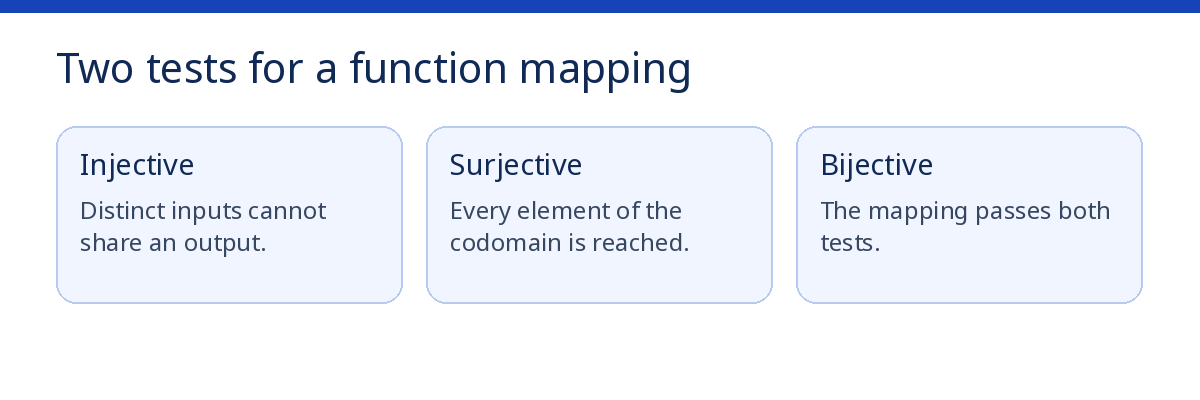
The function-mapping case study uses the same squaring rule with different declared sets. That makes it a useful way to see why a formula alone does not specify a mapping. Injectivity asks whether distinct inputs in the domain can share an output. Surjectivity asks whether every element of the stated codomain is reached. The range is the set of outputs actually reached; it need not equal the codomain. A bijection must satisfy both tests.
Inverse trigonometry requires a different distinction: the domain tells you which arguments are allowed, while the principal-value range tells you which angles may be returned. For real inverse sine and inverse cosine, the argument must lie in . When the argument is an expression, impose that restriction on the whole expression, not just on its variable.
Choose a calculus method from the quantity asked for
The calculus questions move between differentiation, rates of change, integration and differential equations. In a related-rates problem, start with a relation between the quantities and differentiate with respect to time before substituting values for the instant in question. Keep the sign of a signed rate: a decreasing quantity has a negative derivative, even when the question asks for the positive magnitude of the decrease.
For area by integration, sketch the boundaries before choosing limits. Horizontal slices measure right boundary minus left boundary; vertical slices measure upper boundary minus lower boundary. Split the integral if the relevant boundary changes within the interval. The differential-equation questions also distinguish a general solution, which retains an arbitrary constant in a first-order equation, from a particular solution, which uses a supplied condition to determine that constant.
Match the algebraic tool to the geometric task
The matrices and determinants questions include short checks on inverses and the adjugate, as well as a longer problem that uses a matrix inverse to solve simultaneous equations. The inverse method requires a nonsingular coefficient matrix. When reviewing your working, check that the order of the variables in the column vector matches the order of the coefficients in every row; a correct inverse cannot fix a mismatch in the setup.
In the vectors and three-dimensional geometry questions, separate a point on a line from its direction vector. For two nonzero vectors, a zero dot product tests perpendicularity, while the magnitude of the cross product gives the area of the parallelogram they span. These operations answer different questions even when they use the same pair of vectors.
A useful connection: two kinds of optimisation
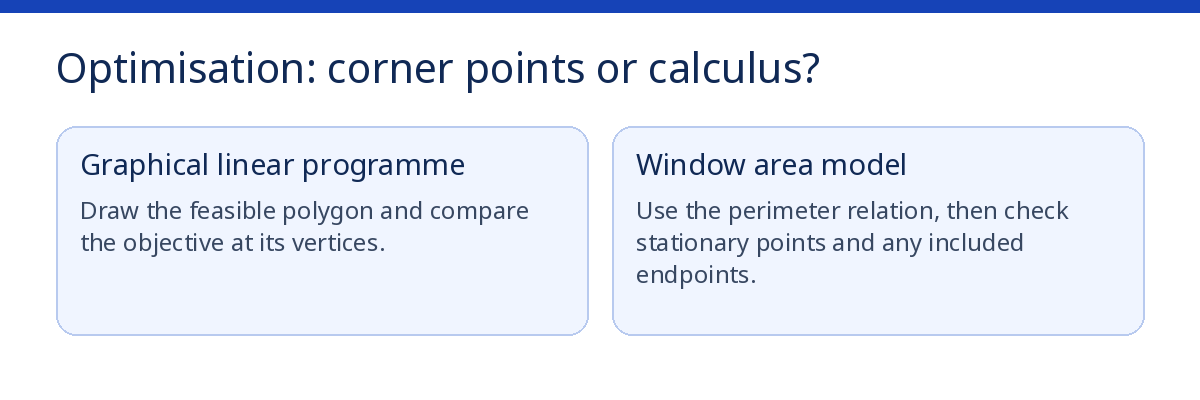
The graphical linear programming problem and the window case study both ask for an optimum, but the methods are different. In the linear programme, the inequalities define the feasible region and the objective is a separate linear expression. For a nonempty, bounded polygonal feasible region, an optimum occurs at a vertex. If adjacent vertices have the same optimal value, every point on the edge between them has that value too.
In the window case study, the geometry supplies a perimeter relation before the area can be written as a function of one variable. Here the dimensions limit the allowable inputs. A stationary point is a candidate, not proof of a maximum: check its behaviour within the feasible domain and compare with any included endpoints.
Before using Bayes’ theorem, check the event model
The probability questions give practice with independent events, a discrete probability distribution and conditional probability. Keep independence separate from mutual exclusivity: independence lets you multiply probabilities to find the probability of a joint outcome; mutually exclusive events cannot occur together. In a discrete distribution, the listed probabilities must be nonnegative and sum to one. An event that covers several listed values calls for adding the probabilities of all the values it includes.
For a Bayes’ theorem setup, identify the observed event and the hypothesis whose probability is being updated. The condition goes after the bar, so reversing the two events changes the question. When using total probability to find the denominator, the cases must be mutually exclusive and exhaustive, and the observed event must have positive probability.
Use the worked solutions to find the first wrong step
After your attempt, use the question-number links to open the relevant solutions. The file separates the formula used, concept used and explanation in steps. Read the concept note before checking the final line. If your method differs, compare the first step where the approaches diverge: did you choose the wrong rule, miss a condition or make an algebraic slip after a sound setup?
For longer answers, check whether your written work makes the setup and reasoning visible, not just whether the final result matches. Then retry the question without the solution open. This guide omits the disputed worked details in Q21, Q25 and Q38; leave those details out of any comparison you use to judge your understanding.
Spotted an error? Report a correction. Practise this in the app: notes, formula sheets and mind maps.





























































































































































Loading comments…