CBSE Class 12 Mathematics: 2024 Supplementary Paper
CBSEMathematics2024 Previous Year Paper
Paper code: 65/S/3 · 2024Use the full English-language 2024 CBSE Class 12 Mathematics supplementary paper (65/S/3) for a timed attempt, then use the worked solutions to check where your reasoning or choice of method went wrong.
This set is one of the year's papers. See every set from 2024, grouped by series.
Read the paper pattern before you start
This year-wise resource contains one full supplementary examination, not a chapter-wise question bank. The paper carries 80 marks, allows three hours and does not permit a calculator. Its 38 questions are arranged in five sections. Section A has 18 multiple-choice questions followed by two assertion–reason questions, all worth one mark each. Sections B, C and D contain very short, short and long answers worth two, three and five marks per question, respectively. Section E contains three case studies worth four marks each.
All questions are compulsory, but there are internal choices in selected questions in Sections B through E. For a timed attempt, answer only one alternative wherever an OR is printed. After marking that attempt, you can use the unchosen alternatives as fresh practice without losing the value of the original sitting.

Mathematics Supplementary 2024 | Class 12 | Previous Year Paper | Code 65/S/3
In the StudentCurio app
The 2024 CBSE Class 12 supplementary Mathematics paper with worked solutions, covering topics including calculus, vectors, matrices and probability. Helps students practise the board-exam format and review solution methods.
Calculus: decide what the question is asking you to measure
The calculus questions range from continuity and differentiability to rates of change, increasing functions, local extrema, integration and differential equations. These tasks may all involve derivatives or integrals, but they do not use them for the same purpose. In a rates question, identify the changing quantities and the variable with respect to which they change. In a local-maximum question, a zero derivative identifies a candidate, not a conclusion; a change in the derivative from positive to negative confirms a local maximum.
In the area questions, start by identifying the region rather than looking for an antiderivative. The long-answer alternatives give practice with boundaries described in terms of different coordinate axes. A definite integral gives signed accumulation; to find geometric area, set up the difference between the appropriate boundaries so the width or height being integrated is nonnegative.
Before using a formula, check where it applies
The paper gives you several reasons to write down a domain or interval before calculating. When checking continuity at the join of a piecewise function, compare the left-hand limit, right-hand limit and function value, provided the point lies inside the domain. In inverse trigonometry, the output must lie in the principal-value range; for inverse cosine, that range is . An angle with the required cosine is not enough unless it also lies in that range.
The same habit matters in differential equations. Before using the integrating-factor method for a first-order linear equation, write it with coefficient one on the derivative. If that requires division by an expression, work on intervals where it does not vanish.
Matrices, vectors and lines: match the method to the object
Matrix questions ask about product dimensions, inverses and determinants, and the plot case study uses matrices to solve simultaneous equations. Before multiplying two matrices, check that the number of columns in the first equals the number of rows in the second. Before using a formula involving the inverse of a square matrix, check that the matrix is invertible. These are separate checks: being able to form a product does not establish that an inverse exists.
In the vector and three-dimensional geometry questions, distinguish locating a point from finding a direction. A direction vector can establish perpendicularity, but it cannot by itself show that two lines intersect. For an intersection question, the two line equations must describe the same point for some values of their respective parameters.
Case studies: translate the context before calculating
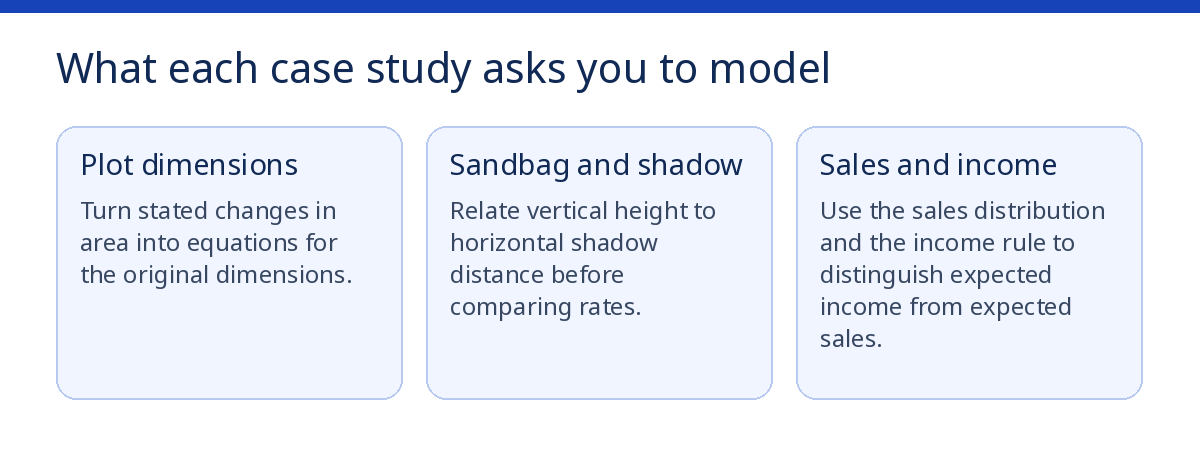
The plot, sandbag and sales-income case studies each require a different translation from words to mathematics. For the plot, define the original dimensions and distinguish each new area from the stated change in area. In the sandbag case, keep the vertical height and horizontal shadow distance separate. Finding when the sandbag reaches a given height is not the same operation as finding a rate at that instant; the latter requires differentiation with respect to time.
The sales-income case distinguishes the number of sales from the income it generates. The probabilities must total one, but the possible income values come from the stated income rule. Elsewhere, the attendance question tests conditional probability: identify which information is already known before deciding which probability you need.
Quick self-check: what would justify your conclusion?
Two long-answer tasks make this distinction particularly clear. To prove an equivalence relation, check reflexivity, symmetry and transitivity on the stated set before describing an equivalence class. A handful of examples cannot establish all three properties. In the graphical linear programming problem, plotting boundary lines is only a start: the feasible region must satisfy all inequalities simultaneously, including the nonnegativity conditions. As you review either response, ask yourself which line of your work establishes the conclusion, rather than merely preparing for it.
Use the worked solutions to find the first missed step
The file links from question numbers to worked solutions, which are organised around the formula, the concept and the steps. Keep them closed during your timed attempt. In review, open a solution and compare the setup first: did you identify the right quantities, choose a valid method and check its conditions? If your setup agrees, look for the first algebraic, sign or interpretation error instead of copying the whole solution. Then retry the question or attempt the unused OR choice without looking.
This guide omits the assertion–reason item about event inclusion and does not reconstruct questions where the extracted notation is unclear.
Spotted an error? Report a correction. Practise this in the app: notes, formula sheets and mind maps.





























































































































































Loading comments…