CBSE Class 12 Maths: 2023 Supplementary Paper Guide
CBSEMathematics2023 Previous Year Paper
Paper code: 65(B) · 2023Use the full 2023 CBSE Class 12 Mathematics supplementary paper to practise the three-hour board-paper format, then review the worked solutions to see where your reasoning, notation or choice of method needs attention.
This set is one of the year's papers. See every set from 2023, grouped by series.
Know the paper before you start
This year-wise file contains the adapted English version of the 2023 supplementary examination, identified as paper 65(B). It is a full CBSE Class 12 Mathematics paper, not a chapter worksheet. The paper allows three hours for 80 marks, contains 38 questions across five sections and does not allow calculators.
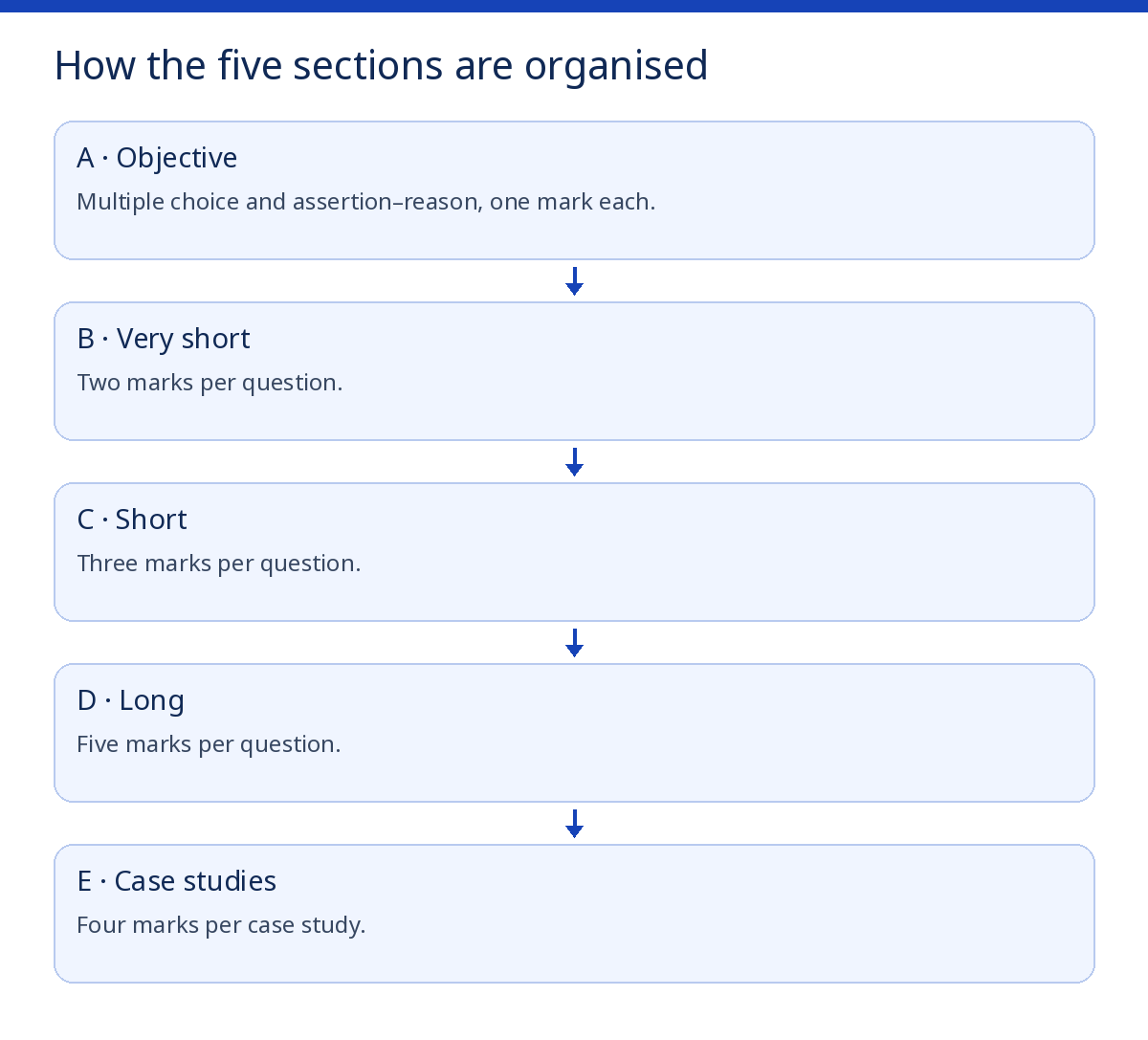
Section A contains 18 multiple-choice questions and two assertion–reason questions, all worth one mark each. The response format then changes from two-mark very short answers in Section B to three-mark short answers in Section C and five-mark long answers in Section D. Section E contains three four-mark case studies. There is no overall choice: attempt every question number, selecting one alternative wherever an internal OR is printed. The instructions list internal choices in Sections B through E. Save the unused alternatives for revision rather than counting them as extra work in your timed attempt.

Mathematics Supplementary 2023 | Class 12 | Previous Year Paper | Code 65(B)
In the StudentCurio app
A complete 2023 CBSE Class 12 Mathematics supplementary examination paper with worked solutions, covering topics across the syllabus. It helps students practise the board-paper format and review solution methods.
Read the notation before choosing a method
The paper brings together relations, functions, matrices and determinants. In a relation question, identify the underlying set before testing a property such as reflexivity. For a function, keep the domain, range and codomain distinct: the domain specifies the allowed inputs, the range consists of the outputs actually attained, and whether the function is onto depends on the stated codomain.
For matrix products, the number of columns in the left factor must equal the number of rows in the right factor. Check each product in the order written; if a transpose is present, account for the swapped dimensions first. Symmetry and skew-symmetry, by contrast, concern how a square matrix compares with its transpose. Editorial note: The individual matrix-order item is not analysed here because the extracted question notation does not clearly show the transpose used in the worked solution.
Calculus: check the condition as well as the formula
The calculus questions move between continuity, differentiation, rates of change, increasing and decreasing intervals, integration and differential equations. These tasks ask for different kinds of evidence. To establish continuity at a junction, check that both one-sided limits agree with the function value there. To justify increasing or decreasing behaviour using differentiation, examine the sign of the derivative on the relevant intervals within the stated domain.
Good to remember: A real inverse-sine expression requires its argument to lie between and , inclusive. That input restriction is different from the restriction on cancelling inverse sine against sine: holds directly only for . Keep the question's interval in view before simplifying.
Also distinguish an indefinite integral from a definite integral with bounds, and a general differential-equation solution from a particular solution. When an initial condition is given, check that the particular solution satisfies it as well as the differential equation.
Vectors and optimisation: identify what each quantity does
The vector and three-dimensional geometry questions include collinearity, components parallel and perpendicular to a given vector, angles between lines, and the foot of a perpendicular. A point on a line tells you where it passes; a direction vector tells you how it runs. For an angle or perpendicularity question, first isolate the direction information. For an intersection question, check whether the two line equations can describe the same point for some choice of their parameters.
The linear programming question makes a different distinction: the constraints determine which points are feasible, while the objective function gives each feasible point a value. When the problem supplies the corner points of a bounded feasible region, compare the objective values there. Report the requested extreme values together with the corresponding points, rather than listing coordinates without explaining what they represent.
Case studies: translate the context before calculating
The case studies use typing charges, profit from bulb sales and seed germination. Each asks you to convert information in words into a mathematical representation. In the typing scenario, distinguish per-page charges from the total charged for a job before expressing the information as equations and then in matrix form. In the profit scenario, keep the selling price per bulb separate from total revenue, and distinguish revenue from profit after costs.
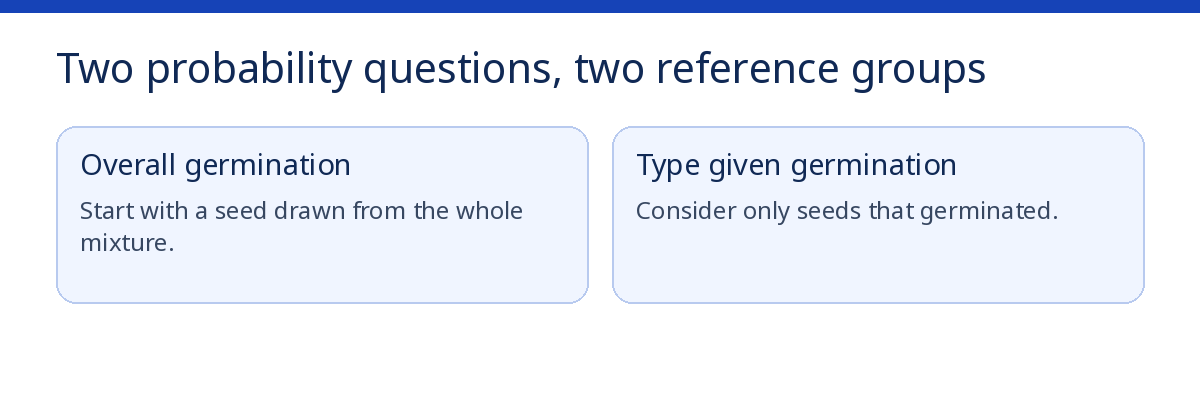
Quick self-check: In the seed scenario, can you explain the difference between the probability that a seed germinates and the probability that a germinated seed belongs to a specified type? The first combines germination across the types using their proportions in the mixture. The second restricts attention to seeds that germinated. Identify which group the question is asking about before you write a probability expression.
Use the worked solutions after an independent attempt
The file links question numbers to worked solutions organised around the formula used, the concept used and the steps. After a timed attempt, compare your work with those explanations. Start at the first line where your reasoning differs, rather than looking only at the final answer. Ask whether the issue was a missed restriction, a misread symbol, an unsuitable method or an error in carrying out a valid method.
For assertion–reason questions, check the truth of each statement separately before deciding whether the reason explains the assertion. For written responses, look for the step that makes your choice of method clear. Then try an unused OR alternative without opening its solution: it gives you a fresh way to check whether you can select and apply a method independently.
Spotted an error? Report a correction. Practise this in the app: notes, formula sheets and mind maps.





























































































































































Loading comments…