CBSE Class 12 Mathematics: 2022 Supplementary Paper
CBSEMathematics2022 Previous Year Paper
Paper code: 65(B)/6 · 2022This year-wise resource pairs the full 2022 CBSE Class 12 Mathematics supplementary paper with worked solutions. Use it for a timed attempt, then review how each solution chooses a method and checks where it applies.
This set is one of the year's papers. See every set from 2022, grouped by series.
What is in the 2022 paper file?
The cover identifies this as the adapted English-language version of the 2022 CBSE Class 12 Mathematics supplementary examination, paper code 65/B/6. The stated duration is two hours and the maximum is 40 marks. It is organised as a full paper for one year, not as a chapter-wise question bank. The file preserves the original English question layout, options and diagrams, and provides worked solutions for every question and subpart, including both alternatives wherever an OR is printed.
The question-number links let you open individual solutions. Each solution separates the formula, the concept and the steps, so you can check whether you chose the right approach before looking at how the algebra or calculation was carried out.

Mathematics Supplementary 2022 | Class 12 | Previous Year Paper | Code 65(B)/6
In the StudentCurio app
A complete 2022 CBSE Class 12 supplementary Mathematics paper with worked solutions. It includes exam-style questions across calculus, probability, vectors and three-dimensional geometry, helping students practise and review the paper.
Integration: read the structure before choosing a method
The integration questions reward different kinds of recognition. A power substitution is useful when a power inside a larger expression is accompanied by its derivative up to a constant factor. A quotient-shaped integrand can instead be checked against a derivative you recognise. In that case, differentiating the proposed quotient is the test: its appearance alone is not enough. With partial fractions, the work starts by decomposing a rational expression before integrating the simpler terms.
When reviewing partial fractions, check the derivative of each linear denominator. Its coefficient affects the factor in front of the logarithm, including the sign. Also distinguish the algebraic decomposition from the domain of the integral: rewriting an expression does not make it defined at a zero of its original denominator.
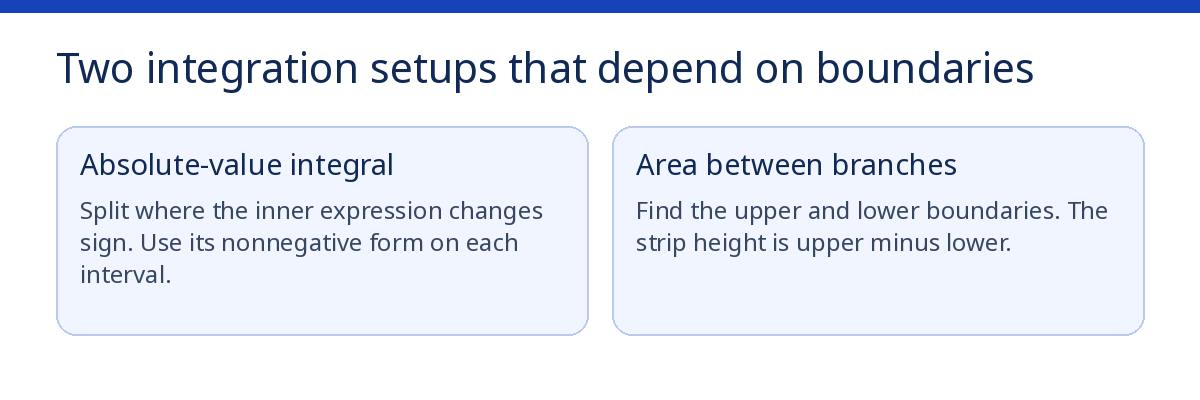
Common mistake: treating signed accumulation as area
For a definite integral involving an absolute value, locate any sign change of the inner expression within the interval before integrating. The absolute value keeps the expression on the side where it is nonnegative and reverses its sign on the other side. Keeping one algebraic form across a sign change would calculate a different integral.
The area question requires a related but different decision: identify the top and bottom boundaries of the shaded region. The verified diagrams show both branches of an ellipse or a parabola between vertical boundaries. A vertical strip has height upper branch minus lower branch; integrating only the upper branch measures the area down to the horizontal axis, not the full shaded region. This guide leaves out Q2’s final antiderivatives, Q7’s numerical result and both evaluated areas in Q12.
When a differential-equation method applies
The worked pages distinguish a directly separable equation from one that becomes separable after a homogeneous substitution. In the first case, the key check is whether the factor used to separate the variables can be divided out. The paper explains why its divisor is positive for real values. In the homogeneous example, the substitution uses the ratio , which is defined only when is nonzero. The initial condition then fixes the constant on the branch containing the given point.
One printed alternative rewrites an equation involving as a linear equation in as a function of . Taking the reciprocal derivative is valid only where the local inverse exists and the derivative being inverted is nonzero.
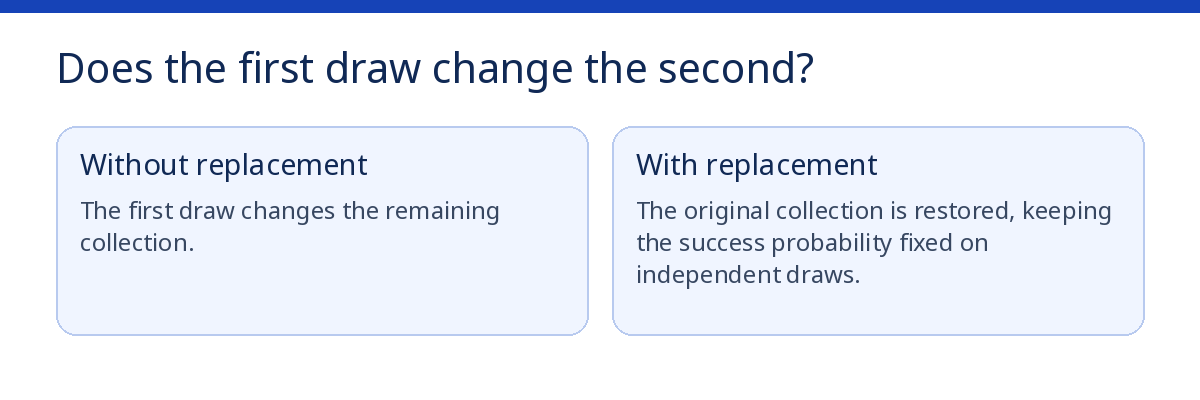
Probability: what changes after the first draw?
The card and ball questions illustrate why the sampling rule matters. Without replacement, the first draw changes what remains, so a second-draw probability must reflect the updated collection. Counting equally likely unordered pairs is another way to model the card question, provided both favourable and total outcomes are counted as pairs. In the ball question, replacement keeps the success probability the same on each independent draw, which supports a binomial distribution for the number of successes.
The final probability question makes a different distinction. The law of total probability combines contributions from the two groups to find the chance of the stated outcome. Bayes’ theorem then reverses the conditioning: the probability of an outcome given a group is not the probability of belonging to that group given the outcome.
Vectors and 3D geometry: directions, normals and distances
Read the point and direction separately in a vector equation of a line. The fixed vector locates a point, while the coefficient of the parameter gives the direction. To obtain direction cosines, divide that nonzero direction vector by its length. Reversing all three signs gives the opposite orientation along the same line; changing only one sign does not, in general.
The cross product has several roles in this paper. Its result is a vector; taking the dot product of that vector with a third vector gives a scalar triple product. For the distance between skew lines, the cross product of their directions supplies a common normal. For a plane through three noncollinear points, crossing two displacement vectors in the plane gives a normal that can be used to write the plane equation and find its distance from the origin.
Before you move on: review the decision you missed
Try the paper within the stated two hours before opening the worked pages. Follow the printed choices in your timed attempt, then use the unused OR alternatives for further practice. When reviewing, compare your setup with the Concept used entry first. An incorrect setup calls for a different kind of review from a correct method followed by a sign or arithmetic slip.
Cover the solution and write one sentence justifying your first step: what feature of the integrand, sampling rule or geometry made that method appropriate? If you can justify the step without relying on the final answer, you have identified what to carry into a similar question.
Spotted an error? Report a correction. Practise this in the app: notes, formula sheets and mind maps.





























































































































































Loading comments…