CBSE Class 12 Mathematics 2026 Supplementary Paper
CBSEMathematics2026 Previous Year Paper
Paper code: 65/7/1 · 2026Use the full 2026 CBSE Class 12 Mathematics supplementary paper (65/7/1) for a three-hour practice attempt, then use the worked solutions to check why each method applies.
This set is one of the year's papers. See every set from 2026, grouped by series.
How the 80-mark paper is organised
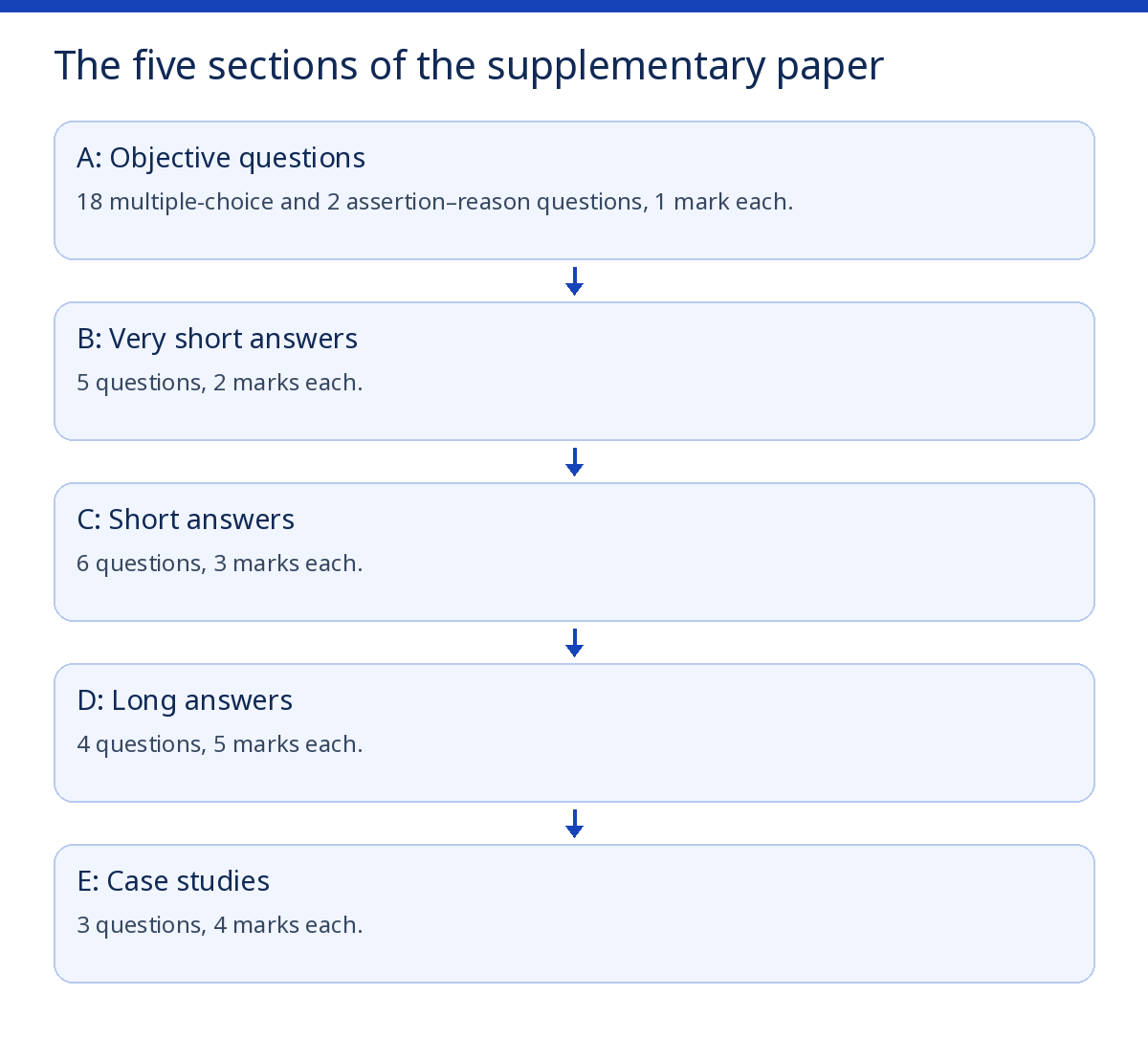
This English-language paper has 38 questions across five sections. Section A starts with 18 multiple-choice questions and ends with two assertion–reason questions, all worth one mark each. Sections B, C and D move from two-mark very short answers to three-mark short answers and five-mark long answers. Section E contains three four-mark case studies. The paper allows three hours and does not permit calculators.
There is no overall choice: where an internal choice appears, you select an alternative within that question rather than skipping the question. Follow the alternatives marked in the question pages rather than relying on the cover’s wording about choices. The library-based assertion in Q19 is not discussed here because the question leaves part of the library’s book composition unspecified.

Mathematics 2026 | Class 12 | Supplementary Paper | Code 65/7/1
In the StudentCurio app
A CBSE Class 12 Mathematics supplementary examination paper with worked solutions, covering matrices, calculus, vectors, three-dimensional geometry, linear programming and probability. It helps students practise the board-paper format and review problem-solving methods.
Matrices, determinants and relations
The matrix questions test several different operations: forming a product, working with a transpose, evaluating determinants and using matrices to find the intersection of two lines. Keep matrix entries and determinants separate in your working. For a product to be defined, the first matrix must have as many columns as the second has rows. An entry then comes from a row of the first matrix and a column of the second. A determinant, by contrast, is a scalar associated with a square matrix; scaling the matrix affects the determinant according to its order.
The relations questions ask you to identify a domain and range or test whether a relation is an equivalence relation. Check reflexivity, symmetry and transitivity separately on the stated set: establishing one property does not establish the other two.
Common mistakes with inverse functions and continuity
An inverse trigonometric function returns a principal value. When it is applied to the result of a trigonometric function, do not simply cancel the two operations. For inverse sine, the returned angle must lie in . Check whether the original angle is in that interval before treating it as the result.
For a piecewise function, being continuous within each piece does not settle what happens at the joins. At an interior join, compare the left-hand and right-hand limits with the assigned function value. If the one-sided limits disagree, changing the value at the join cannot make the function continuous there. A related habit helps with differentiation: check where a composite expression is real and where its derivative exists, rather than assuming the two domains are identical.
A useful connection: calculus choices depend on the task
The paper uses differentiation for rates of change, critical points and a window-design case study. In the design task, the perimeter constrains the dimensions, while area is the quantity to maximise. That distinction explains why the paper asks for an area function of one variable before asking for dimensions. A stationary point is a candidate, not proof of a maximum; the feasible dimensions matter when making that conclusion.
Integration serves several purposes here. Evaluating a definite integral is different from finding a bounded area, where you must first identify the relevant boundaries and decide which curve lies above the other when using vertical slices. The differential-equation question adds another distinction: a general solution describes a family, while the given initial condition selects a member of that family.
From spatial directions to feasible regions
The vector and three-dimensional geometry questions use points, direction vectors and line equations to describe parallel paths, perpendicularity and distances. In the swimming-pool case study, separate the point that locates a path from the vector that gives its direction. Two parallel paths can share a direction without passing through the same point. For a distance problem, first identify whether the question concerns a point and a line or two lines, since those are different setups.
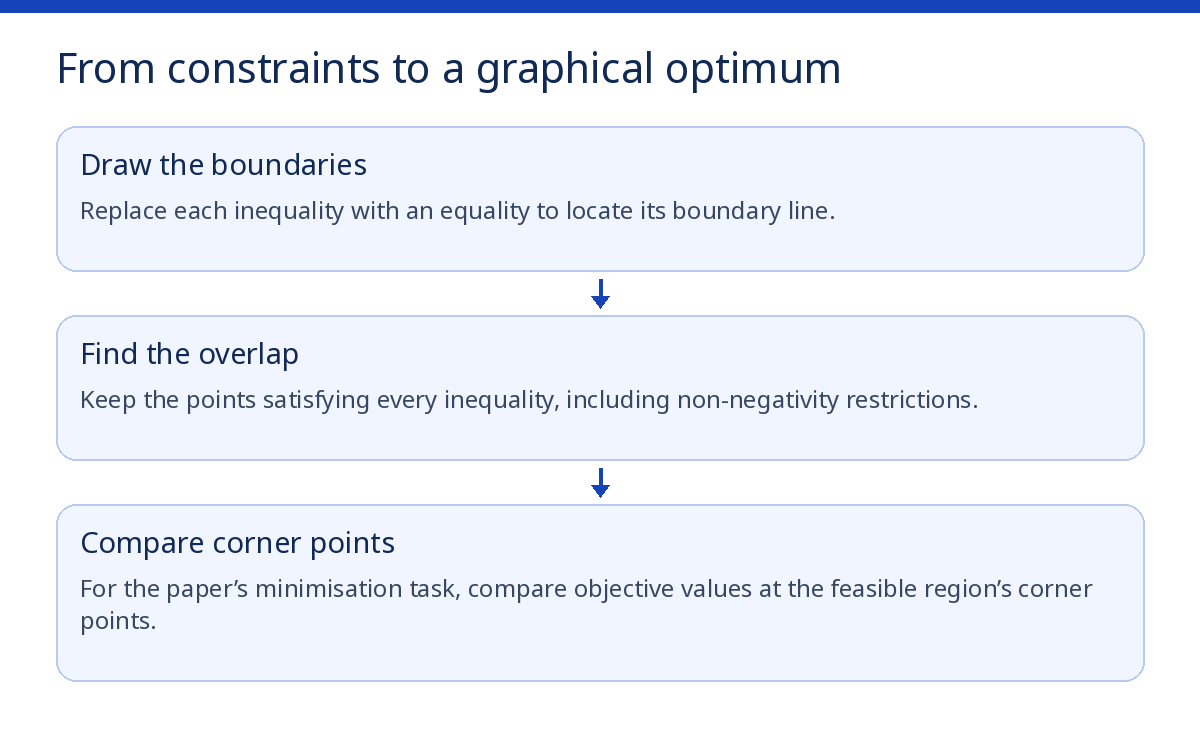
In linear programming, the constraints define the feasible region; the objective function states what is to be minimised or maximised. The paper includes both a graphing task and a graphical minimisation problem. Check which side of each boundary satisfies the inequality, then use the overlap rather than treating any single shaded half-plane as the feasible region.
Probability: identify what is known first
The probability questions cover independence, complements, draws without replacement and conditional probability. Independence is not the same as mutual exclusivity: independence means that knowing one event occurred does not change the probability of the other, provided the conditioning event has positive probability. Mutually exclusive events cannot occur together.
The construction-company case study distinguishes the chance of selecting a company from the chance of observing a construction outcome given that company. The questions reason in the other direction, starting from an observed outcome. Before using a formula, write down which event is given and which event is being asked about. This makes it easier to spot a reversed conditional probability even when the arithmetic looks plausible.
Use the worked solutions to find your first error
Attempt the paper before opening the solutions. The file’s question-number index lets you jump to individual worked solutions, which separate the formula, the concept and the explanation in steps. On review, compare your setup with the worked method before checking your final result. If they diverge, note the first difference: a copied sign, a missed condition or an unsuitable operation will call for different practice.
After the timed attempt, try an internal alternative you did not choose. This gives you a fresh problem from the same paper without changing how you judge the original attempt. For a case study, review the subparts together to see whether a relation or representation established early gives you a starting point for a later part.
Spotted an error? Report a correction. Practise this in the app: notes, formula sheets and mind maps.





























































































































































Loading comments…