CBSE Class 12 Mathematics 2026 Previous Year Paper
CBSEMathematics2026 Previous Year Paper
Paper code: 65/2/3 · 2026Practise the full English-language CBSE Class 12 Mathematics main examination paper for 2026 (65/2/3). Use the worked solutions after your attempt to check where you chose the wrong method, missed a condition or made a calculation error.
This set is one of the year's papers. See every set from 2026, grouped by series.
What the 2026 paper contains
This year-wise resource contains the full 80-mark, three-hour paper, with 38 questions across five sections. Section A has 18 multiple-choice questions and two assertion–reason questions, each worth one mark. Sections B, C and D contain very short, short and long answers worth two, three and five marks respectively. Section E has three case-study questions worth four marks each.
There is no overall choice, but some questions outside Section A offer internal alternatives. For a timed attempt, follow those choices as printed and work without a calculator. Use the paper’s question-number navigation to open the worked solutions afterwards. The recurring labels—Formula Used, Concept Used and Explanation in Steps—help you distinguish the mathematical rule from the reason it applies and the way it is carried out.

Mathematics 2026 | Class 12 | Previous Year Paper | Code 65/2/3
In the StudentCurio app
Covers a 2026 CBSE Class 12 Mathematics paper with worked solutions, including questions on relations and functions, matrices, calculus, vectors, three-dimensional geometry, probability and linear programming. Useful for board-exam practice and reviewing solution methods.
Relations, functions and matrix reasoning
The relations questions ask you to distinguish reflexivity, symmetry and transitivity. These are separate checks: look for the required diagonal pairs, check whether reversing a pair keeps it in the relation, and consider whether two linked pairs require a third. In the functions questions, notice what the domain and codomain specify. To check injectivity, ask whether two different inputs can have the same output. To check whether a function is onto, ask whether every element of the stated codomain is attained.
The matrix questions move from properties such as symmetry and multiplication to determinants and solving simultaneous equations. Keep the order of factors when expanding a matrix product: distributivity applies, but matrix multiplication does not generally commute. When reviewing a matrix equation, identify which step depends on a property of the particular matrices rather than a rule that holds for every matrix of that size.
Good to remember: Check the domain before using calculus
The paper uses implicit and parametric differentiation as well as derivatives of explicitly defined functions. The distinction matters: in implicit differentiation, a variable such as may depend on even when it has not been isolated. In parametric differentiation, both coordinates depend on a parameter; the derivative-ratio rule requires a nonzero derivative of the horizontal coordinate with respect to that parameter.
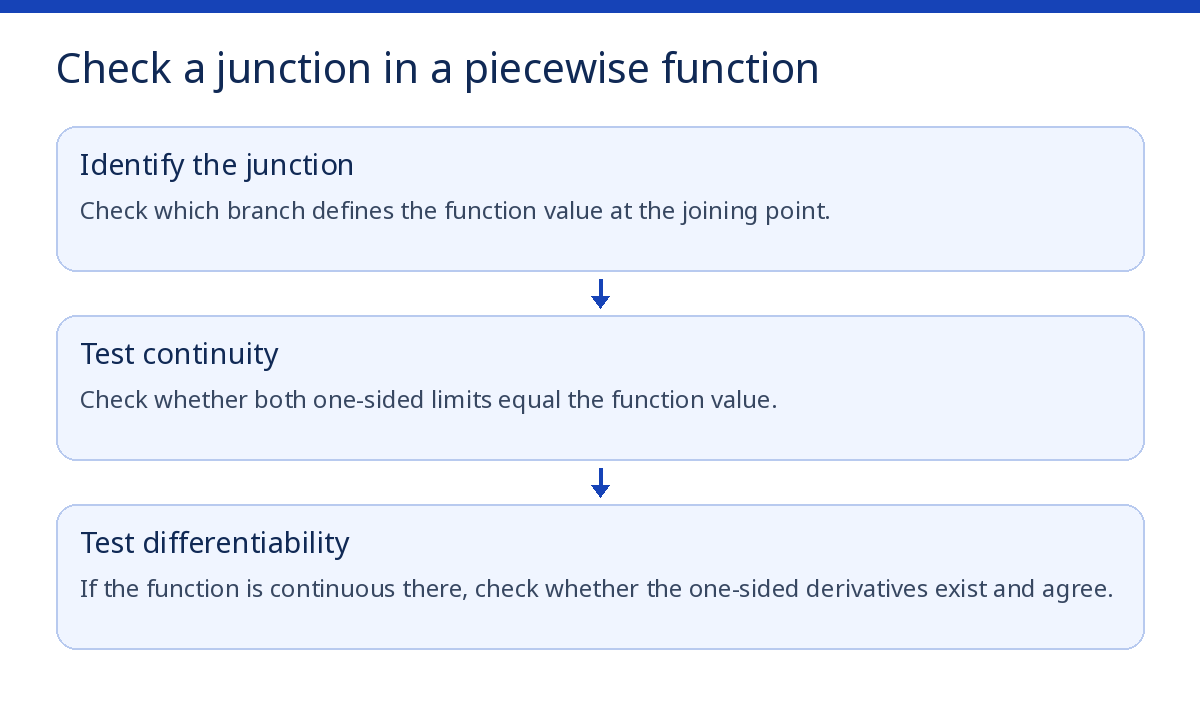
For applications of derivatives, distinguish an interval of increase or decrease from an extremum at a point. When looking for an absolute extremum of a continuous function on a closed interval, compare the endpoint values with those at interior critical points. In the piecewise-function case study, a derivative found inside one branch does not settle what happens at the junction. Check continuity there before testing whether the one-sided derivatives agree.
Integration: Decide what the result represents
The integration questions ask for antiderivatives, definite integrals and areas. An indefinite integral gives a family of antiderivatives; a given function value can determine the constant on the interval in question. An area calculation starts from a different question: what length does each strip represent? For horizontal strips, use the right boundary minus the left boundary; for vertical strips, use the upper boundary minus the lower boundary. The geometry determines the limits and whether you need to split the integral.
The differential-equation questions also involve integration, but the first task is to recognise the equation’s form. Before using an integrating factor in a first-order linear equation, put it into standard form on an interval where the resulting coefficients are defined. If you divide by an expression involving the unknown function, check separately whether a solution could make that expression zero.
Vectors, spatial lines and feasible regions
The vector and three-dimensional geometry questions connect component calculations with geometric statements about directions, midpoints, line intersections and perpendicularity. Keep a line’s direction separate from a point it passes through: a direction vector describes how the coordinates change, while a point fixes the line’s position. Direction cosines describe a unit direction, so direction ratios generally need normalising before they can be used as cosines.
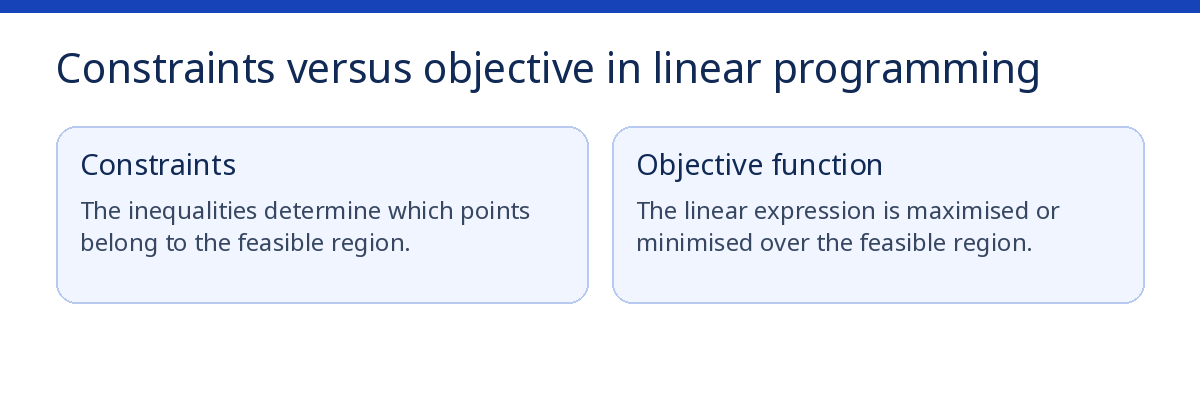
Linear programming makes a different distinction: constraints determine which points are feasible, while the objective function specifies what to maximise or minimise. In the graphical questions, first identify each boundary line, then decide which side satisfies the inequality. A correctly drawn boundary alone does not tell you which half-plane to include.
Quick self-check: What is given in a probability question?
The paper tests conditional probability both directly and in a case study. Before calculating, say which group or outcome is already known and which event you are trying to measure. Reversing those roles changes the conditional probability. The conditioning event must also have positive probability, because it supplies the denominator.
Ask yourself: if I switch the event of interest to its complement, have I kept the same condition? An event and its complement have conditional probabilities that sum to one only when both are measured under the same condition. In a case study, this check helps you distinguish a probability within a subgroup from a probability about subgroup membership after an outcome is known.
Turn the worked solutions into a second attempt
After the timed paper, review questions where you guessed, stopped early or reached a result without being sure why. Open the matching solution and read the concept label before the steps. If that is enough to get you moving, close the solution and finish independently. For assertion–reason questions, judge each statement separately before asking whether the reason explains the assertion.
Keep a brief record of the first step you would change, such as checking the domain before dividing or checking the inequality before shading. Then retry that question without the worked steps in view. This guide leaves out the disputed details in Q8, Q9, Q24(b) and Q26(a), rather than treating them as examples to learn from.
Spotted an error? Report a correction. Practise this in the app: notes, formula sheets and mind maps.





























































































































































Loading comments…