CBSE Class 12 Mathematics 2026 Previous Year Paper
CBSEMathematics2026 Previous Year Paper
Paper code: 65/4/3 · 2026Use this full English-language CBSE Class 12 Mathematics paper for a three-hour practice attempt, then review the methods in the linked worked solutions. The guide highlights what to check when a question depends on a domain, a geometric model or a probability assumption.
This set is one of the year's papers. See every set from 2026, grouped by series.
Know the format before you start
This year-wise resource contains the 2026 CBSE Class 12 Mathematics main examination, paper code 65/4/3. The paper carries 80 marks and has 38 questions across five sections. Section A contains 18 multiple-choice questions and two assertion–reason questions, all worth one mark each. Sections B, C and D contain very short, short and long answers worth two, three and five marks per question, respectively. Section E contains three case studies worth four marks each.
The printed instructions specify no overall choice, but offer internal alternatives in Sections B through E. For a timed attempt, use the three-hour limit, work without a calculator and choose only one alternative where the paper gives you an OR. Save the other alternative for a separate practice attempt.

Mathematics 2026 | Class 12 | Previous Year Paper | Code 65/4/3
In the StudentCurio app
A complete CBSE Class 12 Mathematics 2026 examination paper with worked solutions. The included solutions cover Bayes’ theorem and a related-rates problem involving a cone, helping students practise the board-paper format and review problem-solving methods.
Good to remember: domains and principal values
The paper tests inverse trigonometry through a graph and through expressions involving principal values. When identifying an inverse function from a graph, check the allowed inputs, the output range and the direction of the curve. In an expression such as , do not cancel the functions automatically: the result lies in the principal range of inverse tangent and equals the original angle only if that angle is already in that range.
The functions and relations questions call for a different check. To test whether a function is onto, ask whether every element of the stated codomain has a preimage in the stated domain. An algebraic expression for a possible preimage is not enough if that input is excluded. For an equivalence relation, check reflexivity, symmetry and transitivity separately.
Common calculus mistakes to check in your working
The paper moves from continuity and differentiability to increasing intervals, integration and differential equations. At a junction in a piecewise function, continuity requires the left-hand and right-hand limits to agree with the function value. That does not establish differentiability: the one-sided derivatives must also agree for the derivative to exist there. When finding where a function increases, keep any excluded inputs out of the intervals you report.
For an area question, distinguish the signed definite integral from geometric area. If the graph crosses the horizontal axis within the interval, split the integral at the crossing and count each piece as positive area. In a differential equation, distinguish order, which comes from the highest derivative present, from degree, which is read from the power of that derivative when the equation is polynomial in its derivatives.
Translate words and diagrams before calculating
The paper uses matrices both as algebraic objects and as a way to represent a situation. In the box-dimensions case study, the verbal conditions must become simultaneous equations before they can be written as a matrix equation. Keep the unknowns in the same order in every row. When the question asks whether the square coefficient matrix has an inverse, justify existence by checking that its determinant is nonzero.
For vectors and three-dimensional geometry, distinguish a direction from a length. A nonzero cross product gives a direction perpendicular to both input vectors, but its magnitude is not automatically the length requested. Graphical linear programming calls for a different translation: the feasible region is the intersection of all the constraints. A point that satisfies one inequality is not necessarily feasible.
Quick self-check: what is given in a probability question?
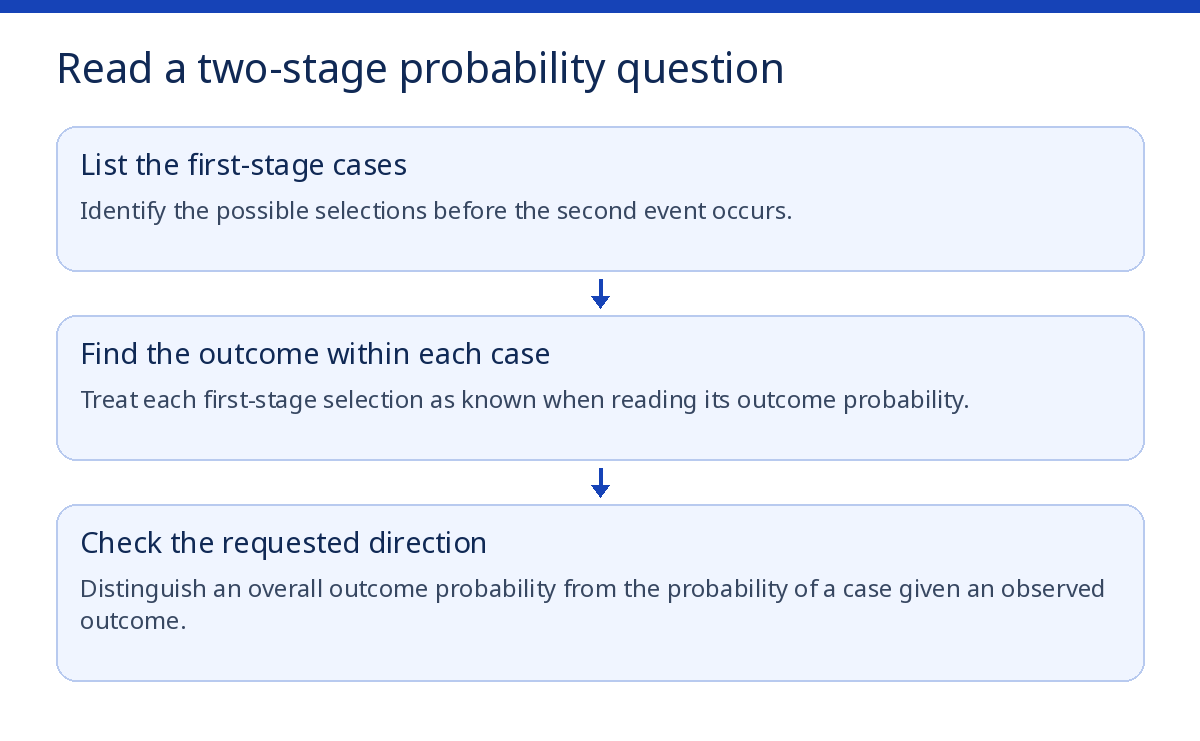
The probability questions include a team-selection context and a case study in which a box is selected before a cap is picked. In a two-stage setup, name the first-stage alternatives before writing probabilities for the second stage. To find the overall probability of an outcome, combine the contributions from the mutually exclusive and exhaustive first-stage cases, weighting each conditional probability by the chance of its case.
Before checking your attempt, ask: Which event am I treating as known? The probability of a cap colour given a box is not the same as the probability of a box given the cap colour. In a separate kind of setup, the probability of at least one event is one minus the probability of none. Multiplying the individual non-occurrence probabilities requires independence; the individual probabilities alone do not justify that product.
Related rates: decide what changes with time
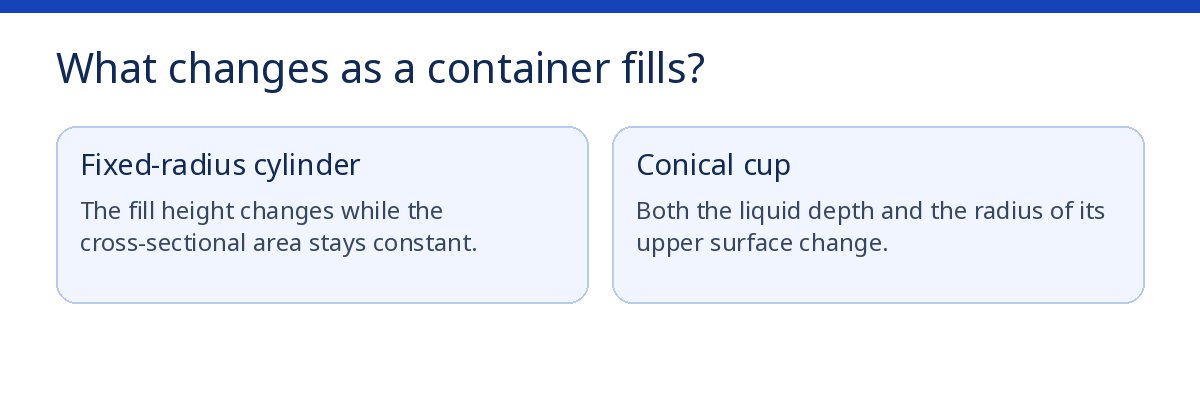
The paper includes a cylindrical-tank question and a conical-cup case study. In a cylinder of fixed radius, the cross-sectional area is constant. In a cone, the radius of the liquid surface changes with the depth, so treating that radius as constant would change the model. Before differentiating, identify which dimensions are fixed and which quantities depend on time.
The cone case also distinguishes the upper surface of the liquid from the wetted inside surface of the cup. These are different areas, so identify the surface requested before choosing an expression. A final unit check helps distinguish the rates: depth changes in length per time, area in square units per time and volume in cubic units per time.
Use the worked solutions to locate the first error
After the timed attempt, use the question-number index to open the relevant worked solution. The visible solutions separate the formula used, concept used and explanation in steps. Compare your work in that order: did you choose an applicable rule, recognise why it fits the question and carry it through correctly? If your setup matches but the result differs, look for the first line where your algebra, sign or units diverge. Then retry from that line without looking at the remainder.
For internal choices, follow the printed paper instructions rather than the cover’s wording about choice coverage. This guide leaves out the cylindrical-tank answer because the question gives no rounding instruction, and does not claim that a Bayes’ theorem worked solution was verified from the excerpt.
Spotted an error? Report a correction. Practise this in the app: notes, formula sheets and mind maps.





























































































































































Loading comments…