CBSE Class 12 Mathematics 2026 Paper and Worked Solutions
CBSEMathematics2026 Previous Year Paper
Paper code: 65/5/3 · 2026Use the full English-language CBSE Class 12 Mathematics Main Examination 2026 paper, set 65/5/3, for a three-hour practice attempt. Then use the worked solutions to check how you chose a method, applied it and justified your result.
This set is one of the year's papers. See every set from 2026, grouped by series.
What the five sections ask you to do
This year-wise previous paper has 38 questions for 80 marks. Section A contains 18 multiple-choice questions and two assertion–reason questions, all worth one mark each. Sections B, C and D contain very short, short and long written answers worth two, three and five marks per question respectively. Section E has three case studies worth four marks each.
The paper has no overall choice: where an internal choice is printed, choose between the alternatives within that question or subpart rather than skipping the question. The instructions prohibit calculators. For a timed attempt, use the paper without opening the solutions and practise deciding when to leave an unfinished question and return to it.

Mathematics 2026 | Class 12 | Previous Year Paper | Code 65/5/3
In the StudentCurio app
The complete CBSE Class 12 Mathematics Main Examination 2026 paper (set 65/5/3) includes multiple-choice, written-answer and case-study questions with worked solutions. It helps students practise the full board-exam format and review solution methods across the syllabus.
From matrix properties to mathematical models
The matrix questions move between recognising properties and using matrices to represent a problem. For example, the paper includes questions about transpose and invertibility as well as a long-answer problem that asks for a matrix method in a book-price setting. In that longer format, check that each column represents the same unknown throughout and that each row matches the information for one purchase. A correct calculation cannot repair a system that was set up incorrectly.
Vectors and three-dimensional geometry call for a different kind of translation. A question about an angle between lines uses their direction vectors; a question about the foot of a perpendicular also needs the position of a point on the line. Before calculating, distinguish the information that locates a line from the information that tells you its direction.
Before using a calculus rule, check its conditions
The calculus questions cover continuity, differentiation, increasing intervals, integration and applications of derivatives. For continuity at a specified point, compare the limit with the value assigned at that point. Simplifying an expression away from an excluded point may help you find the limit, but it does not define the original expression there. For increasing intervals, keep any breaks in the domain visible when you analyse the sign of the derivative.
Inverse trigonometry adds a separate check: an inverse function returns an angle in its principal range, not any angle with the required trigonometric value. When simplifying a composite expression before differentiating, use the given interval to check that the simplification stays on the correct branch. For a closed-interval extrema problem, include the endpoints in your comparison rather than relying only on interior stationary points.
Read a graph for the region, not just the formula
The paper includes both area by integration and graphical linear programming. For an area question, sketch the boundaries before setting the integration limits. A definite integral of a curve below the horizontal axis gives a negative signed contribution; geometric area uses a non-negative height. Where a region is bounded by two curves, identify which is above the other over the interval you are integrating.
For linear programming, the constraint lines help you construct the feasible region, but a point is feasible only if it satisfies every inequality. Where the feasible region is a non-empty bounded polygon, comparing the linear objective at its vertices finds the optimal value. Keep the feasible coordinates separate from the objective value they produce: the point and the value answer different questions.
What changes in the three case studies
The case studies apply differentiation to an open-top tumbler, probability to survey data and relations and functions to groups of students. Start by identifying what stays fixed or what is given. In the tumbler setting, surface area is fixed while the dimensions can vary. The constraint links the dimensions, so differentiating volume while treating the height as fixed would model a different situation.
In the survey setting, distinguish a probability within a specified group from a probability about which group a person belongs to after an outcome is known. In the sets case study, check whether the relation meets the definition of a function before asking whether it is injective. These distinctions matter in short subparts as much as in longer written answers: the context changes what you should calculate or justify.
Use the worked solutions to find your first wrong step
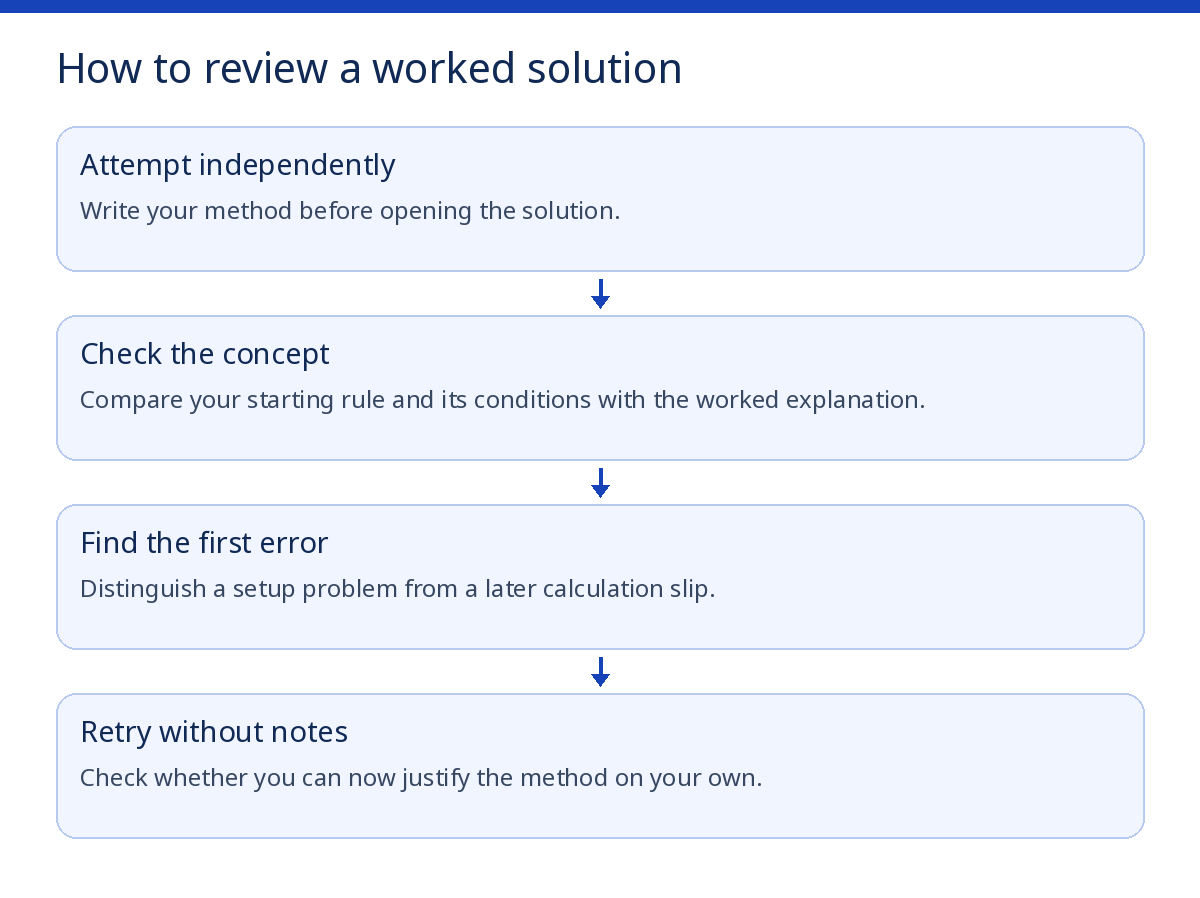
After your attempt, use the question-number index to find the worked solution for an item you missed or answered uncertainly. The solution layout separates the formula used, concept used and explanation in steps. Compare your setup with the concept first, then look for the earliest point where your reasoning diverges. That may be an unsuitable rule, a missed restriction or an arithmetic slip after a sound setup.
For assertion–reason items, assess each statement separately before deciding whether the reason explains the assertion. For written answers, check whether your work makes the link between the setup and the conclusion clear, even if your calculation follows a different valid route. This guide leaves out Q8’s numerical example because its printed givens are inconsistent, and Q33(a)’s identity and derivation because the logarithm’s argument is not clearly delimited.
Quick self-check: Was it the method or the execution?
Choose one response you want to revisit. Can you explain why your starting rule applies and name any condition you needed to check? Then close the worked solution and redo the question from that starting point. If the method is clear but the same error returns, focus on the particular algebraic or interpretive step rather than rereading the entire solution.
Spotted an error? Report a correction. Practise this in the app: notes, formula sheets and mind maps.





























































































































































Loading comments…