CBSE Class 12 Mathematics 2026 Paper: Set 65/3/1
CBSEMathematics2026 Previous Year Paper
Paper code: 65/3/1 · 2026Use this complete English-language paper from the 2026 CBSE Class 12 Mathematics main examination for a three-hour mock. Then use the worked solutions to check not just your answers, but also why each method applies.
This set is one of the year's papers. See every set from 2026, grouped by series.
Read the paper structure before you start
Set 65/3/1 is a year-wise previous year paper worth 80 marks, with 38 questions across five sections. Section A contains 18 multiple-choice questions and two assertion–reason questions, all worth one mark each. Section B has five very short answer questions worth two marks each, Section C has six short answer questions worth three marks each, and Section D has four long answer questions worth five marks each. Section E contains three four-mark case studies.
There is no overall choice: all numbered questions are compulsory, but some offer an internal choice. Choose between the alternatives where the paper gives you an option rather than treating the whole question as optional. Keep the printed three-hour limit and work without a calculator if you want to practise under this set’s exam conditions.

Mathematics 2026 | Class 12 | Previous Year Paper | Code 65/3/1
In the StudentCurio app
The complete CBSE Class 12 Mathematics paper for 2026, set 65/3/1, includes worked solutions and questions across the syllabus. It helps students practise the board-exam format and review solution methods.
In algebra, check the conditions before calculating
The paper tests matrix dimensions, transposes, determinants and inverses. Before multiplying two matrices, check that the number of columns in the first equals the number of rows in the second. The product takes its row count from the first matrix and its column count from the second. This check can rule out an impossible product before you do any arithmetic. When transposing a product, reverse the order of the factors as well as transposing each one.
The paper also moves from matrix properties to a word problem that calls for a system of linear equations and a matrix method. Here, review the translation separately from the calculation: define what each unknown represents, then check that each equation expresses one of the stated conditions. For graphical linear programming, the corresponding check is whether the feasible region satisfies all the inequalities, including non-negativity.
Calculus: identify the variable, interval and target
The calculus questions cover inverse trigonometric functions, continuity, parametric differentiation, increasing intervals, rates of change and integration. These tasks require different checks. For continuity at a point where a piecewise definition changes, the limit must exist and equal the function value there. In a rate-of-change problem, identify the variable in the denominator of the derivative: differentiating with respect to a radius does not give the rate with respect to a diameter unless you account for the relation between them.
For area by integration, use the diagram to decide which variable to integrate with respect to and where the limits come from. In an optimisation question, check exactly which expression is to be minimised. A case study can reuse the same quantities across parts without asking you to optimise the same expression each time.
Good to remember: a general solution is not a particular one
The differential-equation questions distinguish between recognising a homogeneous form and finding a general or particular solution. When testing for the first-order homogeneous form used here, check whether the right-hand side can be expressed as a function of the ratio , on a domain where that ratio and the original expression are defined. The mere presence of both variables is not enough.
A general solution describes a family, while a particular solution must also satisfy the stated condition. In an assertion–reason question, assess the two statements individually before deciding whether the reason explains the assertion. A familiar-looking general expression does not by itself establish that every proposed choice of constant gives an admissible real solution.
Separate direction from position, and independence from conditioning
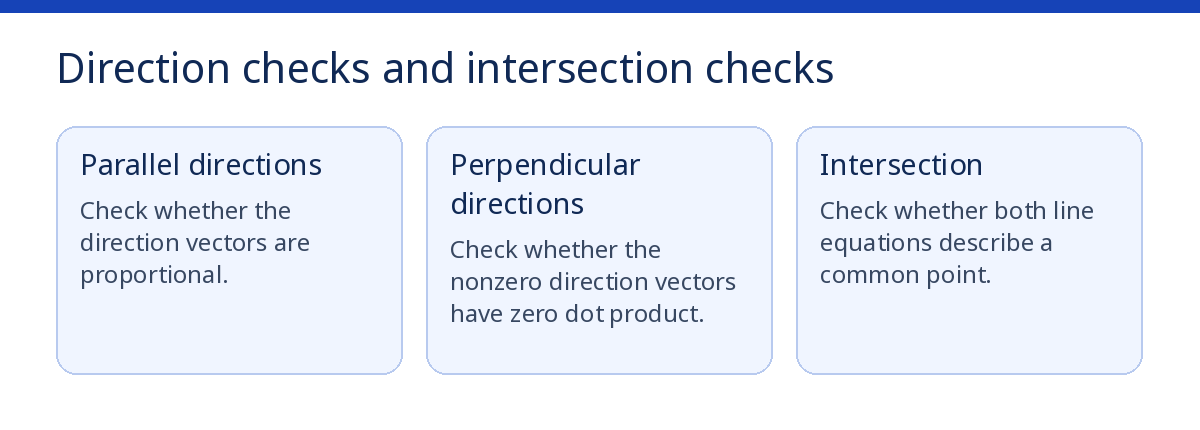
The vector and three-dimensional geometry questions use direction ratios, direction cosines and vector equations of lines. Proportional direction vectors give parallel directions, while a zero dot product between nonzero directions establishes perpendicular directions. Neither check tells you whether the lines meet. To test intersection, look for a common point by checking whether the coordinate equations can be satisfied together.
Probability questions likewise ask you to distinguish between related ideas. Independence allows you to multiply probabilities for the joint occurrence of independent events. Conditional probability instead changes the reference group to the event you are given, which must have nonzero probability. In the survey case study, knowing the group and asking about the outcome is not the same as knowing the outcome and asking about the group. Name the given event before choosing a calculation.
After the mock: find the first step that went wrong
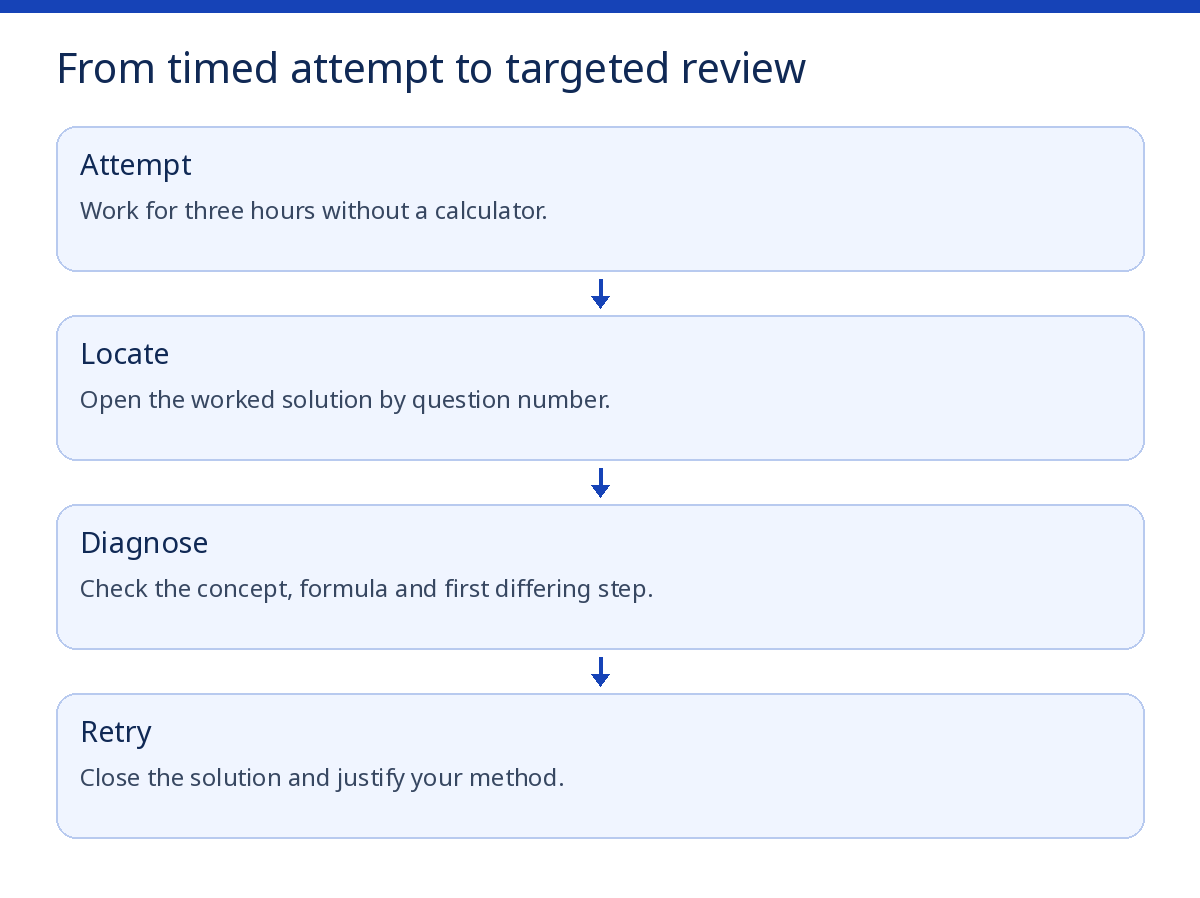
Attempt the question paper before opening the worked solutions. The file lets you navigate by question number, and the solution pages separate the formula used, concept used and explanation in steps. Use those labels to diagnose different problems. If you chose an unsuitable method, start with the concept. If your method was suitable but the result did not follow, compare the steps until you find the first divergence rather than copying the entire solution.
For a case study, check the setup separately from the later computation: a wrong variable, boundary line or conditioning event can carry through multiple parts. After reviewing a mistake, retry the question without the solution visible and write down the condition that makes your method valid. This guide leaves out the relation alternative in Q23(b) because of a print ambiguity and the square alternative in Q35(b) because its stated conditions are inconsistent.
Spotted an error? Report a correction. Practise this in the app: notes, formula sheets and mind maps.





























































































































































Loading comments…