CBSE Class 12 Mathematics 2026 Previous Year Paper: 65/1/2
CBSEMathematics2026 Previous Year Paper
Paper code: 65/1/2 · 2026Use the full English version of the CBSE Class 12 Mathematics 2026 Main Examination paper 65/1/2 for a three-hour practice attempt. Then use the worked solutions to check where you chose the wrong method, missed a condition or made a calculation error.
This set is one of the year's papers. See every set from 2026, grouped by series.
Know the format before you start
This year-wise previous year paper carries 80 marks across 38 questions in five sections. There is no overall choice, but some questions outside Section A provide internal alternatives. When you encounter an OR, choose one alternative for the timed attempt. You can try the other later for revision. Calculators are not allowed.
- Section A: Questions 1–18 are multiple-choice and Questions 19–20 are assertion–reason, all worth 1 mark each.
- Section B: Questions 21–25 are very short answers worth 2 marks each.
- Section C: Questions 26–31 are short answers worth 3 marks each.
- Section D: Questions 32–35 are long answers worth 5 marks each.
- Section E: Questions 36–38 are case studies worth 4 marks each.
Start from the question-paper pages and leave the solution links unopened until the attempt is over.

Mathematics 2026 | Class 12 | Previous Year Paper | Code 65/1/2
In the StudentCurio app
CBSE Class 12 Mathematics Main Examination paper 65/1/2 for 2026, with worked solutions and questions spanning the syllabus. It includes objective, assertion–reason, short- and long-answer, and case-study questions, helping students practise the full examination and review solutions.
Match your reasoning to the question format
Section A switches quickly between ideas such as inverse trigonometric ranges, matrix properties, vector relationships and extrema. When you review an MCQ, ask whether you could justify the choice without the options. In the assertion–reason items, make two separate checks: decide whether each statement is true, then, if both are true, decide whether the reason actually explains the assertion.
In the written sections, make the reasoning visible. A continuity check for a piecewise function needs the left-hand and right-hand limits at the joining point, as well as the function value there. A longer geometry question may ask you to establish that two lines intersect and then use the intersection to describe another line. Pay attention to verbs such as show, find and hence: a correct intermediate result may not finish the task.
Calculus: identify what the question is asking for
The paper uses calculus in several ways: finding antiderivatives, evaluating definite integrals, finding geometric area, solving differential equations and studying extrema. Before calculating, identify the object you need to produce. An antiderivative is a family of functions on an interval; a definite integral over given limits is a number. Geometric area, unlike a signed integral, cannot be negative. If a curve crosses the axis, split the interval at the crossings or integrate the absolute value of the function when finding the area between the curve and the axis.
For a first-order linear differential equation, identify the independent variable before choosing the integrating factor. It need not be . If you divide through by the coefficient of the derivative to reach standard form, do so only on intervals where that coefficient is nonzero.
Common mistakes: losing a condition or reversing the wrong order
Inverse trigonometric simplification requires more than recognising a familiar identity. The inverse function returns a principal value, so check whether the angle you propose lies in the appropriate range. Keep track of whether an endpoint is included; replacing a strict inequality with an inclusive one can change the result.
In matrix algebra, transposing a product reverses the factor order: whenever is defined. Transposing a difference does not reverse the subtraction: for matrices of the same order. A useful check in the written algebra questions is to confirm that the operation exists before carrying it out. In particular, solving a system by a matrix inverse requires the square coefficient matrix to be invertible. A singular matrix has no inverse.
Two ways the paper tests optimisation
In graphical linear programming, keep the constraints and the objective separate. The inequalities determine the feasible region; the objective assigns a value to each feasible point. For a nonempty, bounded polygonal feasible region, a linear objective attains its maximum and minimum at vertices, though an entire edge can share an optimum. This is why finding the region correctly comes before comparing objective values.
The revenue case study asks you to build an objective from a changing subscription fee and subscriber count. Here the task is to express revenue as a function and use calculus to analyse it. For questions about an absolute extremum of a continuous function on a closed interval, check the endpoints as well as interior critical points rather than stopping at a point where the derivative is zero.
Quick self-check for the case studies
The three cases use prize probabilities, circular regions and subscription revenue. After reading a case, pause before calculating and ask what mathematical object each subpart needs. In the probability case, can you distinguish an individual outcome from an event that groups several outcomes? For the circular regions, can you explain why the whole circle is not the graph of a single function of , and why a sketch helps you choose which branch or region to use? For the revenue model, can you distinguish the fee paid by one subscriber from the total money collected? These checks help you catch a modelling error before it carries through to a later subpart.
Use the worked solutions to locate your first error
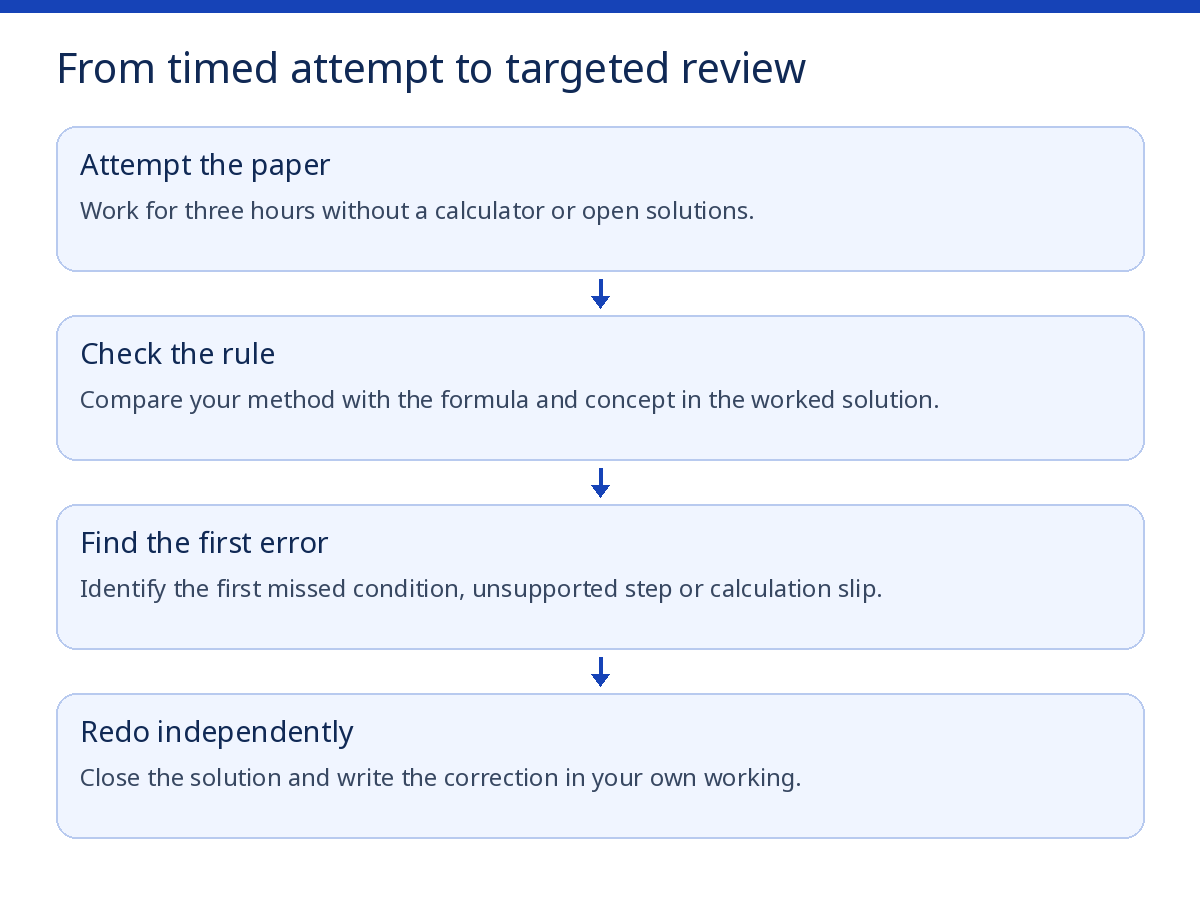
After the attempt, use the numbered links to open the solutions you need. The worked pages separate the formula used, the concept used and the explanation in steps. Compare your work in that order: was the rule applicable, did it fit the problem, and at which line did your reasoning or calculation first diverge? Then close the solution and redo the question from that point, writing the condition or justification you originally missed.
This guide leaves out Q2’s worked calculation and keyed answer because the solution does not match the printed integrand. It also leaves out Q9’s ambiguous line notation and worked answer, and discusses Q19–20 only as examples of the assertion–reason format.
Spotted an error? Report a correction. Practise this in the app: notes, formula sheets and mind maps.





























































































































































Loading comments…