CBSE Class 12 Mathematics 2026 Paper: Set 65/3/2
CBSEMathematics2026 Previous Year Paper
Paper code: 65/3/2 · 2026Use the full English-language 2026 CBSE Class 12 Mathematics main examination paper as a three-hour, no-calculator mock. Then use the question-indexed worked solutions to check whether you chose a suitable method, applied it under the right conditions and showed enough reasoning.
This set is one of the year's papers. See every set from 2026, grouped by series.
How the 80 marks are organised
Set 65/3/2 contains 38 questions across five sections. Section A has 18 multiple-choice questions and two assertion–reason questions, each worth one mark. Section B has five very short-answer questions worth two marks each; Section C has six short-answer questions worth three marks each. Section D has four five-mark long-answer questions, and Section E has three four-mark case studies.
There is no overall choice. Internal alternatives appear in two questions in Section B, three in Section C, two in Section D and all three in Section E. During a timed attempt, answer one branch where an alternative is offered rather than treating the whole question as optional. Save the unused branch for a fresh practice attempt after you have reviewed the paper.

Mathematics 2026 | Class 12 | Previous Year Paper | Code 65/3/2
In the StudentCurio app
Complete CBSE Class 12 Mathematics main examination paper for 2026, set 65/3/2, with worked solutions for all 38 questions. Includes multiple-choice, assertion–reason, long-answer and case-study questions across the syllabus.
Calculus: decide what the expression represents
The calculus questions move between inverse trigonometric functions, continuity, rates of change, integration and differential equations. In a piecewise continuity question, distinguish the formula used near the joining point from the value assigned at the point itself. Continuity requires the limit to exist and equal that assigned value. In a rate question, identify the variable named after with respect to: a quantity expressed in terms of radius may be changing with respect to diameter, so the chain rule must account for the relationship between them.
The integration questions also reward checking the setup before calculating. Even symmetry can reduce a definite integral only when the integrand is even and the limits are symmetric about zero. When finding area with horizontal strips, use the right boundary minus the left boundary and take the limits along the vertical axis. The diagram tells you which boundaries apply.
Algebra and geometry: check what the representation allows
The matrix questions range from transpose and adjugate properties to modelling a pair of linear equations. In the voucher problem, the mathematical work begins with naming the two unknown counts and translating each statement into an equation. When reviewing the matrix method, check that the columns of the coefficient matrix follow the same variable order in both rows. If you use an inverse, the coefficient matrix must be invertible.
In three-dimensional geometry, separate a point on a line from its direction vector. Proportional nonzero direction vectors establish a common direction, but the points still matter if you need to distinguish coincident lines from distinct parallel lines. For a proposed intersection, the parameters must give the same point in all three coordinates, not just agreement in the coordinates used to find the parameters.
Common mistake: dropping conditions from a rule
For a first-order differential equation written as , the homogeneity test in this paper concerns the right-hand side: it must be unchanged when both variables are scaled by the same factor, for admissible scalings on the domain. A quotient or logarithm still has to be defined. Also distinguish a general solution, which contains an arbitrary constant, from a particular solution selected by a condition. An algebraically written candidate is not a real solution if its defining equality cannot hold for real values.
The same attention to conditions matters in the one-one and onto question. One-one concerns whether distinct inputs in the stated domain can share an output; onto concerns whether the range fills the stated codomain. Keep those sets in view rather than reasoning from the formula alone.
Case studies: translate the context before calculating
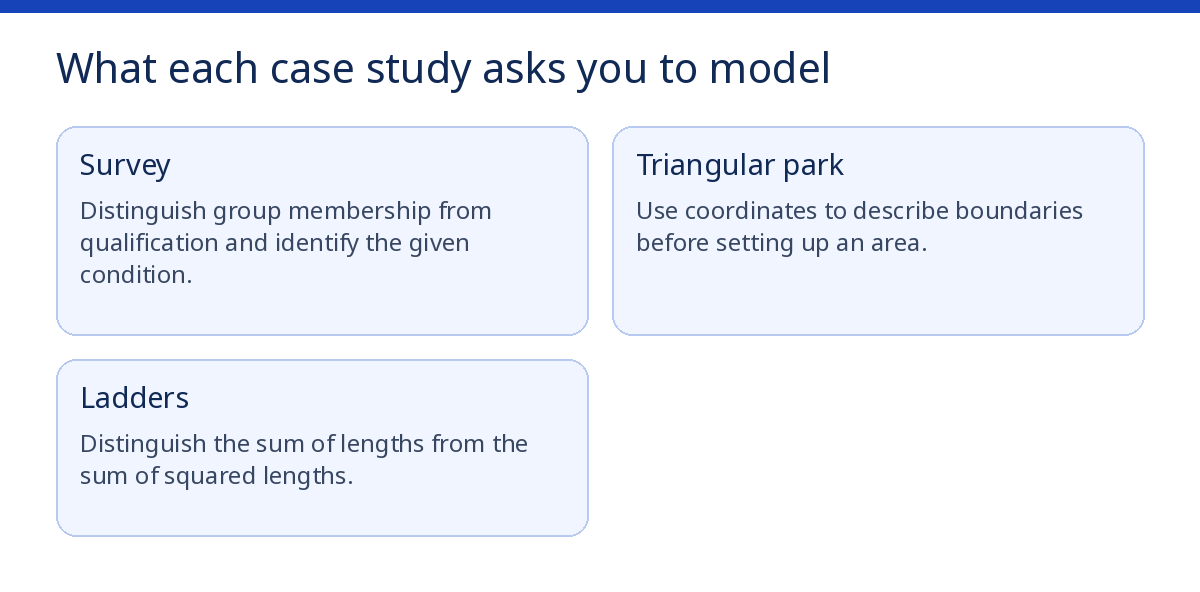
The three case studies ask for different kinds of translation. The survey separates candidates by group and by qualification outcome. In a conditional probability statement, identify which group or outcome is already known: the probability of qualifying given group membership is not the same as the probability of group membership given qualification. This differs from the surgery question elsewhere in the paper, where independence is explicitly assumed.
The triangular park case moves from coordinates to boundary equations and then to area by integration. The ladder case asks first about the sum of lengths, while its minimisation alternatives concern the sum of squares. Write the requested objective before differentiating; those expressions are not interchangeable. In the separate graphical linear programming question, check each inequality’s direction when locating the feasible region, since a boundary line alone does not tell you which side is allowed.
Use the worked pages to find your first wrong step
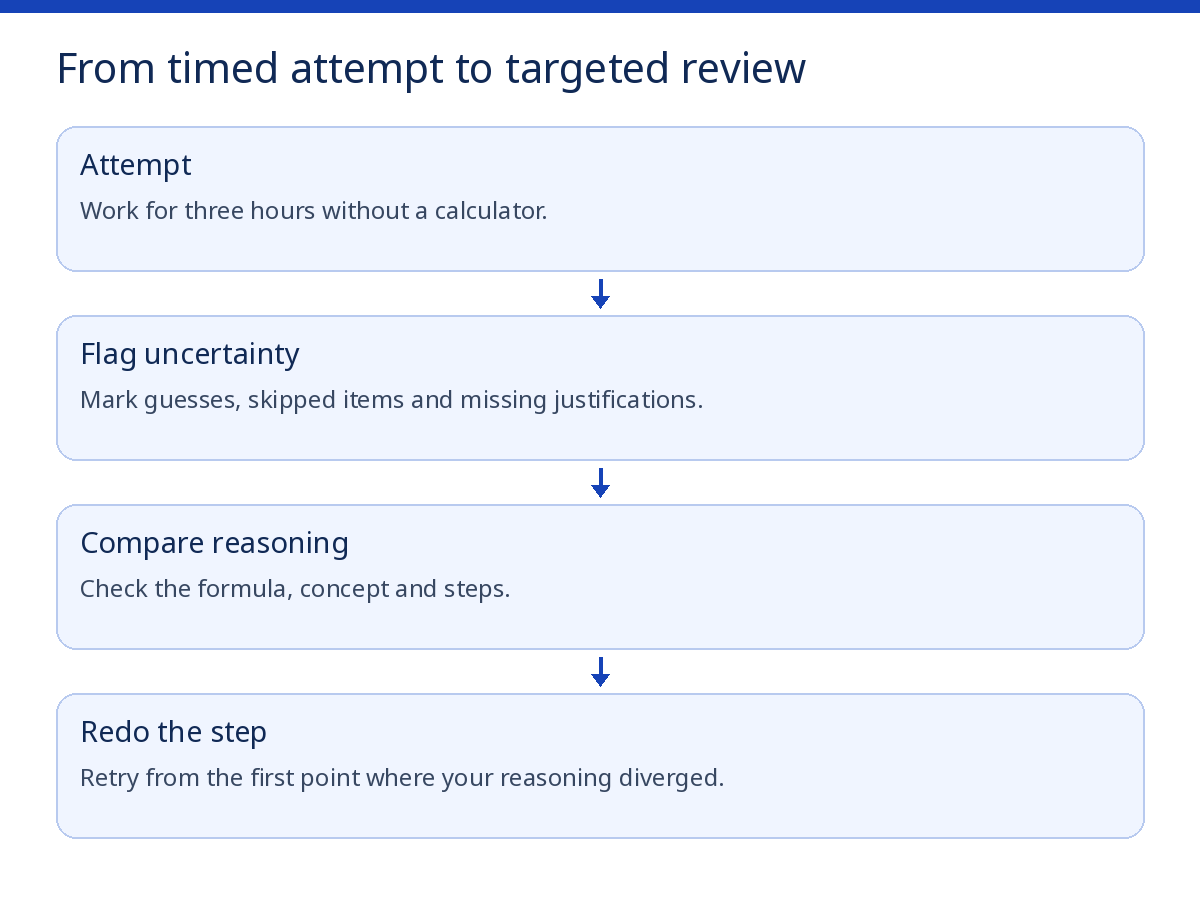
Keep the solutions closed during the timed attempt and mark questions you guessed, skipped or could not justify. Afterwards, use the question-number index to open the relevant worked page. The supplied solutions separate the formula, the concept and the explanation in steps. Compare your reasoning in that order: did you select a suitable rule, identify why it applied, and carry it through correctly? For an assertion–reason item, check each statement independently before deciding whether the reason explains the assertion.
For this guide, the inconsistent matrix equality in Q15 and the relation listing with a missing comma in Q21(b) have been omitted, along with answer keys and option letters. For the unambiguous items, redo the first step where your reasoning diverged before reading on. That makes the review useful even when your final answer happened to match.
Spotted an error? Report a correction. Practise this in the app: notes, formula sheets and mind maps.





























































































































































Loading comments…