CBSE Class 12 Mathematics 2026 Previous Year Paper
CBSEMathematics2026 Previous Year Paper
Paper code: 65/4/1 · 2026Practise with the full English-language 2026 CBSE Class 12 Mathematics main examination paper, code 65/4/1. Use the worked solutions after your attempt to check not just what went wrong, but whether the error was in choosing a method, setting up the problem or carrying out the calculation.
This set is one of the year's papers. See every set from 2026, grouped by series.
Paper format and internal choices
This year-wise resource contains a full paper worth 80 marks, with 3 hours allowed and no calculator. Its 38 questions are divided into five sections. Section A contains 18 multiple-choice questions and two assertion–reason items, each worth one mark. Section B has five two-mark very short answer questions, Section C has six three-mark short answer questions, and Section D has four five-mark long answer questions. Section E has three four-mark case studies.
The paper has no overall choice. All question numbers are compulsory, but some questions or subparts in Sections B to E offer an internal choice. For a timed attempt, follow the printed instructions and answer only the required alternative. Save the other branch for revision so that you can still use it as an unseen problem.

Mathematics 2026 | Class 12 | Previous Year Paper | Code 65/4/1
In the StudentCurio app
Complete CBSE Class 12 Mathematics paper for 2026 with worked solutions, covering topics including calculus, matrices, vectors, probability, linear programming and three-dimensional geometry. Useful for full-paper exam practice and reviewing solution methods.
Functions and matrices: check what the notation means
The paper asks you to recognise an inverse trigonometric graph, work with principal values, and reason about functions and relations. For an inverse trigonometric function, check both the domain of the inverse and its principal range. The first tells you which inputs are allowed; the second tells you which output angle is selected. For a one-one or onto question, read the stated domain and codomain before doing any algebra: to prove a function is onto, you need a permitted preimage for every element of its codomain.
The matrix questions move from reading entries and taking a transpose to calculating a matrix expression and modelling a system of equations. A transpose interchanges rows and columns; it does not undo the action of the matrix. For the square coefficient matrix in the case study, the determinant test decides whether an inverse exists before you try to compute it.
Calculus checkpoints: limits, signs and derivative order
Calculus appears in several formats, from continuity and differentiation to integration, area and differential equations. Common mistake: concluding that a piecewise function is differentiable just because it is continuous. At a join, continuity requires the two one-sided limits to agree with the function value. Differentiability also requires the one-sided derivatives to exist and agree.
For integration, distinguish the signed value of a definite integral from geometric area. The integral gives area directly when the curve stays on or above the axis over the interval. A change in sign calls for separating the regions so their areas do not cancel. A change in the expression for the curve, as with an absolute value, can also require splitting the interval even if the curve stays nonnegative. In differential equations, identify the highest derivative first: it determines the order, while degree refers to its exponent when the equation is polynomial in the derivatives.
Choosing a method for geometry and optimisation
Vectors and three-dimensional geometry test different uses of directions and coordinates. When points are given by position vectors, subtract them to obtain the displacement vectors that describe the sides. Side lengths can be compared using magnitudes, whereas a cross product of two nonparallel directions gives a direction perpendicular to both. In the line questions, keep a point on the line separate from its direction vector when reading or converting forms.
Linear programming starts with a different kind of setup: the feasible region consists of points that satisfy every constraint at once. Draw the boundary lines and check the permitted side of each before working with the objective function. If both endpoints of a feasible segment achieve the same optimum, a linear objective has that value throughout the segment. This explains why an optimal solution need not be a single point.
Case studies: turn the given information into a model
The three case studies use a conical cup, a box-design problem and a selection of caps from different boxes. In the related-rates problem, distinguish the cup's fixed dimensions from the liquid's changing dimensions. A volume rate, a height rate and a surface-area rate describe different quantities, so their units help you check which derivative a subpart is asking for. In the design problem, assign a variable to each dimension and keep their order consistent when writing the coefficient matrix.
Quick self-check: In the probability case study, can you distinguish the chance of a colour given a particular box from the chance of a particular box given the colour? The latter uses the observed colour as the condition. That is a different setup from the earlier repeated-draw question, where replacement allows successive random draws to be treated as independent.
How to review with the worked solutions
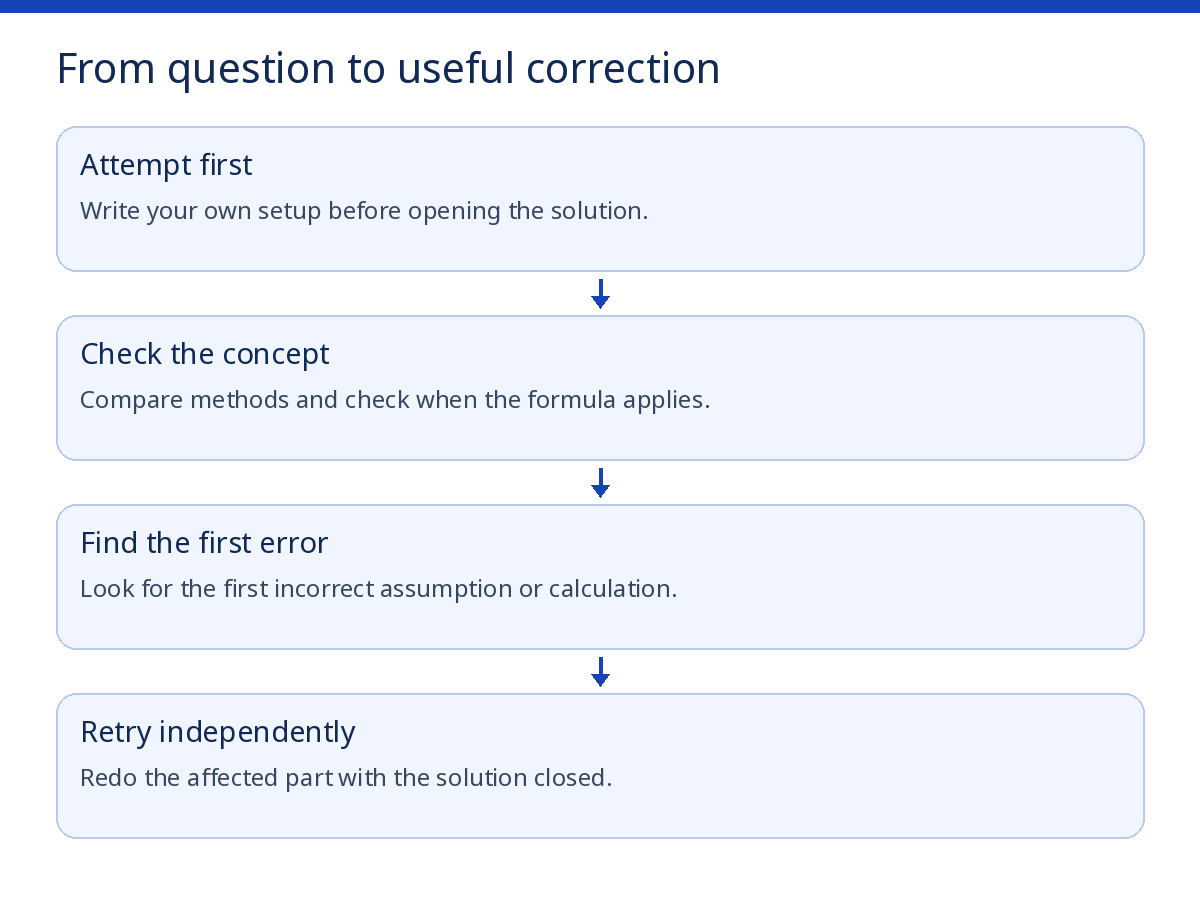
Attempt the question paper before opening the solutions. During review, use the question-number links and read the Formula Used, Concept Used and Explanation in Steps labels for different purposes. Compare the concept with the method you chose, check whether the formula's conditions hold, and then find the first step where the approaches differ. In an assertion–reason item, check the truth of each statement separately before deciding whether the reason explains the assertion.
For a longer response, compare the written setup even if your final result agrees. A missing constraint, a mixed-up variable or an unsupported conclusion can be invisible in a final value. Reattempt that part without the solution open. This guide leaves out the cover's wording about the choice count, the equation as transcribed in the order-and-degree solution, and the option label in the vector-area solution.
Spotted an error? Report a correction. Practise this in the app: notes, formula sheets and mind maps.





























































































































































Loading comments…