CBSE Class 12 Mathematics 2026 Paper and Worked Solutions
CBSEMathematics2026 Previous Year Paper
Paper code: 65/5/2 · 2026Practise the full English-language CBSE Class 12 Mathematics 2026 main examination paper, code 65/5/2. Use the worked solutions to check not just your answers, but also why a method applies and where your reasoning needs more detail.
This set is one of the year's papers. See every set from 2026, grouped by series.
Know the format before you start
This year-wise paper has 38 questions across five sections, with 3 hours for 80 marks. Calculators are not allowed. All questions are compulsory, but some offer an internal choice. That means you answer one of the printed alternatives where a choice is given; there is no overall choice to skip a question and replace it with another.
Section A contains 18 multiple-choice questions and two assertion–reason questions, all worth one mark each. Sections B, C and D contain very short, short and long answers worth two, three and five marks per question, respectively. Section E has three case studies worth four marks each. Use this structure in your timed attempt: read the instructions first, leave time for the case-study subparts, and save the worked solutions for after the attempt.

Mathematics 2026 | Class 12 | Previous Year Paper | Code 65/5/2
In the StudentCurio app
Complete CBSE Class 12 Mathematics paper for 2026 with worked solutions covering questions across the syllabus. Helps students practise board-exam questions and review solution methods.
Algebra and functions: check the condition before the rule
The matrix questions range from entrywise operations and transpose properties to a longer cost problem that specifies the matrix method. These tasks test different skills: matrix addition requires matrices of the same order, a matrix inverse requires a nonsingular square matrix, and a word problem requires you to translate each statement into an equation before doing any matrix arithmetic. When reviewing the cost problem, compare your equations with the wording before checking your calculation. An accurate matrix calculation cannot fix a wrongly translated condition.
The paper also tests principal values of inverse trigonometric functions and continuity at a point. For an inverse trigonometric composition, check the principal range before assuming that the two functions cancel. For continuity, distinguish the limit from the value assigned at the point. Simplifying the expression at nearby inputs can help you find the limit, but it does not by itself tell you what value the original function takes there.
Calculus: decide what the expression must represent
Differentiation appears in questions on increasing intervals, related rates and optimisation. For an increasing-interval problem, examine the sign of the derivative only on the stated domain. In the circular-ring problem, the area and circumference change with the same radius, so the relationship between their rates matters more than differentiating either formula in isolation. In the tumbler case study, the surface area is fixed and the top is open. The constraint therefore links the radius and height, rather than letting you vary the radius while holding the height fixed.
The integration questions distinguish evaluating an integral from using integration to find geometric area. A sketch helps you identify the boundaries and tell where the curve lies above or below the axis. An integral can be negative, but a geometric area cannot. The differential-equation questions likewise test two separate tasks: identifying order and degree, and finding a solution. Order comes from the highest derivative present; degree concerns the power of that derivative when the equation is polynomial in its derivatives.
A useful connection: identify what the geometry asks for
The vector questions cover perpendicular directions and triangle area, while the three-dimensional geometry questions ask about lines, angles and distances. Choose an operation by the quantity you need. A zero dot product tests perpendicularity of two nonzero vectors. Half the magnitude of the cross product gives the area of a triangle when the vectors represent two sides drawn from the same vertex.
For a point-to-line problem, the foot of the perpendicular is a point on the line; the perpendicular distance is a length. If a question asks for both, review those as separate outputs. The graphical linear programming question makes a similar distinction: the constraints determine which points are feasible, and the objective function determines which feasible points are best. For a nonempty bounded feasible polygon, test the objective at the vertices only after verifying that they meet all the constraints.
Common mistakes in probability and relations
In conditional probability, reversing the events changes which event you are treating as given. Before calculating, read the expression in words and identify the event after the conditioning bar. In the card problem, replacement determines how the second draw is made. It does not establish that any two events defined using the draws are independent. Check independence for the events the question actually names, using their joint probability and the product of their individual probabilities.
The relations case study also rewards checking definitions in the right order. A relation from one set to another is a function only if each input has exactly one output. Establish that before asking whether the function is injective or bijective. For a proposed equivalence relation, check reflexivity, symmetry and transitivity separately; verifying one property does not establish either of the others.
Use the worked steps to diagnose mistakes
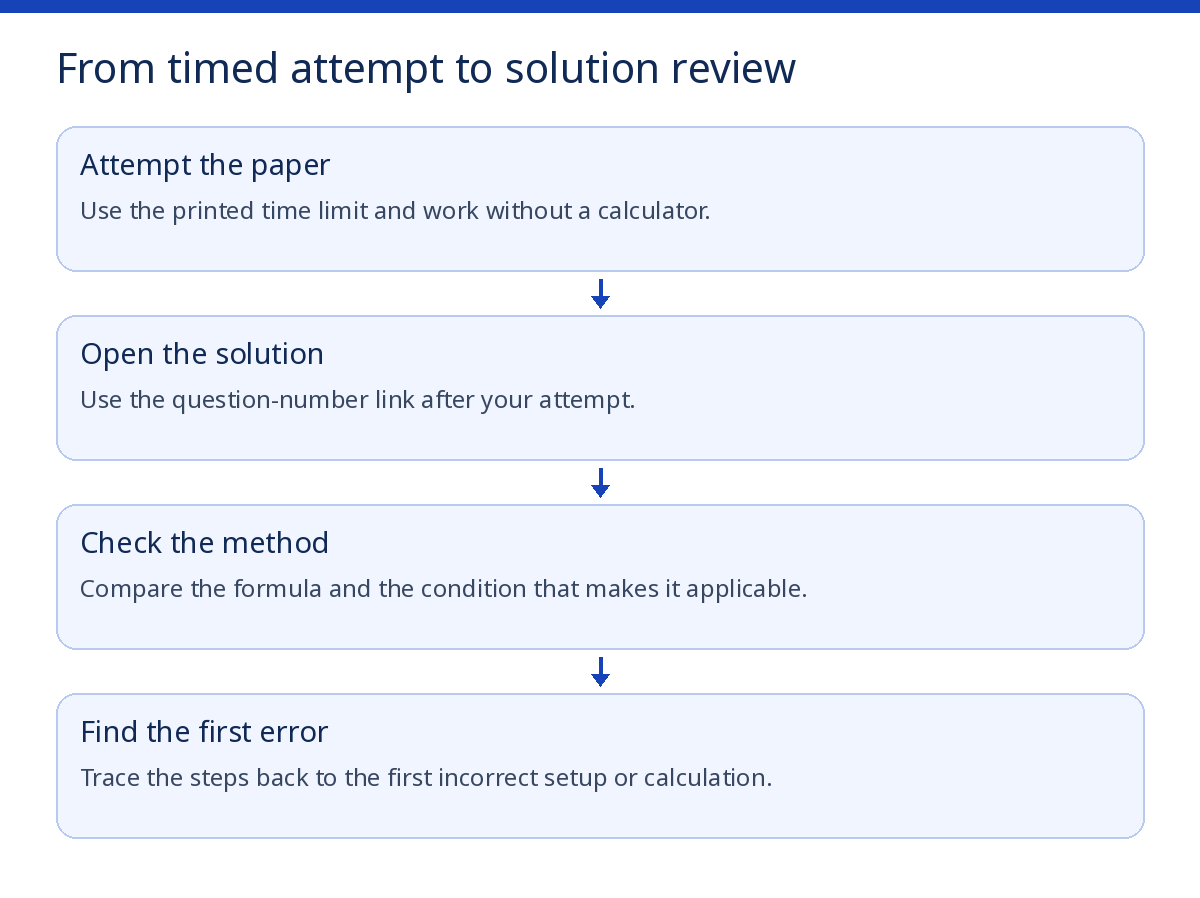
After your attempt, use the question-number links to open the worked solutions. The solution format separates the formula used, the concept used and the explanation in steps. Compare your work in that order. If you chose the wrong rule, identify the condition you missed. If the rule was suitable, find the first line where your setup or calculation diverged. For assertion–reason questions, check the truth of each statement separately before deciding whether the reason explains the assertion.
Three printed items are left out of this guide’s examples: Q10 lacks an interval to settle the sign choice, Q17 gives incompatible probabilities, and Q35(a) leaves the scope of the logarithm unclear. Use the other questions to practise the underlying methods rather than treating these items as models to copy.
Spotted an error? Report a correction. Practise this in the app: notes, formula sheets and mind maps.





























































































































































Loading comments…