CBSE Class 12 Mathematics 2026 Paper with Worked Solutions
CBSEMathematics2026 Previous Year Paper
Paper code: 65/2/2 · 2026Use the complete English-medium CBSE Class 12 Mathematics 2026 main examination paper (65/2/2) for a three-hour practice attempt, then review the worked solutions to see where your choice of method, reasoning or calculation needs attention.
This set is one of the year's papers. See every set from 2026, grouped by series.
Know the five-section paper format
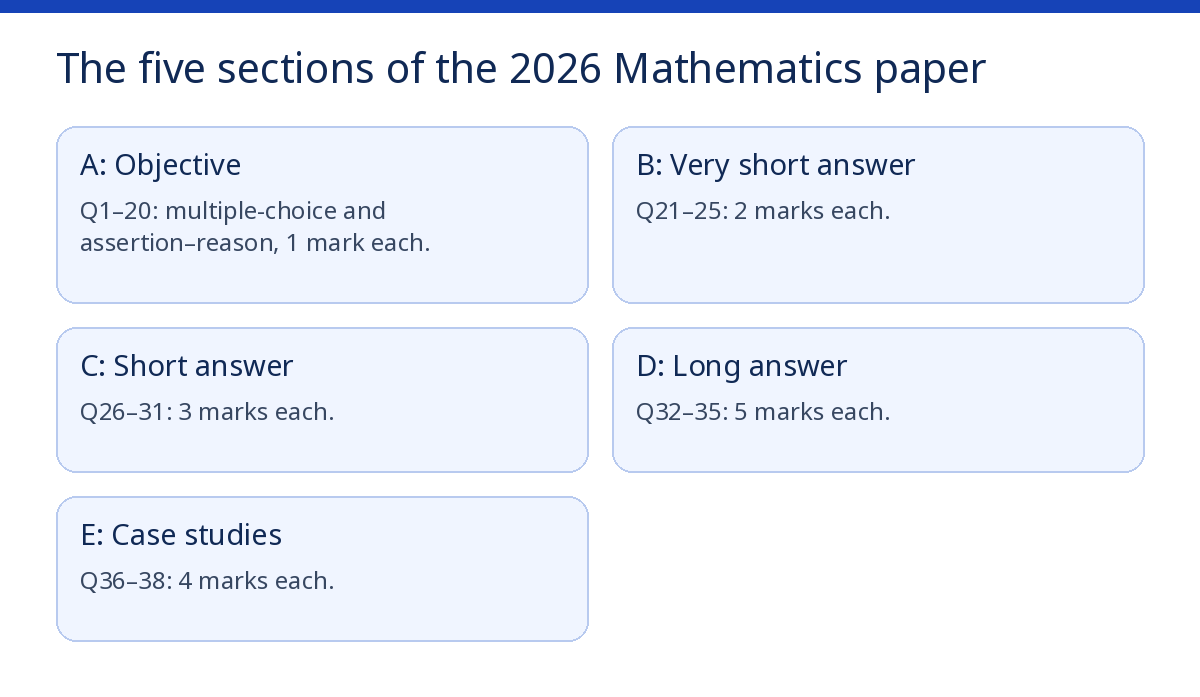
This year-wise previous year paper is worth 80 marks and contains 38 questions. Section A has 18 multiple-choice questions and two assertion–reason questions, all worth one mark each. Section B has five very short answer questions worth two marks each, Section C has six short answer questions worth three marks each, and Section D has four long answer questions worth five marks each. Section E has three case-study questions worth four marks each.
There is no overall choice, but some questions outside Section A offer an internal choice. For a timed attempt, answer one alternative where the paper prints an OR, rather than treating both alternatives as required. Work without a calculator, as the paper instructs. If you want to practise the other alternative, save it for a separate attempt so it does not affect your timing.

Mathematics 2026 | Class 12 | Previous Year Paper | Code 65/2/2
In the StudentCurio app
A complete CBSE Class 12 Mathematics examination paper with worked solutions, covering questions across multiple syllabus topics. Helps students practise the board-paper format and review solution methods.
Follow the calculus across question formats
Calculus appears in several forms: recognising an integration method, differentiating implicit or parametric expressions, analysing extrema and monotonicity, and using definite integrals to find area. The paper also includes differential equations, with both general-solution tasks and a problem that supplies an initial condition. A general solution can contain an arbitrary constant; an initial condition is used to select a solution that satisfies the given value.
The two-mark question on an absolute maximum and the longer question on increasing and decreasing intervals call for different conclusions. On a closed interval, a continuous function’s absolute maximum can occur at an endpoint or at an interior critical point. A monotonicity question instead asks where the function increases or decreases. Finding where the derivative is zero is a starting point, not a substitute for checking its sign on the relevant intervals.
Common mistakes: ignoring the domain or changing the product order
The functions questions test whether you read the stated domain and codomain as carefully as the formula. To check whether a function is onto, ask whether every element of the codomain has a preimage in the allowed domain. To check whether it is injective, ask whether equal outputs force equal inputs. An algebraic candidate that lies outside the domain does not establish that a codomain value is reached. The inverse-trigonometry question adds another distinction: the set of permitted inputs is not the same as the range of the resulting expression.
For matrices, keep the order of multiplication when expanding a product: distributivity does not imply that . The paper moves from short questions on matrix properties to longer work with a system of equations or a determinant. When reviewing either type, identify the property that justifies the step rather than relying on a rule remembered from ordinary algebra.
Separate geometric conditions from optimisation goals
The vectors and three-dimensional geometry questions progress from magnitudes and directions to a triangle median, a foot of a perpendicular, and lines in space. A foot-of-perpendicular problem combines two requirements: the point must lie on the given line, and the segment joining it to the original point must be perpendicular to that line. Keeping those requirements separate helps you see why a point on the line is only a candidate until perpendicularity has also been checked.
Linear programming makes a different distinction. The constraints determine which points are feasible; the objective function is what is maximised or minimised. This paper asks you both to read constraints from a shaded region and to solve a graphical optimisation problem. When checking your graph, distinguish drawing the boundary line from selecting the side that satisfies the inequality. A correct boundary can still enclose the wrong region if the inequality is read backwards.
Quick self-check: what changes between case-study parts?
The case studies use an elliptical ground for integration and area, a piecewise track model for differentiation and continuity, and a group-based scenario for conditional probability. Read each subpart’s instruction before carrying over a method from the previous one. Differentiating within a single branch of a piecewise function is not the same task as testing differentiability where two branches meet.
In the probability case study, ask: Which event is already known, and which event am I finding the probability of? Reversing those roles generally changes the probability. The conditioning event is also the one whose probability appears in the denominator, so its probability must be positive. Writing the two events in words first can expose a reversed condition before you substitute any values.
Use the worked solutions after the timed attempt
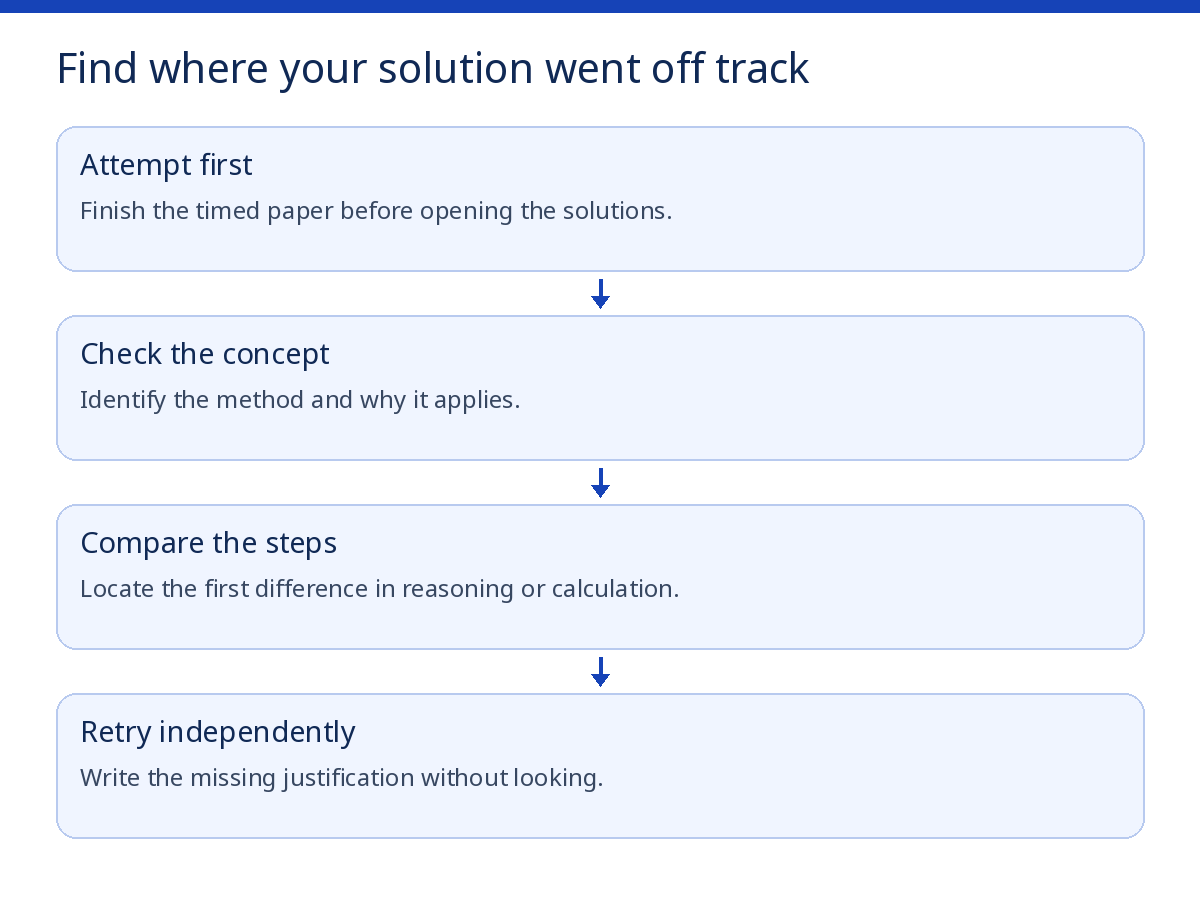
Keep the solution pages closed until you finish the paper. Then use the cover’s question-number links to revisit answers you got wrong, left unfinished or reached without being sure why the method worked. The worked solutions separate Formula Used, Concept Used and Explanation in Steps. Start with the concept if you could not choose a method. If your setup was sound, compare the steps to find the first line where your reasoning or calculation diverged.
When you retry a question, write the missing justification without consulting the solution. For an assertion–reason item, for instance, check the truth of each statement separately before deciding whether the reason explains the assertion. Judge the retry by whether you can explain that decision, not just recall the option. This guide leaves out the disputed wording in Q21(b).
Spotted an error? Report a correction. Practise this in the app: notes, formula sheets and mind maps.





























































































































































Loading comments…