CBSE Class 12 Mathematics 2026 Paper: Set 65/1/1
CBSEMathematics2026 Previous Year Paper
Paper code: 65/1/1 · 2026Use the complete English paper from the 2026 CBSE Class 12 Mathematics Main Examination for a three-hour practice attempt. Then use the worked solutions to check how you chose a method, handled the conditions and explained your reasoning.
This set is one of the year's papers. See every set from 2026, grouped by series.
Know the format before you start
This year-wise resource contains the full paper for set 65/1/1 and its worked solutions. The paper carries 80 marks across 38 questions in five sections. There is no overall choice, but some questions in Sections B to E offer internal alternatives. Attempt one branch wherever an internal choice is given during your timed sitting; save the other branch for later practice. Calculators are not allowed.
Section A has 18 multiple-choice questions and two assertion–reason questions, each worth one mark. Sections B, C and D move from very short answers worth two marks to short answers worth three and long answers worth five. Section E contains three four-mark case studies. Practising the complete paper lets you switch between selecting an option, writing a proof or calculation, and interpreting information in context.

Mathematics 2026 | Class 12 | Previous Year Paper | Code 65/1/1
In the StudentCurio app
Complete CBSE Class 12 Mathematics Main Examination paper for 2026, set 65/1/1, with worked solutions covering questions across the syllabus. It helps students practise exam-style problems and review solution methods.
Algebra and functions: check what is defined
The paper covers inverse trigonometry, relations and functions, and matrices and determinants. An inverse-trigonometric identity is not enough on its own: the input must be in the function’s domain, and the output must belong to its principal range. The interval specified in a question can therefore affect how you simplify an expression.
For a function proof, keep the stated domain and codomain in view. To show a function is one-one, establish that equal outputs force equal inputs. To show it is onto, check that every element of the stated codomain has a preimage in the stated domain. In matrix questions, make a different preliminary check: are the operations defined for the given dimensions? If a method requires a matrix inverse, the coefficient matrix must be square and have a nonzero determinant.
Calculus: identify what the question is asking for
The calculus questions include continuity at a piecewise boundary, related rates, definite integrals, geometric area and differential equations. At a piecewise boundary, continuity requires both one-sided limits to agree with the function value. In a related-rates problem, first express the changing quantities in terms of each other, then differentiate with respect to time. The rate of change of a volume and the rate of change of a height have different units; a quantity described as decreasing has a negative derivative.
For a differential equation, identify the independent variable before choosing a standard form or an integrating factor. A request for a general solution is also different from a request for a particular solution: when an initial condition is supplied, use it to determine the constant and check that the resulting solution satisfies the condition.
Common mistake: confusing signed integral and area
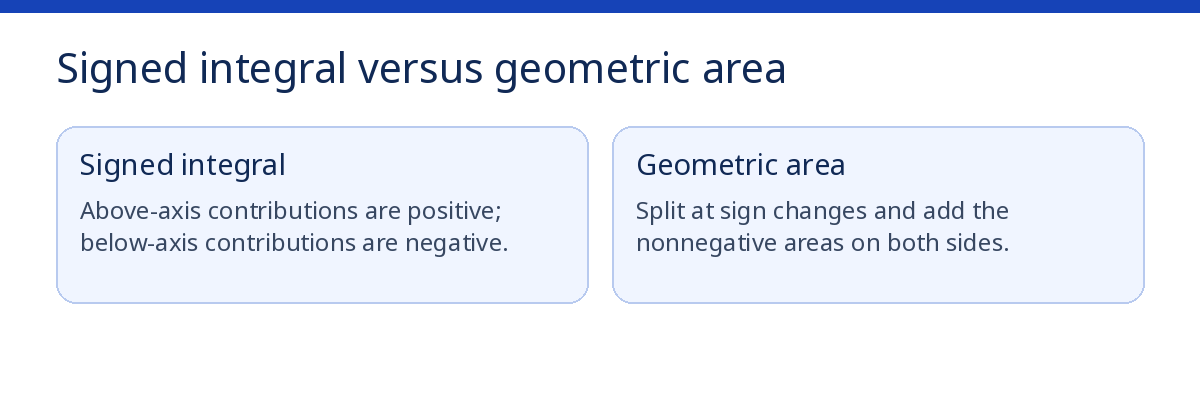
A definite integral can include negative contributions from parts of a graph below the horizontal axis. Geometric area cannot. When finding the area between a curve and the axis, check whether the curve crosses the axis within the interval. If it does, split the interval at the sign changes and add the nonnegative areas rather than letting them cancel.
The circular-region case study adds another distinction: a full circle does not give a single value of for every interior . A sketch helps you distinguish the upper and lower branches and identify the region named in the question before deciding on integration limits.
Vectors and graphs: test the right condition
The vector and three-dimensional geometry questions move between coordinates, displacement vectors and lines. Keep direction explicit when subtracting position vectors: the displacement from one point to another is the destination position minus the starting position. For two nonzero vectors, a zero dot product tests perpendicularity. When investigating whether two lines intersect, however, you need a point that satisfies both line equations. In three dimensions, lines that are not parallel need not intersect.
The linear programming questions include reading a given feasible region and drawing one from inequalities. In the graphical problem, a point is feasible only if it satisfies every constraint. On a nonempty bounded polygonal feasible region, a linear objective attains its maximum and minimum at vertices, though an entire edge can share an optimal value. Identify the feasible region before comparing objective values.
Quick self-check for case-study questions
Section E uses subscription revenue, a prize draw and a circular layout to test how you turn a description into mathematics. In the revenue case, ask what the variable measures and how the fee and subscriber count both depend on it. In the probability case, distinguish an event such as winning at least a stated amount from winning exactly that amount. Before using results from one subpart in another, check that the later question refers to the same event, quantity or region.
Use the worked solutions after your attempt
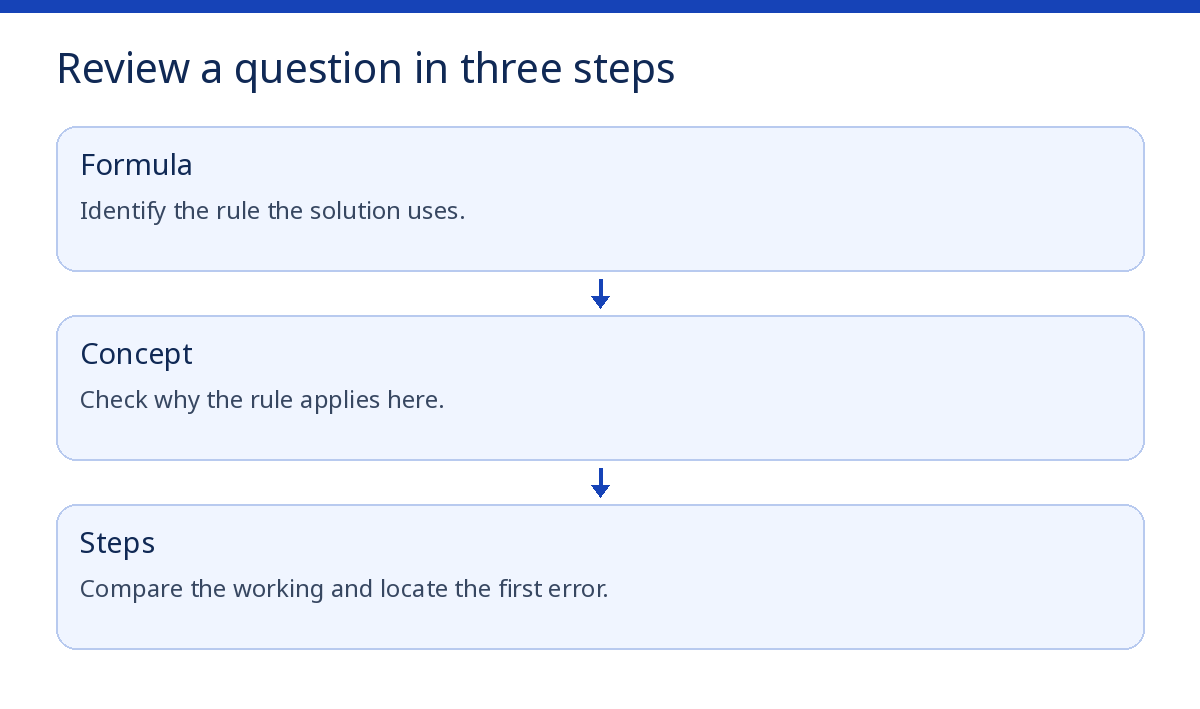
Work from the question-paper pages first, without opening the solution links. Afterwards, use the question-number index to revisit items you skipped or answered without confidence. The worked-solution layout separates the formula, the concept and the steps. Compare those in order: did you choose a rule whose conditions were met, and can you identify the first line where your working took a wrong turn? Then retry the question without the solution in view.
For assertion–reason items, judge the two statements separately before deciding whether the reason explains the assertion. The statements in Questions 19 and 20 are assessment prompts, not reference rules. This guide also leaves out the worked solution to Question 9 because it does not match the printed question.
Spotted an error? Report a correction. Practise this in the app: notes, formula sheets and mind maps.





























































































































































Loading comments…