CBSE Class 12 Mathematics 2025 Paper and Worked Solutions
CBSEMathematics2025 Previous Year Paper
Paper code: 65/4/2 · 2025Use the complete English-language CBSE Class 12 Mathematics 2025 main-examination paper, set 65/4/2, for a three-hour practice attempt. Then use the worked solutions to check not only your answers, but also why each method applies.
This set is one of the year's papers. See every set from 2025, grouped by series.
What this 2025 paper includes
This is a year-wise previous year paper, not a chapter worksheet. It carries a maximum of 80 marks and preserves the original English question layout, answer options and diagrams. The file includes worked solutions for all 38 questions and both printed internal choices. Its question-number index lets you go directly to the solution you need without working through the explanations in order.
The paper brings together topics including functions, continuity, derivatives, integration, differential equations, matrices, determinants, vectors and three-dimensional geometry. That mix is what makes a full-paper attempt useful: there is no chapter heading telling you which technique to use. Part of the practice is recognising the mathematical task from the wording, notation or diagram before you start calculating.

Mathematics 2025 | Class 12 | Previous Year Paper | Code 65/4/2
In the StudentCurio app
The complete CBSE Class 12 Mathematics 2025 paper, set 65/4/2, with worked solutions. It includes questions across multiple syllabus areas, helping students practise the board-paper format and review their problem-solving steps.
Separate the timed attempt from the review
For a board-format rehearsal, keep the worked solutions closed and use the printed three-hour duration. Follow the paper’s instructions for internal choices during the attempt. Afterwards, try any alternative you did not select. This separates two useful skills: deciding which route to take under time pressure and checking whether you can handle the other route without that pressure.
As you work, mark questions where you are unsure of the method, even if you reach an answer. Keep your written reasoning for those questions. On review, distinguish a result you could justify from one you reached by guessing or by applying a familiar rule without checking its conditions. An answer option alone cannot tell you which of those happened.
Read the worked solutions in three passes
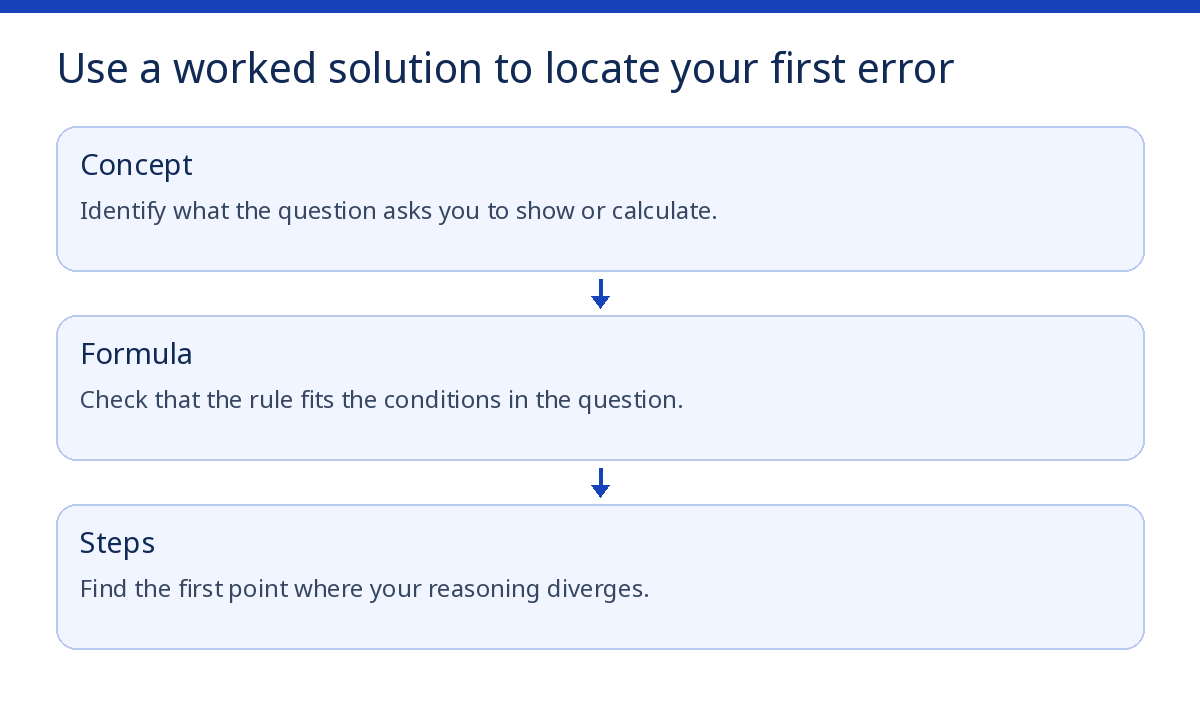
The explanations are organised into Formula used, Concept used and Explanation in steps. Use those labels to diagnose where your reasoning broke down. Start with the concept: did you recognise what had to be shown? Next, read the formula and check that its conditions fit the question. Finally, compare the written steps and locate the first point where your reasoning diverged, rather than copying the whole solution.
A different route is not automatically a mistake. For instance, recognising an integrand as a product derivative and arriving at the same antiderivative by another valid method are both legitimate. What matters is whether your steps justify the result. For an indefinite integral, differentiate your proposed antiderivative to check it and include the arbitrary constant.
Common mix-ups: range, continuity and increase
For an inverse trigonometric function, distinguish the inputs accepted by the inverse from its outputs on the principal branch. The branch matters because the original trigonometric function must be restricted to an interval where it is one-to-one before it can be inverted. Likewise, when testing an ordinary function for surjectivity, check whether it reaches every element of the stated codomain, not just whether you can describe its range.
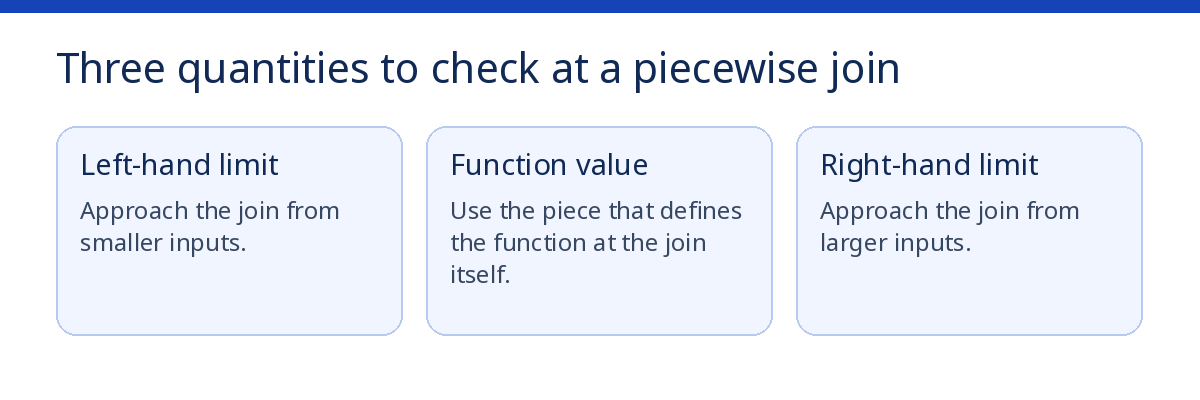
For a piecewise function, continuity of each formula away from the join does not establish continuity at the join. Both one-sided limits must exist, agree and equal the function value there. A derivative sign addresses a different property: a strictly positive derivative throughout the interior of an interval implies strict increase on that interval when the function is continuous there, including at any endpoints.
When a calculus rule applies
For an area under a curve, a definite integral gives the ordinary area between the graph and the horizontal axis over the chosen interval when the function is nonnegative there. If the graph crosses the axis, the integral is signed: contributions below the axis can cancel contributions above it. Decide whether you need signed accumulation or geometric area before interpreting the result.
In a linear differential equation, first put the equation into the form before forming the integrating factor . Work on an interval where the coefficients are continuous. If they contain trigonometric expressions that are undefined at certain points, do not carry a solution across those points merely because the algebraic expression looks usable on both sides.
Quick self-check: turn definitions into tests
In the matrix questions, identify the operation that tests the property. A skew-symmetric matrix satisfies . Over the real numbers, its diagonal entries must therefore be zero, and entries reflected across the diagonal must be negatives of one another. A zero diagonal by itself is not enough. When a step uses associativity, ask whether it only moves brackets: associativity does not permit you to reverse the order of the factors.
For vectors, ask whether the question requires a displacement or its length. In a median problem, first identify the midpoint of the opposite side and form the vector from the vertex to that midpoint. Take the magnitude only if the task calls for a length. This check keeps the geometric construction separate from the numerical calculation.
Use the paper to choose what to revisit
Pick follow-up work based on what you missed, not just on the topic name. If you treated continuity on either side of a join as proof of continuity at the join, retry a piecewise-function question and write down the three quantities you must compare. If you found a correct median vector but stopped before giving its length, practise identifying the requested output before doing any arithmetic. Then retry the original question with the solution closed to see whether the specific mistake is gone.
For clarity, this guide omits the answer statement and option letter for Q5, and does not discuss the disputed premise or intended answer for Q17.
Spotted an error? Report a correction. Practise this in the app: notes, formula sheets and mind maps.





























































































































































Loading comments…