CBSE Class 12 Mathematics 2025 Paper 65/5/2 with Solutions
CBSEMathematics2025 Previous Year Paper
Paper code: 65/5/2 · 2025Practise the full English-language 2025 CBSE Class 12 Mathematics main examination, paper 65/5/2. Use the worked solutions to check not just your results, but also whether you chose a method that fits the question.
This set is one of the year's papers. See every set from 2025, grouped by series.
What this 2025 paper contains
This year-wise resource pairs the original question paper with worked solutions. It preserves the English question layout, options and diagrams, and provides solutions for all 38 questions, including the printed internal choices. The examination allows 3 hours and carries 80 marks. Because the file is organised as a full paper rather than a chapter worksheet, you can see how questions from different topics sit alongside one another and practise changing methods as the paper demands.
The question-number index lets you review an individual item without paging through every solution. Each worked explanation separates the formula used, the concept used and the explanation in steps. That distinction matters: remembering a formula is different from recognising why it applies and carrying out the calculation correctly.

Mathematics 2025 | Class 12 | Previous Year Paper | Code 65/5/2
In the StudentCurio app
Worked solutions for the 2025 CBSE Class 12 Mathematics paper, code 65/5/2, covering questions across calculus, matrices, vectors, probability, linear programming and other topics. Helps students practise board-paper questions and review solution methods.
Use the paper first, then use the explanations
For a timed attempt, work from the question pages for the printed three hours before opening the solutions. Follow the printed choice instructions, and leave enough working to reconstruct your reasoning later. When you are unsure how to begin, note what is holding you up: identifying the topic, translating the wording into mathematics, or deciding which condition to check. That note makes the later review more useful than a record of right and wrong answers alone.
After the attempt, open the worked solution by question number. Read the concept label first and see whether it is enough to restart your work. If you still need help, compare your method with the displayed formula and the steps beneath it. Look for the first point where your reasoning diverged: a misread condition calls for a different fix from a sign slip after a sound setup.
Before differentiating, check what the question asks
The paper uses limits, continuity and differentiation in different roles. To establish continuity at a point, the left- and right-hand limits must agree with each other and with the function value there. If the one-sided limits differ, the function is discontinuous at that point and therefore cannot be differentiable there. The implication does not run backwards: showing continuity alone does not establish differentiability.
Another question asks about the slope of a curve. Here the derivative gives the slope as a function of position, so maximising slope is not the same task as finding the highest point of the original curve. If the answer calls for a point on that curve, distinguish the location found from the slope condition from the height obtained using the original function. In inverse trigonometry, make a similar distinction between finding an angle with the right trigonometric value and checking that it lies in the prescribed principal range.
When an integral measures area
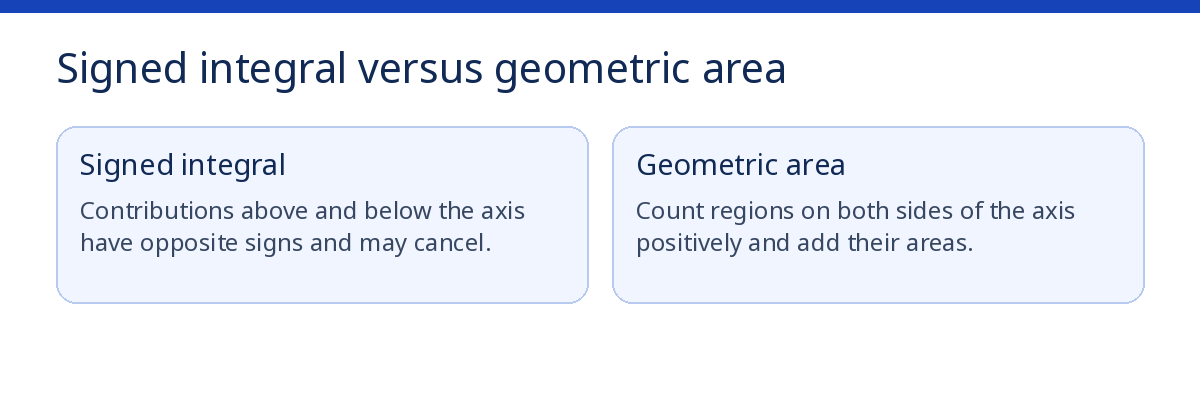
A definite integral gives a signed contribution: wherever the integrand is negative, its contribution is negative. Geometric area between a curve and the horizontal axis counts the region below the axis positively. Use the diagram in Q10 to identify where the sign changes and to see why adding geometric areas differs from simply taking the signed integral across the whole interval. In particular, cancellation in the integral does not mean there is no area.
Q12 illustrates a different decision: recognising that an integrand has an inverse-tangent antiderivative and then using it to evaluate a definite integral. In review, keep the two tasks separate. An indefinite integral describes a family of antiderivatives; a definite integral is evaluated over bounds. This guide discusses Q10 and Q12 by method only, omitting their numerical answers and option letters and not quoting the Q12 formula box.
Common mistakes in matrices and differential equations
Do not transfer scalar cancellation to matrix products. Multiplication distributes, but in general and are different, so terms in a matrix expansion cannot cancel merely because they contain the same two factors. Check the order of each product before simplifying. Likewise, the shortcut of multiplying diagonal entries in the paper's diagonal-matrix example relies on the matrix structure; it is not a determinant rule for an arbitrary square matrix.
For a differential equation, separate order from degree. Order is the order of the highest derivative present. When the equation is polynomial in its derivatives, degree is the power of that highest-order derivative, not the largest exponent anywhere in the expression. For an integrating-factor question, first identify the dependent variable and put the equation in linear form. Work on an interval where its coefficients are defined.
Connect the symbols to events, vectors and regions
The probability question uses inclusion–exclusion: adding two event probabilities counts their intersection twice, so subtracting the intersection once gives the union probability. This rule does not require the events to be independent. When checking your setup, name the event each term represents rather than treating the probabilities as numbers to combine without reference to the events.
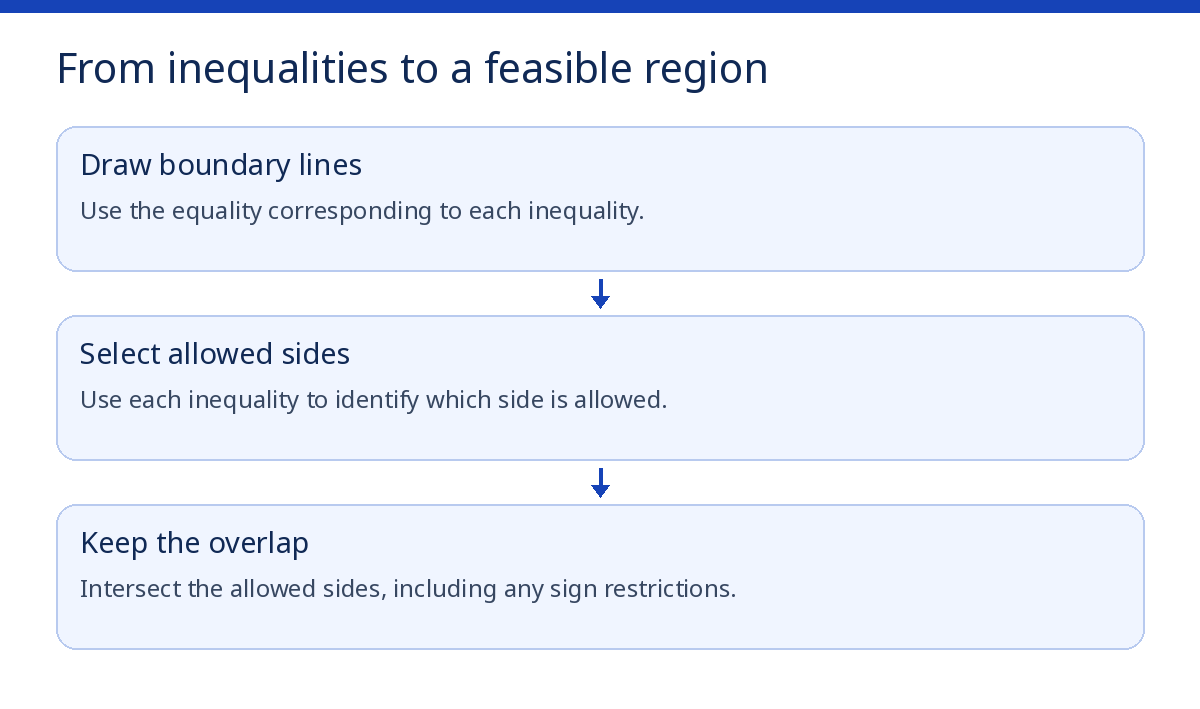
For vectors, the resource distinguishes an endpoint from a displacement: the coordinates of the starting point and the components of the displacement play different roles. In linear programming, the key distinction is between an individual boundary line and the feasible region. Each inequality selects a side of its boundary; the feasible region is the intersection of all the allowed sides, including any restrictions on the signs of the variables. Use the preserved diagram to check that a region satisfies the constraints together, not just one at a time.
Spotted an error? Report a correction. Practise this in the app: notes, formula sheets and mind maps.





























































































































































Loading comments…