CBSE Class 12 Mathematics 2025 Paper With Worked Solutions
CBSEMathematics2025 Previous Year Paper
Paper code: 65/7/3 · 2025Practise the full 2025 CBSE Class 12 Mathematics main examination paper, set 65/7/3, in its original English layout. Then use the worked solutions to see not just which rule was used, but why it applied.
This set is one of the year's papers. See every set from 2025, grouped by series.
What this year-wise paper includes
This file pairs the complete 2025 question paper with worked solutions. The paper is marked out of 80 and has a printed duration of three hours. The original English question layout, options and diagrams are preserved. The cover lists 38 questions and states that the worked solutions cover all of them, including both printed internal choices. A question-number index lets you jump to a specific solution when reviewing your attempt.
This is a year-wise paper, not a chapter exercise. Its value is that the topic changes from question to question: rather than starting with a chapter heading that tells you what method to use, you have to infer the method from the information given. The solution layout separates the formula, the concept and the steps, so you can check those decisions separately.

Mathematics 2025 | Class 12 | Previous Year Paper | Code 65/7/3
In the StudentCurio app
The complete 2025 CBSE Class 12 Mathematics paper, set 65/7/3, with worked solutions across the paper’s syllabus topics. It helps students practise the board-exam format and review solution methods.
Sit the paper before opening the solutions
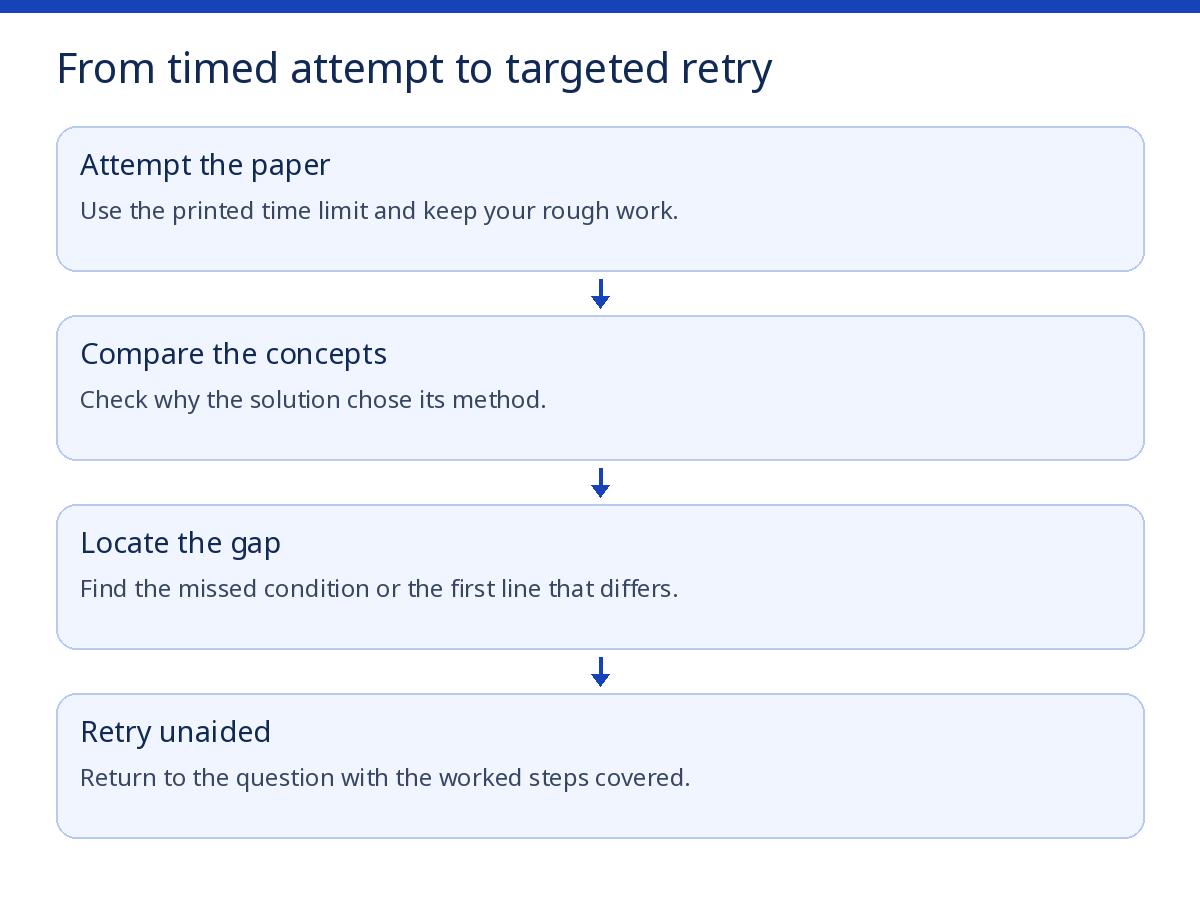
For a full practice attempt, use the printed three-hour limit and work from the question pages. Follow the paper’s instructions for internal choices rather than treating the extra worked alternatives as additional questions to attempt under time. For questions with options, keep enough rough work to tell afterwards whether you selected an option by reasoning, elimination or a guess. Read diagrams and their labels alongside the question text rather than relying on the picture alone.
During review, compare your first step with the solution’s concept used before reading the full explanation. If you chose the right method but still went wrong, the useful comparison is the line where your calculation diverged. If you never found a starting point, identify the clue in the question that should have prompted the method.
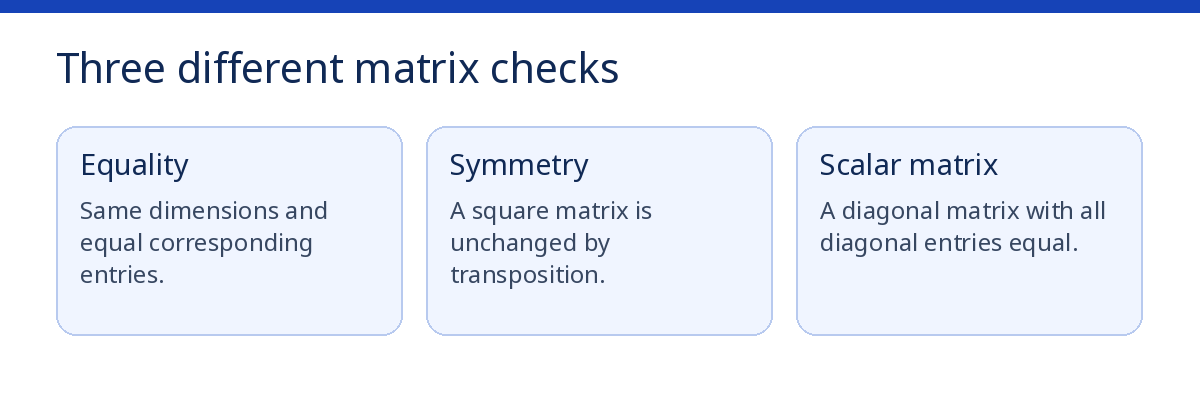
Matrices: identify what the question is testing
The matrix questions are useful for separating tasks that can look similar on the page. Matrix equality is an entry-by-entry statement: the matrices must have the same dimensions, and corresponding entries must agree. Symmetry is a different test: a square matrix is symmetric if . A diagonal matrix is unchanged by transposition, but being diagonal does not by itself make it scalar; for that, all diagonal entries must be equal.
Determinant questions require attention to the order of the matrix. For an matrix, because multiplying the whole matrix by scales every row. This is not the same operation as multiplying just one row by . When comparing methods, check whether you identified the operation before choosing the scalar factor.
Common calculus mistake: losing a condition in the algebra
When a question combines two real-valued functions by addition, an input must be allowed by both functions. The domain of the sum is their intersection, not their union. In integration, a different version of the same oversight can occur when cancelling a common factor: the simplified expression may exist at a point where the original denominator was zero. Cancelling a factor does not restore that point to the original domain. Record restrictions before simplifying, so you know where an antiderivative applies.
For continuity at a point where two branches meet, getting equal left- and right-hand limits is only part of the test. Their common value must also equal the function’s defined value there. When reviewing a continuity attempt, look for all three quantities rather than checking only the two branch calculations.
When calculus rules need an interval or a sign check
The paper includes differentiation in both rate-of-change and increasing-function settings. In a related-rates problem, a quantity such as a length can itself depend on time. Differentiating a formula involving that length with respect to time requires the chain rule. Keeping the units in your working helps distinguish a length per unit time from an area per unit time.
For an increasing-function argument, the sign of a derivative at one input does not establish its sign throughout an interval. A differentiable function with a strictly positive derivative throughout an interval is strictly increasing there. In substitution questions, look for a different kind of sign check: the differential can introduce a minus sign. For a definite integral, if you change variables, the limits must be expressed in the new variable as well.
Vectors and probability: choose the test for the relationship
In vector questions, parallelism and orthogonality ask for different evidence. For nonzero parallel vectors, one vector is a scalar multiple of the other, with the same multiplier for every component. The scalar-multiple test avoids dividing by a component that could be zero. For nonzero perpendicular vectors, the dot product is zero. Use the worked explanations to check whether the property you tested was the one the question actually asked about.
In probability, distinguish multiplying marginal probabilities from using a conditional probability. For independent events, the intersection probability is the product of the individual probabilities. If the calculation uses , the product for the intersection is , with . When a question also gives a union, keep it separate from the intersection: adding the individual probabilities counts the overlap twice.
Quick self-check: name the decision you would change
Pick one attempt where reading the solution changed your understanding. Cover the steps and write the rule you would now choose, the condition that makes it applicable and the first line you would put on the page. For a domain question, can you identify which part of the expression excludes an input? For probability, can you say whether the information describes a union, an intersection or a conditional probability before substituting anything?
Then return to the original question and retry it without the worked steps. If you attempted an internal choice, you can study the other printed alternative afterwards as a separate exercise. Keep that attempt distinct from the timed sitting so your review reflects what you did under the paper’s conditions.
Spotted an error? Report a correction. Practise this in the app: notes, formula sheets and mind maps.





























































































































































Loading comments…