CBSE Class 12 Mathematics 2025 Paper: Set 65/7/2
CBSEMathematics2025 Previous Year Paper
Paper code: 65/7/2 · 2025Use this full 2025 CBSE Class 12 Mathematics paper for a three-hour board-exam practice session. Then use the worked solutions to check not just your answers, but also why each method applies.
This set is one of the year's papers. See every set from 2025, grouped by series.
What the 2025 paper includes
This year-wise resource contains the English version of the 2025 CBSE Class 12 Mathematics main examination, set 65/7/2. The paper carries 80 marks and has a printed duration of three hours. The file preserves the original question layout, options and diagrams, and provides worked solutions for all 38 questions and both printed internal choices. The question-number links let you go directly to the solution you want to review.
Because this is a complete paper rather than a chapter worksheet, part of the practice is deciding which concept a question calls for without being told the topic first. For a timed attempt, follow the paper’s printed instructions and leave the solutions closed. Afterward, use the second solution to an internal choice to practise the alternative you did not attempt.

Mathematics 2025 | Class 12 | Previous Year Paper | Code 65/7/2
In the StudentCurio app
Complete CBSE Class 12 Mathematics paper for 2025, set 65/7/2, with worked solutions covering the syllabus. Helps students practise board-exam questions and review solution methods.
Read function graphs through domain and range
The paper’s early questions include inverse trigonometric graphs and the domain of a sum of functions. When reviewing a graph, read the horizontal coordinates as possible inputs and the vertical coordinates as possible outputs. The endpoints help establish those two sets; whether the graph rises or falls gives a separate clue about its behaviour. This is more reliable than identifying an inverse trigonometric function from the curve’s shape alone.
For a sum of real-valued functions, a candidate input must be allowed by both component functions. The domain is therefore the intersection of their domains, not the union. This distinction matters when one term is defined for every real input but the other has a restricted domain: adding the unrestricted term does not remove the restriction.
Common mistake: treating determinants like matrix entries
The matrix and determinant questions call for different kinds of reasoning. Equality of matrices requires the same dimensions and equality at corresponding positions. Determinant properties, by contrast, concern a single number associated with a square matrix. In particular, multiplying an entire square matrix of order by a scalar multiplies its determinant by the scalar raised to the power : the scalar factors out of each of the rows.
It also helps to distinguish matrix types by their defining conditions. A diagonal matrix is unchanged by transposition and is therefore symmetric. Being diagonal does not by itself make it a scalar matrix: the diagonal entries of a scalar matrix must all be equal. When checking a classification, ask whether the defining condition holds, rather than relying on the arrangement of zeros alone.
Before using a calculus rule, check its conditions
The continuity example in the worked solutions highlights a useful distinction: calculating a limit is not the same as establishing continuity. At the point in question, the limit must equal the defined function value. If a substitution or rearrangement introduces division by a parameter, handle the zero case separately rather than assuming the rearrangement holds there. For a monotonicity argument, check the derivative’s sign across the relevant interval; a positive result at one input is not enough.
The integration examples reward the same attention to conditions. An algebraic cancellation can simplify an integrand without restoring inputs excluded by the original expression. Check logarithm arguments and denominators before simplifying. In a definite integral, keep track of the bounds as well as the differential: reflecting the variable about the interval midpoint exchanges the endpoints and introduces a minus sign, so those changes must be handled together.
Distinguish vector tests from probability checks
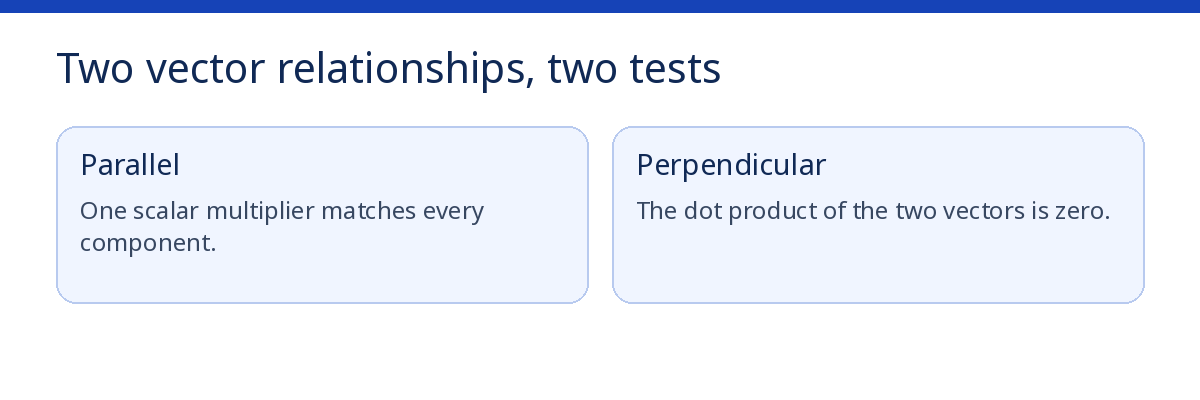
In the vector questions, parallelism and orthogonality call for different tests. For nonzero vectors, parallelism means one vector is a scalar multiple of the other. Check that one multiplier works for every component instead of dividing by a component that might be zero. To check whether two nonzero vectors are perpendicular, use the dot product: it must vanish. When a condition is stated in terms of lengths, expanding squared norms can bring the dot product into view.
In probability, multiplying two marginal probabilities to obtain an intersection requires independence. An intersection also cannot have a greater probability than either event individually, because it is contained in both. The worked solution for Question 17 flags inconsistent printed data. Its numerical result and answer option are omitted here; use the note to understand why a formal calculation still needs a feasibility check.
Use the worked steps to diagnose errors
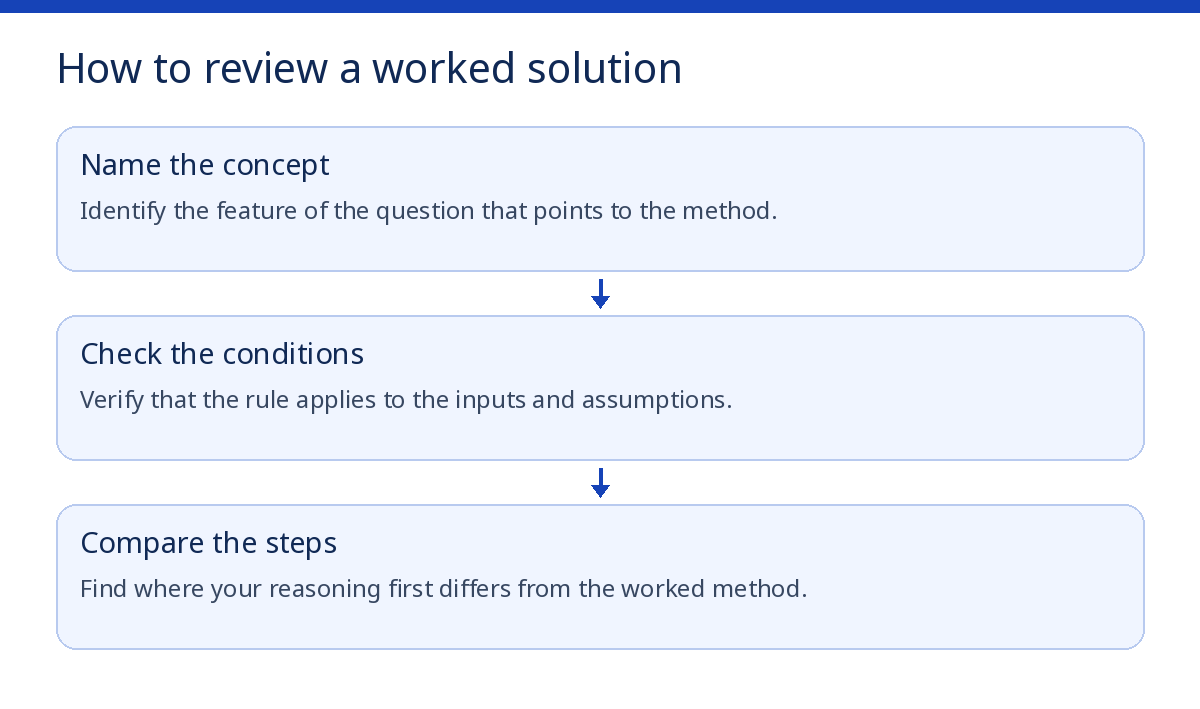
The solutions distinguish the formula used, the concept used and the explanation in steps. Use that structure to locate the first point where your reasoning diverged. If you selected the wrong rule, read the concept note and identify the clue in the question that points to a different method. If you chose the right rule, compare the steps for a missed sign, an unchecked restriction or a mishandled bound.
Revisit questions where you reached the right option by guessing or eliminating choices, not just those you got wrong. With the solution closed, try to write one sentence that justifies your first step and states any condition it needs. That is a useful test of whether you can recognise the same method when it appears in a different form.
Spotted an error? Report a correction. Practise this in the app: notes, formula sheets and mind maps.





























































































































































Loading comments…