CBSE Class 12 Mathematics 2025 Paper With Worked Solutions
CBSEMathematics2025 Previous Year Paper
Paper code: 65/5/3 · 2025Practise with the complete English-language CBSE Class 12 Mathematics 2025 main examination paper, code 65/5/3. Use the worked solutions to check not just your answers, but also why a method applies and whether your working respects its conditions.
This set is one of the year's papers. See every set from 2025, grouped by series.
What this year-wise paper includes
This file presents one complete CBSE board examination, rather than a chapter-wise question bank. The original English question layout, answer options and diagrams are preserved. The paper carries 80 marks and has a three-hour duration. The file includes worked solutions for all 38 questions and both printed internal choices, with a question-number index for finding individual items.
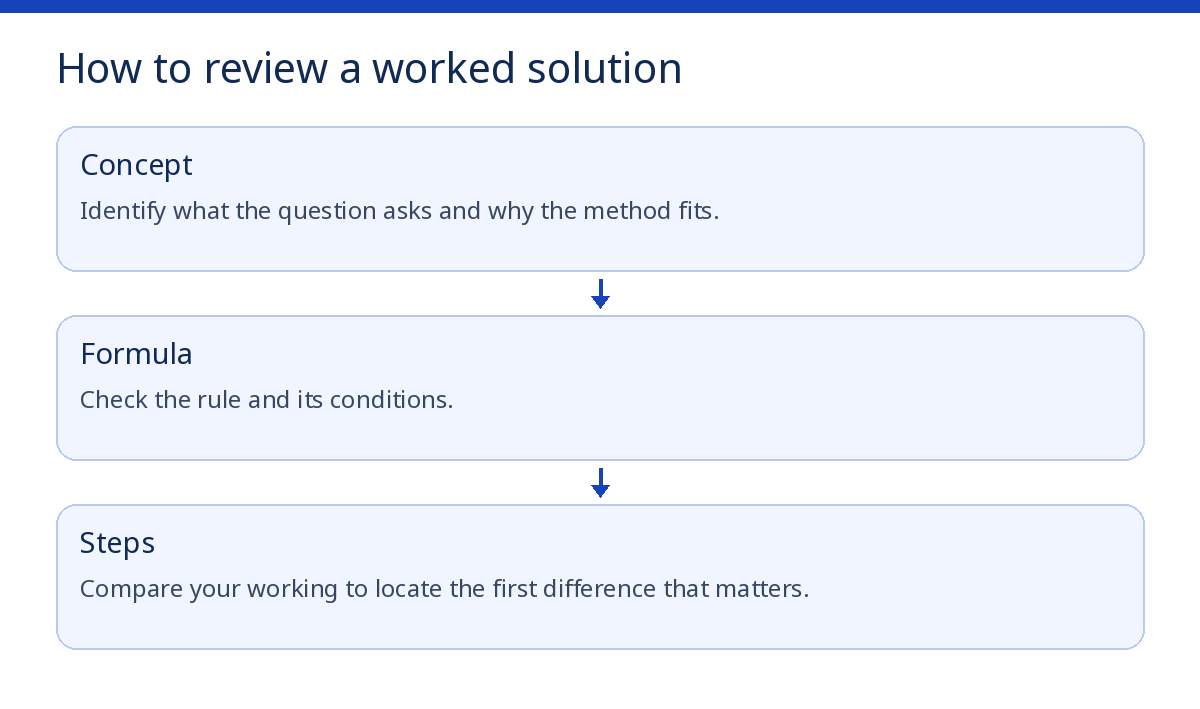
Each worked solution separates the formula used, the concept used and the explanation in steps. These parts answer different questions: what rule was used, why it fits the problem and how it was applied. That distinction is useful when your answer is wrong, but also when you arrive at the correct option without being able to justify it.

Mathematics 2025 | Class 12 | Previous Year Paper | Code 65/5/3
In the StudentCurio app
Complete CBSE Class 12 Mathematics Main Examination 2025 paper, code 65/5/3, with worked solutions. It covers questions across the syllabus, including Bayes’ theorem and optimization using derivatives, and helps students practise the board-exam format.
Attempt the paper before opening the solutions
For a board-format practice attempt, set aside three hours and work from the question pages. Follow the printed directions for internal choices. You can try the alternative branches later as separate practice; completing them during the timed attempt would change the task you are trying to simulate.
When you review, look for the first point where your reasoning went off track. If you did not know how to start, consult the concept label and try again before reading the steps. If your approach was valid but your answer differed, compare the algebra and notation line by line. The question index makes it easy to return to a specific item without rereading the entire paper.
Common mistakes: Matrix order and determinant scaling
The matrix questions give you a chance to distinguish operations on a matrix from operations on its determinant. Multiplying a square matrix of order by a scalar multiplies every row by . The determinant therefore picks up one factor from each row: . By contrast, the determinant of a diagonal matrix is the product of its diagonal entries; it is not their sum.
A different kind of order matters when taking the transpose of a product. For compatible matrices, . Transposing the individual factors is only half the operation: their order must also reverse. As you review, identify which operation the question actually asks for before choosing an identity.
Read the target carefully in derivative questions
The calculus questions use derivatives for different purposes. At an interior point, differentiability implies continuity. If the left-hand and right-hand limits differ, the function is not continuous there, so you can rule out differentiability without computing the derivative. The implication does not run the other way: showing continuity alone does not establish differentiability.
In an optimization question, first name the quantity to be maximized or minimized. If the target is slope, the quantity to optimize is the derivative, not the original function. If the question then asks for a point on the curve, the input found through that optimization determines where to look, but the ordinate comes from the original function. Keeping those two roles separate helps you answer what was asked.
When an integral needs a sign or domain check
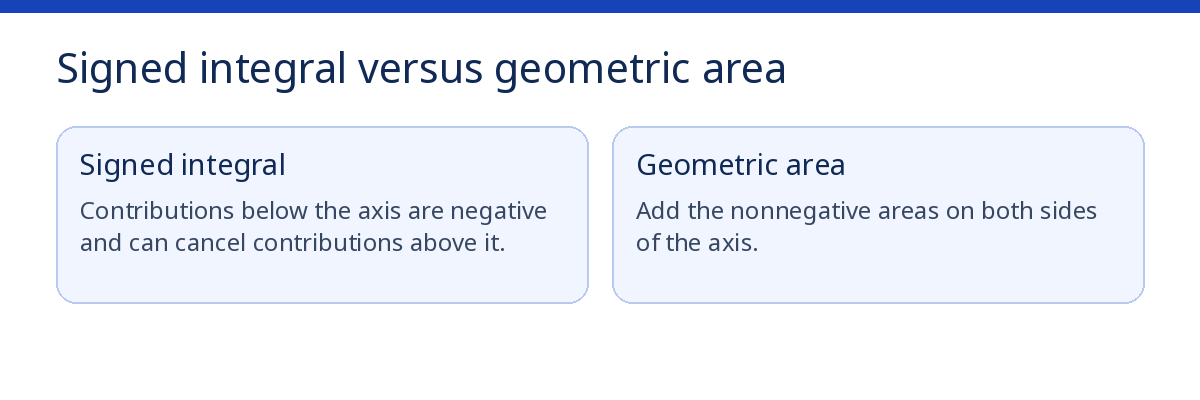
The worked calculus material distinguishes a definite integral from geometric area. A portion of a graph below the horizontal axis contributes negatively to a signed integral, but its geometric area is nonnegative. If the graph changes sign over the interval, split the area calculation at the sign changes rather than letting contributions above and below the axis cancel.
The integration examples also illustrate two checks on algebraic technique. In a definite integral, if you switch to a new variable, express both bounds in that variable before evaluating. When you simplify a quotient by cancelling a common factor, the simplified expression agrees with the original only where the original denominator is nonzero. Cancellation does not make an excluded point part of the original domain. This guide omits the evaluated results and answer-option details for Q9 and Q12.
Good to remember: Probability formulas answer different questions
The paper includes both event-probability relationships and Bayes’ theorem. Inclusion–exclusion gives the probability of a union by adding the individual event probabilities and subtracting the intersection, which would otherwise be counted twice. It does not require the events to be independent.
Bayes’ theorem addresses a different task: it lets you reverse the direction of conditioning. Identify which event is observed and which event the question asks about before writing the calculation. The probability of the event you condition on must be positive for that conditional probability to be defined. Writing the events in words first can help you distinguish the probability of the evidence given an event from the probability of that event given the evidence.
Turn the review into a focused second attempt
The paper also gives you material to review from differential equations, vectors and linear programming. Choose follow-up questions based on where your reasoning broke down, not just which topics felt unfamiliar. For example, when reading a feasible-region diagram, check that the region satisfies all the inequalities, including any non-negativity restrictions. A point satisfying just one constraint is not necessarily feasible.
Return to selected questions with the solution hidden and check whether you can now explain the key decision in your own words. If you relied on an answer option to recognize the result, try reconstructing the reasoning before looking at the options again.
Spotted an error? Report a correction. Practise this in the app: notes, formula sheets and mind maps.





























































































































































Loading comments…