CBSE Class 12 Mathematics 2025 Previous Year Paper
CBSEMathematics2025 Previous Year Paper
Paper code: 65/6/1 · 2025Practise the full 2025 CBSE Class 12 Mathematics main-examination paper, code 65/6/1, under its printed three-hour limit. Then use the worked solutions to check why each method applies, not just whether your final answer matches.
This set is one of the year's papers. See every set from 2025, grouped by series.
What this year-wise paper contains
This is the English version of the 2025 CBSE Class 12 Mathematics board paper, with a maximum of 80 marks. It is organised as one full paper rather than a chapter-wise collection. The file preserves the original question layout, options and diagrams. Its cover lists worked solutions for all 38 questions, including both printed internal choices.
The solution pages separate the formula used, the concept used and the explanation in steps. That separation matters when you review a paper: you might remember the right formula but apply it under the wrong condition, or choose the right method and make a sign error later. The question-number links let you go directly to the solution you want to review after your attempt.

Mathematics 2025 | Class 12 | Previous Year Paper | Code 65/6/1
In the StudentCurio app
Complete CBSE Class 12 Mathematics 2025 board paper with worked solutions, including optimization and probability questions involving Bayes’ theorem. Useful for practising the board-exam paper and reviewing solution methods across syllabus topics.
Matrices and inverse trigonometry: check the conditions first
For a matrix product to exist, the number of columns of the first factor must equal the number of rows of the second. Transposing a matrix swaps its row and column counts, so write the dimensions after taking the transpose and check each stated product separately. For symmetry, the test is . A diagonal matrix can satisfy this test even when its diagonal entries differ; equal diagonal entries are needed for a diagonal matrix to be scalar, not for it to be symmetric.
The inverse-trigonometry material calls for a different kind of check: distinguish an inverse relation from a principal inverse function. Reflecting the full sine graph across gives the inverse relation, with more than one possible angle for some inputs. The principal inverse sine returns one angle in for each input in . Use the principal range to justify an angle rather than relying on its trigonometric value alone.
Calculus: identify what each method needs
The calculus material includes limits, continuity, differentiation, integration, area and differential equations. In a continuity problem, finding a limit is only part of the task: the limit must also agree with the function value at the point. For differentiability, continuity alone is not enough. A graph can be continuous at a corner while its left- and right-hand derivatives differ. When reviewing your work, identify which of these tests the question actually calls for.
The integration solutions illustrate two useful ways to check your reasoning. If you recognise an integrand as a derivative, differentiate your proposed antiderivative to confirm the match on the relevant domain. If an initial value is supplied, use it after integrating to determine the constant. In differential equations, keep order separate from degree: order comes from the highest derivative present, while degree is defined only when the equation can be expressed as a polynomial in its derivatives.
When a corner-point check applies
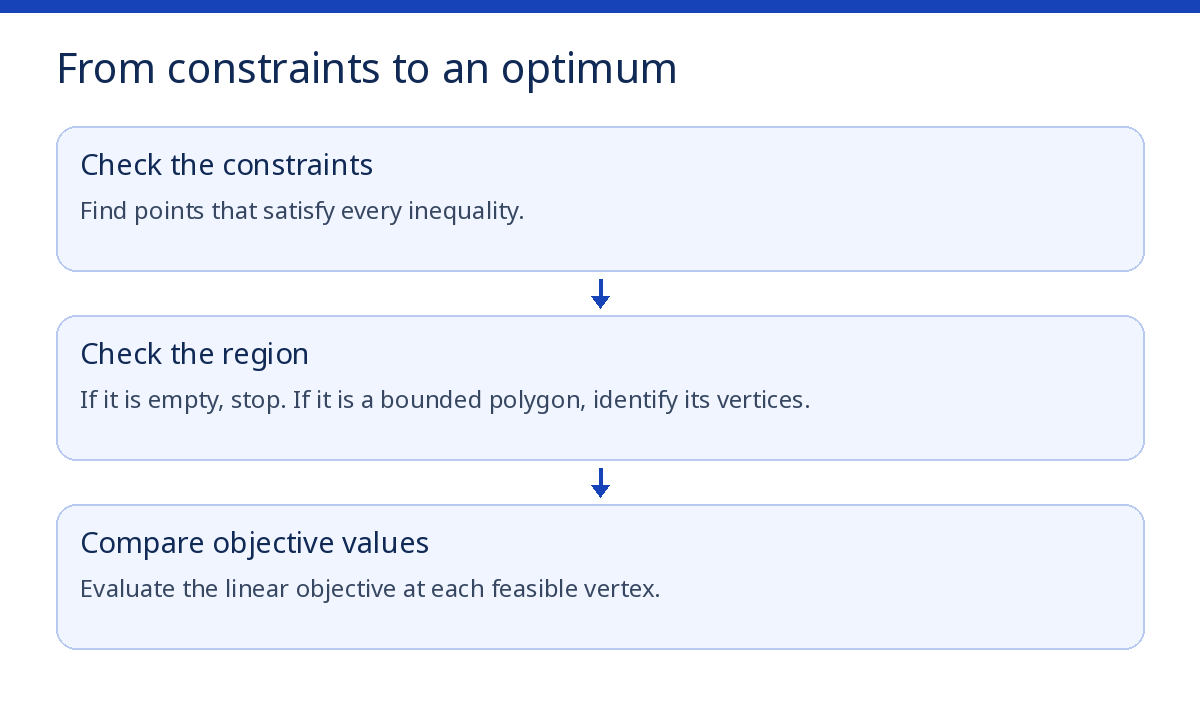
The linear programming questions distinguish feasibility from optimisation. The constraints define the feasible region; the objective function tells you what to maximise or minimise within that region. If the inequalities are incompatible, there is no feasible point and therefore no feasible optimum. Changing how you evaluate the objective cannot fix a contradiction in the constraints.
For a nonempty, bounded polygonal feasible region, a linear objective attains its maximum and minimum at vertices. In that setting, evaluate the objective at each feasible vertex and compare the values. Keep the coordinates and the objective value separate in your working: the coordinates tell you where an optimum occurs, while substitution tells you what the optimum value is.
Probability: distinguish a complement from a conditional event
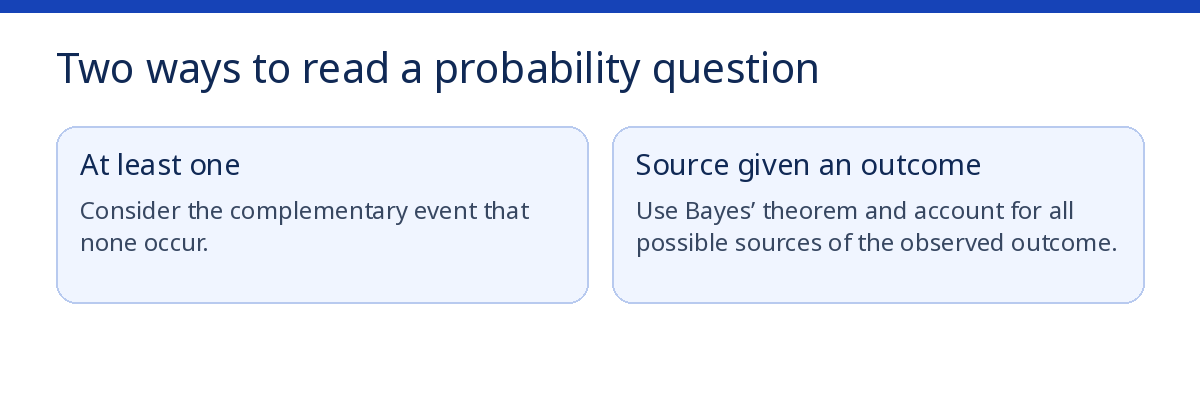
The paper includes repeated draws with replacement and probability involving Bayes’ theorem. For an event phrased as “at least one,” consider its complement, “none,” before listing separate cases. The complement rule itself does not require independence. In the repeated-draw setting shown in the paper, replacement keeps the selection probabilities unchanged from draw to draw, making it valid to multiply the individual probabilities for the complementary event.
Bayes’ theorem addresses a different question: how likely is a possible source or cause given an observed outcome? Label the conditioning event explicitly before substituting. The probability of an outcome given a particular source is not generally the probability of that source given the outcome. When the observation can arise from several mutually exclusive and exhaustive possibilities, its total probability must account for all of them, and it must be positive for the conditional probability to be defined.
Quick self-check after a timed attempt
Attempt the question-paper portion before opening the worked solutions. During review, find the first line at which your reasoning differs from the explanation. Was the rule inappropriate, was a condition left unchecked, or did the calculation go wrong after a valid setup? That distinction gives you a specific step to revisit before trying the question again. You can use the worked internal choices to review alternatives after the timed attempt.
As a check on understanding, ask: could you explain why replacement matters for multiplying probabilities but not for taking a complement? Could you say what must be true of a feasible region before using the bounded-region corner-point test? The vector-magnitude item’s disputed answer options are omitted from this guide; they are not needed to review the independently supported topics above.
Spotted an error? Report a correction. Practise this in the app: notes, formula sheets and mind maps.





























































































































































Loading comments…