CBSE Class 12 Mathematics 2025 Paper: Set 65/7/1
CBSEMathematics2025 Previous Year Paper
Paper code: 65/7/1 · 2025Use the full English-language 2025 CBSE Class 12 Mathematics main examination paper for a three-hour, 80-mark practice attempt. Then use the worked solutions to check why a method applies, not just whether your final answer matches.
This set is one of the year's papers. See every set from 2025, grouped by series.
What’s in the 2025 paper and solution file
This is the year-wise 2025 CBSE Class 12 Mathematics previous year paper, set 65/7/1, rather than a collection arranged by chapter. The file preserves the original English question layout, including options and diagrams. Its cover lists worked solutions for all 38 questions and both printed internal choices. You can use the question-number index to revisit a specific item without having to work back through the paper in order.
The worked entries separate the formula used, the concept used and the explanation in steps. These parts serve different purposes: the formula names the mathematical tool, the concept explains why it fits, and the steps show how it is applied. If an answer matches but your reasoning differs, use those distinctions to check whether your method is valid.

Mathematics 2025 | Class 12 | Previous Year Paper | Code 65/7/1
In the StudentCurio app
Complete CBSE Class 12 Mathematics 2025 examination paper (set 65/7/1), with worked solutions and questions spanning the syllabus. Helps students practise the full board-paper format and review solution methods.
Take the paper before opening the solutions
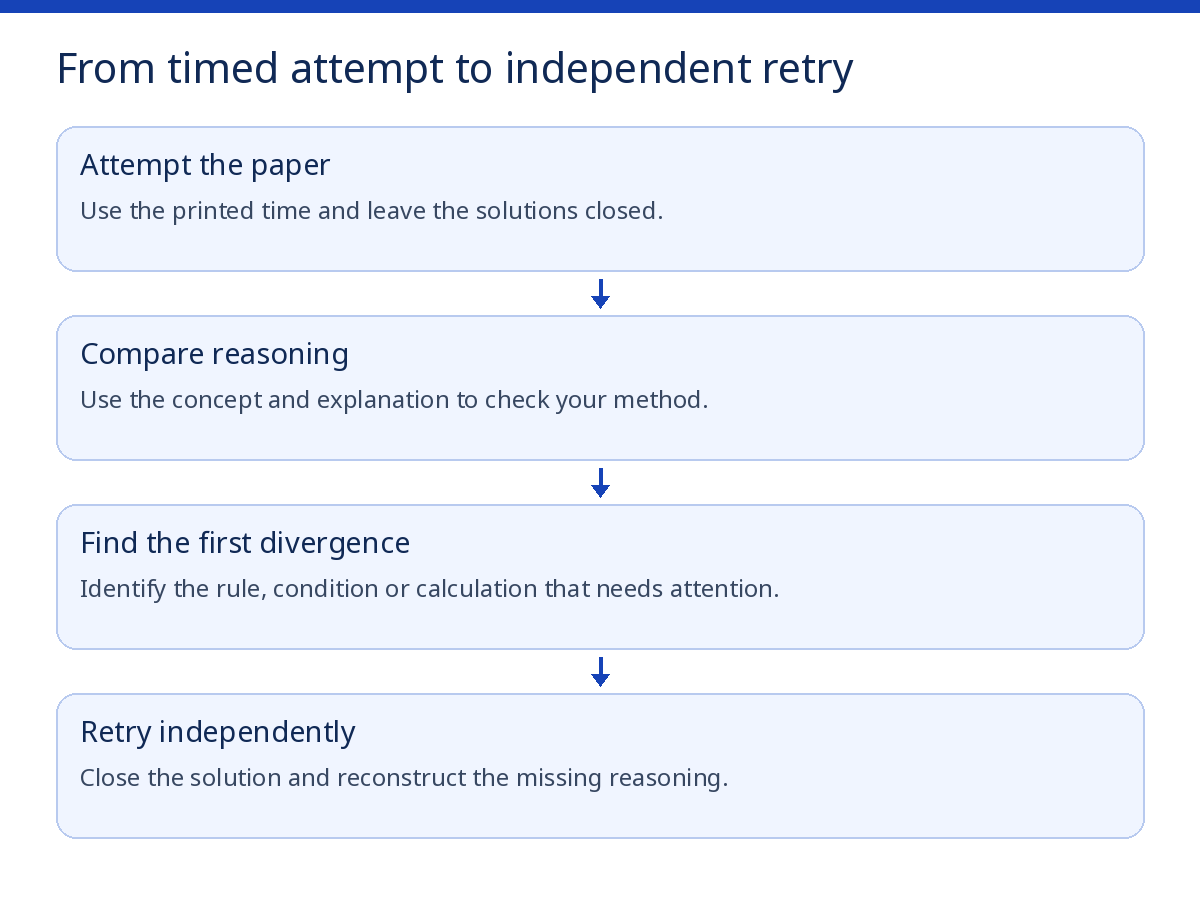
For a board-format practice attempt, set aside the printed time of three hours and work from the question pages. Follow the directions on the paper, including the instructions for internal choices. Save the unattempted alternatives for review so they do not take time away from the first sitting. If an item stalls you, leave enough working to show what you tried before moving on.
Afterward, distinguish between questions you left unfinished and questions you completed using a method you were unsure about. The unfinished work tells you where the time limit affected your attempt. The uncertain work is worth checking even when the final answer agrees with the resource: the key question is whether each step follows from the information given.
Common mix-ups: inverse functions and determinants
The inverse-trigonometry material tests two different skills: recognising a principal-branch graph and deciding which inputs an expression accepts. When you read a graph, separate its domain, the allowed inputs, from its range, the resulting outputs. A horizontal asymptote describes the behaviour of the output; it is not an input boundary. When adding functions, keep only inputs for which both functions are defined.
The matrix and determinant questions call for a different distinction. Transposition checks symmetry, whereas a determinant rule acts on a square matrix. For an matrix, scaling the whole matrix by a scalar contributes a factor of to the determinant. Check the order before choosing the exponent, and do not confuse this rule with the one for the determinant of an adjugate.
In calculus, decide what the derivative must show
The calculus material includes continuity at the joins of a piecewise function, differentiation through an intermediate variable, and monotonicity. For continuity, check each join separately: the left-hand limit and right-hand limit must agree with the function value there. An expression that works at one join need not satisfy the condition at the other.
When a quantity depends on a diameter that itself changes with another variable, the chain rule accounts for both dependencies. Write down which variable the rate is taken with respect to before putting in a particular value. For monotonicity, the question is different: you need information about the sign of the derivative across the interval in question. A positive derivative at one input does not establish that the function is increasing throughout that interval.
Before integrating, keep track of restrictions
The integration material includes algebraic simplification, exponential substitution and reflection of a definite integral about the midpoint of its interval. When simplifying an expression involving a logarithm or a denominator, note the original input restrictions first. Cancelling a factor can give a simpler expression on the permitted domain, but it does not make an excluded input valid in the original integrand.
In an indefinite integral, check that the substituted expression lies in the domain where the standard antiderivative applies, then return to the original variable. For a definite integral, track the limits along with the differential. Under midpoint reflection, the endpoints exchange places and the differential brings in a minus sign. Keeping those changes together helps you avoid introducing an extra negative sign.
Check the relationship before using the formula
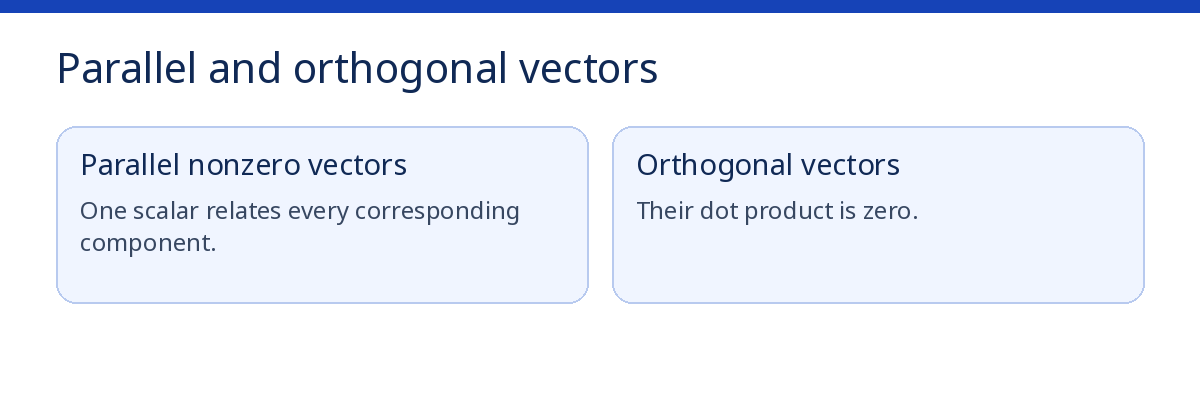
The vector questions distinguish parallelism from orthogonality. For nonzero parallel vectors, one scalar must relate all corresponding components; matching a single pair is not enough. If a component is zero, check the scalar-multiple relation directly rather than dividing by that component. For orthogonality, check whether the dot product is zero.
Probability also rewards checking the relationship first. Multiplication of the two individual probabilities gives the intersection probability when the events are independent, and conditioning requires a conditioning event of positive probability. An intersection cannot be more probable than either event it lies within. The resource flags inconsistent printed data in Question 17. Its numerical calculation and listed option are omitted here; use the item to practise spotting invalid premises, not as a model answer.
Turn the worked steps into a second attempt
For a question you want to revisit, find the first step where your reasoning and the worked method diverge. Identify whether the difference comes from choosing the wrong rule, overlooking a condition or making a calculation error. Then close the solution and redo the item from that point. This tests whether you can recover the method from the question rather than recognise it once it is shown.
Try the internal-choice alternative you skipped before reading its explanation. Compare the alternatives by asking what each requires you to establish before the calculation can begin. That gives you a more useful basis for choosing next time than the visual length of the question or of its finished solution.
Spotted an error? Report a correction. Practise this in the app: notes, formula sheets and mind maps.





























































































































































Loading comments…