CBSE Class 12 Mathematics 2024 Paper with Worked Solutions
CBSEMathematics2024 Previous Year Paper
Paper code: 65/5/2 · 2024Practise the full CBSE Class 12 Mathematics 2024 main examination paper, set 65/5/2, under its original three-hour, 80-mark format. Then use the worked solutions to check which methods you chose, where your reasoning changed course, and which assumptions your answers depended on.
This set is one of the year's papers. See every set from 2024, grouped by series.
What this year-wise paper includes
This is the English version of one complete CBSE Class 12 Mathematics board paper, not a chapter-wise worksheet. It preserves the original question layout, options and diagrams, so you can practise interpreting the paper as presented. The question-number index lets you go straight to a particular solution during review.
The resource includes worked solutions for every question and subpart, including both alternatives wherever the paper prints an OR choice. The solution format separates the formula, the concept and the explanation in steps. That distinction matters: a formula can tell you what operation was used, but the concept explains why it applies to the information given. You can use the two parts of the file separately: the paper for a first attempt and the solutions for a second look.

Mathematics 2024 | Class 12 | Previous Year Paper | Code 65/5/2
In the StudentCurio app
Complete CBSE Class 12 Mathematics 2024 paper (set 65/5/2) with worked solutions, covering a range of board-exam topics. Helps students practise the exam format and review solution methods.
Make the timed attempt useful for revision
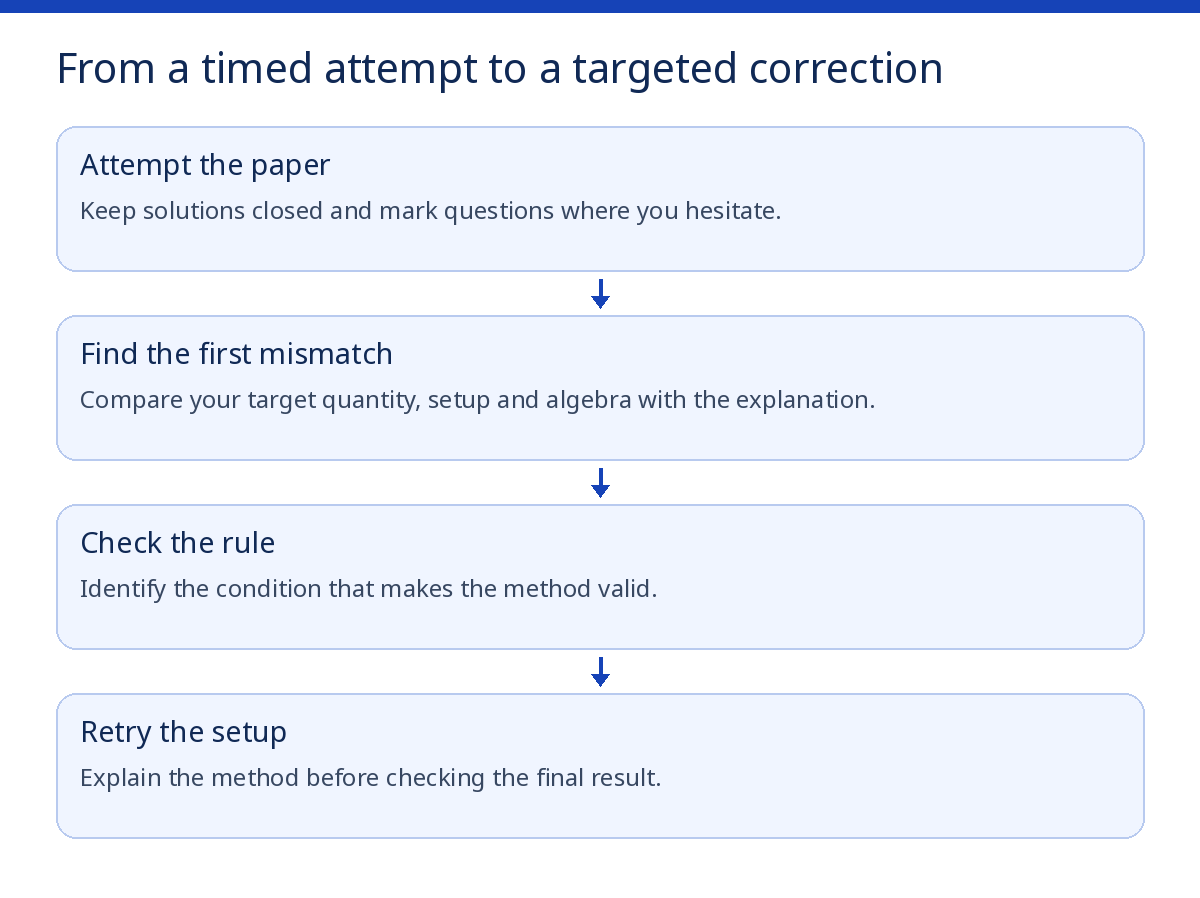
For a full practice sitting, set aside three hours, follow the instructions printed on the paper and leave the solutions closed. When you hesitate, make a brief mark beside the question. After the sitting, that mark will help you distinguish an answer you reached confidently from one you reached by guessing or by trying several methods.
When you review, find the first point of divergence between your work and the explanation. Did you misread what was requested, choose an unsuitable method, or make an algebraic error after a sound setup? Give those errors different follow-up tasks. For a reading error, restate the target quantity; for a method error, identify the clue you missed. Save the unattempted printed alternatives for untimed practice, when you can focus on choosing a method without the clock.
Common mistakes with matrices and determinants
Check dimensions before multiplying matrices. The number of columns of the first matrix must equal the number of rows of the second. The outer dimensions then give the size of the product. If the product is required to be a diagonal matrix, it must also be square. That extra condition is distinct from the condition that makes the multiplication possible.
For determinants, do not treat scaling a matrix as though it were scaling a single number. For a square matrix of order , multiplying the whole matrix by gives , because all rows are scaled. Transposition, by contrast, leaves the determinant unchanged. When checking a solution, identify which operation took place and where the order of the matrix matters.
When derivative rules need a condition
The calculus questions illustrate why identifying the quantity being differentiated matters. If depends on and depends on time, the rate of change of the slope is where the relevant derivatives exist. This is not the rate of change of itself. Before substituting a value, name the quantity whose rate the question requests.
Conditions also matter when one expression is differentiated with respect to another through a common variable. The quotient-of-derivatives method requires a nonzero denominator at the point of use. If cancellation leads to a simpler expression, do not assume it makes the original quotient valid where that denominator is zero. Any extension to such a point needs its own justification.
Read the setup in integration and area questions
The paper includes substitution in integration, area between boundaries and a differential equation treated by separation of variables. These are different setup decisions. In a definite integral, a change of variable also changes the limits if you evaluate in the new variable. Alternatively, return the antiderivative to the original variable before applying the original limits. Do not mix the two approaches.
For an area problem, identify the complete bounded region before writing the integral. With vertical slices, the height is the upper boundary minus the lower boundary on the interval in use. If two branches of a curve bound a slice, using only the upper branch can miss part of the region. In a separable differential equation, the setup to check is different: verify that the variables have been separated before integrating.
Use the given information in functions and geometry
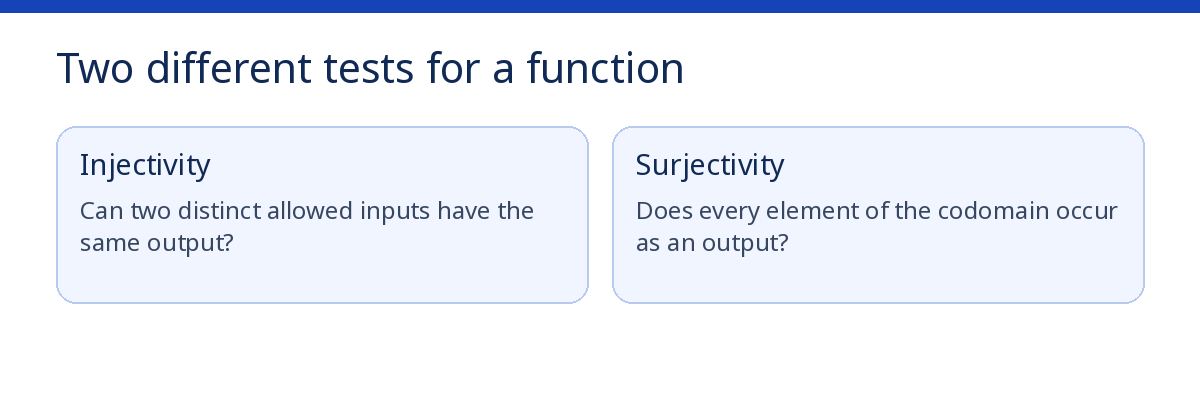
For a function question, separate the test for injectivity from the test for surjectivity. To disprove injectivity, look for two distinct inputs in the domain with the same output. To test surjectivity, compare the range with the stated codomain. Finding a missed output is relevant only if that output belongs to the codomain.
For a line in three-dimensional geometry, distinguish a point on the line from its direction. In vector form, the constant vector locates a point, while the coefficient of the parameter gives a direction. A parallel line through a different point can keep that direction while changing its point vector. For a direction angle, however, preserve the orientation given: the sign of a direction cosine affects the angle in the interval .
Quick self-check: what justifies the conclusion?
Before closing the solutions, pick one answer you changed and explain why the revised reasoning works without referring to the answer option. For conditional probability, for instance, first check that the conditioning event has positive probability. Then ask whether a probability of zero proves that an event is empty, or whether that conclusion needs an extra assumption. In a finite model where every outcome has positive probability, an event of probability zero must be empty; that need not hold in general.
Source note: This guide omits the worked inverse-matrix entry in Q8, where the concept label and the step refer to different entries. It also leaves out the disputed answer choices in Q10 and Q17.
Spotted an error? Report a correction. Practise this in the app: notes, formula sheets and mind maps.





























































































































































Loading comments…