CBSE Class 12 Mathematics 2024 Paper With Worked Solutions
CBSEMathematics2024 Previous Year Paper
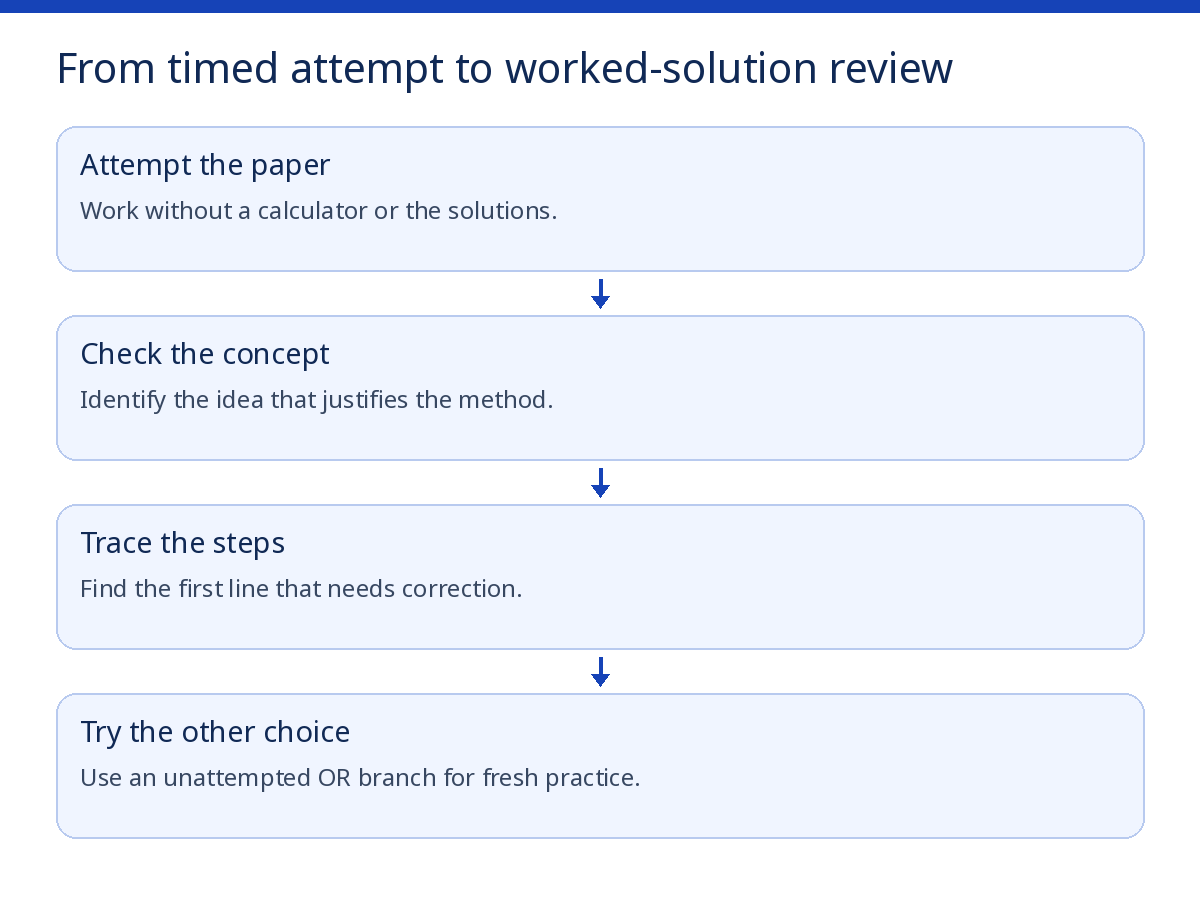
Paper code: 65/3/1 · 2024Use the complete English-language 2024 CBSE Class 12 Mathematics main-examination paper, set 65/3/1, for a timed attempt. Then use the worked solutions to check whether you chose the right method, applied it under the right conditions and justified your steps.
This set is one of the year's papers. See every set from 2024, grouped by series.
What the 2024 paper contains
This is a full year-wise previous paper, not a chapter-wise question bank. The original paper allows 3 hours, carries 80 marks and does not allow calculators. Its 38 questions are arranged in five sections. Section A has 18 multiple-choice questions and two assertion–reason questions, each worth one mark. Sections B, C and D carry two, three and five marks per question, respectively. Section E has three case studies worth four marks each.
There is no overall choice. An internal OR lets you choose between alternatives only where the paper offers one; it does not let you skip the question. For a timed attempt, answer one alternative at each choice point. Keep the other for later practice.

Mathematics 2024 | Class 12 | Previous Year Paper | Code 65/3/1
In the StudentCurio app
The complete 2024 CBSE Class 12 Mathematics paper (set 65/3/1) with worked solutions, covering topics across the syllabus, including matrices, calculus, vectors, probability, linear programming and three-dimensional geometry. Helps students practise a full board-exam paper and review solution methods.
Matrices, relations and functions: start with definitions
The paper tests matrix ideas in several forms: recognising special matrices, working with an adjugate or inverse, and translating the information in a scholarship case study into matrix equations. In that case study, compare your setup with the wording before checking any calculation. Each variable should represent a clearly defined quantity, and each equation should represent a different stated condition. When asked whether a system is consistent, you are checking whether it has at least one solution, not whether you have already found that solution.
The paper also distinguishes functions from relations. For a function, check one-to-one behaviour on the stated domain and onto behaviour against the declared codomain. For an equivalence relation, check reflexivity, symmetry and transitivity before describing an equivalence class.
Calculus: identify what the question asks you to establish
The calculus questions cover continuity, differentiability, rates of change, increasing and decreasing behaviour, optimisation, integration and differential equations. Although several of these tasks use a derivative, they do not ask for the same conclusion. A rate-of-change problem asks how one quantity changes with another; an optimisation problem asks where a quantity reaches an extreme under the stated conditions. Keep the sign and units of a rate visible in your working so that a negative rate is not confused with the positive magnitude of a decrease.
Integration appears both as evaluation and as a way to find a region’s area. In an area question, sketch or identify the boundaries before choosing the limits. If you integrate with respect to , check which curve is above the other on the interval you are using.
Common mistakes at joins, endpoints and denominators
At a join in a piecewise function, continuity requires the two one-sided limits to agree with the function value. To establish differentiability at an interior join, check that the one-sided derivatives exist and agree; continuity alone does not establish that. In a closed-interval extrema problem, do not stop at interior stationary points. For a continuous function, compare the endpoint values with the values at relevant interior points where the derivative is zero or does not exist.
The differential-equation questions give another reason to write down restrictions before doing algebra. When dividing by the coefficient of the derivative to put an equation in standard form, work only where that coefficient is defined and nonzero. Otherwise the division does not preserve the original equation there.
Vectors and linear programming: read the geometry first
The vector and three-dimensional geometry questions move from vector products and direction angles to equations of lines and distances between sides of a parallelogram. Before writing a line equation, separate the data that locate the line from the data that give its direction. A point on a line supplies its position; a nonzero direction vector tells you how it runs. For an external division question, check the order of the named points and do not substitute an internal division rule.
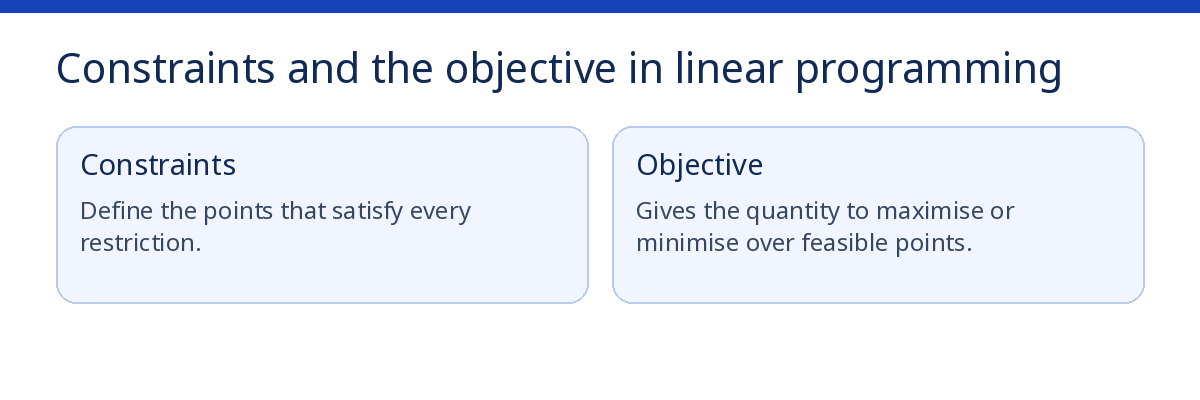
In linear programming, the constraints determine which points are feasible; the objective function determines which feasible points give the desired maximum or minimum. The paper asks you to read inequalities from a shaded region as well as solve an optimisation problem graphically. In both directions, verify which side of each boundary satisfies the inequality and include the nonnegativity restrictions.
Quick self-check: what is the probability conditioned on?
The probability questions include conditional probability, reasoning back from an observed outcome to a possible cause, and a case study built around a discrete probability distribution. Before calculating a conditional probability, name the event you are treating as given. In , the denominator is , which must be positive; reversing the events changes the question and generally changes the probability.
For a discrete distribution, ask a different question: have you listed every possible value with its corresponding probability? If the paper gives probabilities by a piecewise rule, a table lets you check that each value uses the appropriate branch and that the probabilities are nonnegative and sum to one before you use the distribution.
Use the worked solutions to find your first wrong step
Attempt the paper without opening the solutions, then use the question-number links to review your work. The solutions separate formula used, concept used and explanation in steps. Start with the concept: did you recognise the kind of problem correctly? Then check whether the formula applied and identify the first line where your reasoning diverged. That is more useful than comparing final answers alone, especially when a correct setup was followed by an arithmetic error.
The file also provides worked solutions for the printed OR alternatives, so you can attempt the unused branch after reviewing your first pass. This guide leaves out Q13’s worked answer because the printed sign-order choices are ambiguous.
Spotted an error? Report a correction. Practise this in the app: notes, formula sheets and mind maps.





























































































































































Loading comments…