CBSE Class 12 Mathematics 2024 Paper: Set 65/1/3
CBSEMathematics2024 Previous Year Paper
Paper code: 65/1/3 · 2024Practise with the full English-language CBSE Class 12 Mathematics 2024 main examination paper, set 65/1/3. The year-wise file pairs the original questions with worked solutions so you can attempt the paper under exam conditions and then check where your reasoning needs work.
This set is one of the year's papers. See every set from 2024, grouped by series.
How the 80-mark paper is organised
This is a three-hour, 80-mark paper with 38 questions across Sections A–E. Section A contains Questions 1–18 as multiple-choice questions and Questions 19–20 as assertion–reason questions, all worth 1 mark each. Sections B, C and D contain very short-answer, short-answer and long-answer questions worth 2, 3 and 5 marks per question, respectively. Section E contains three case studies worth 4 marks each.
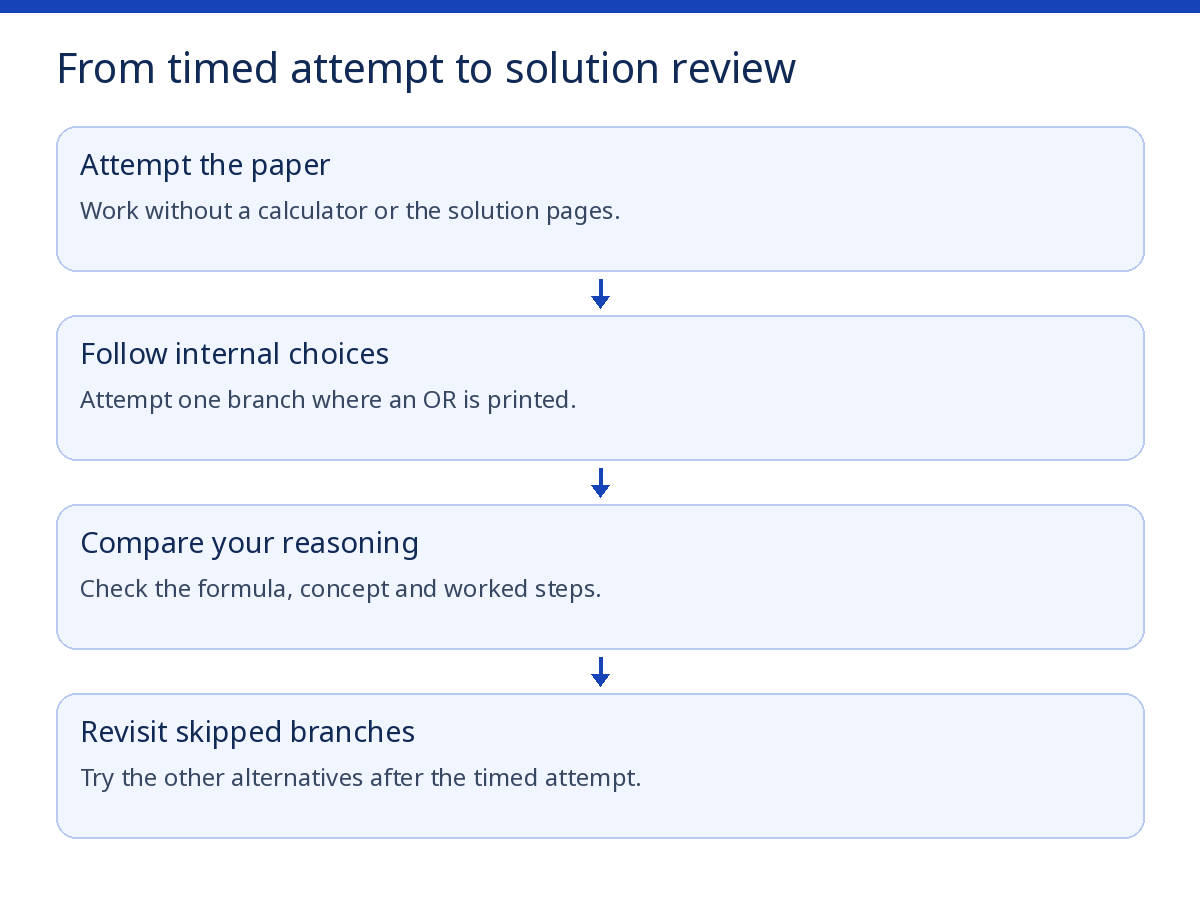
There is no overall choice: all numbered questions are compulsory, but some contain an internal choice. The printed instructions specify choices in two questions in Section B, three in Section C, two in Section D and two in Section E. In a timed attempt, answer only the required alternative where an OR appears. Calculators are not allowed.

Mathematics 2024 | Class 12 | Previous Year Paper | Code 65/1/3
In the StudentCurio app
Complete CBSE Class 12 Mathematics 2024 examination paper, set 65/1/3, with worked solutions across multiple-choice, short-answer, long-answer and case-study sections. It covers topics including relations and functions, matrices, calculus, vectors, three-dimensional geometry, probability and linear programming.
What this set tests across the syllabus
Use the paper as a full-year practice resource, not as a chapter worksheet. Its calculus questions ask you to do different kinds of work: check differentiability, use derivatives to investigate local extrema, evaluate integrals, solve differential equations and interpret an integral as an area. Reviewing them together helps you distinguish between finding a derivative, using it to justify a conclusion and working backwards from an equation involving a derivative.
The algebra questions include matrix operations, determinants, an inverse-matrix approach to simultaneous equations, and tests of relation and function properties. Vector and three-dimensional geometry questions move between components, direction and geometric quantities. The paper also includes graphical linear programming and probability. When reviewing, label questions by the decision they require, not just the chapter: for example, testing whether a relation is transitive is a different task from checking whether a function is onto.
Common mistakes: overlooking a rule’s conditions
In calculus, separate the rule from the conditions that let you use it. For a parametric derivative, the quotient of the parameter derivatives requires the derivative of the horizontal coordinate with respect to the parameter to be nonzero at the point considered. For a piecewise function, a formula valid on either side of a join does not settle what happens at the join. Check the function value against the limit before claiming continuity there; differentiability requires continuity, but continuity alone does not establish differentiability.
The same habit matters in algebra and probability. In a matrix product, check that the inner dimensions agree after any transposes, and use the outer dimensions for the product’s order. For conditional probability, first check that the event being conditioned on has positive probability.
A useful connection: sketches and algebra
Several questions make more sense when you connect an expression to a picture. In graphical linear programming, the constraints define the feasible region; the objective is the separate linear expression to be optimised over that region. A point on a boundary line is not automatically feasible: it must also satisfy every other constraint. An unbounded feasible region can still have corner points, so do not confuse the shape of the region with the absence of vertices.
For an area question, a sketch helps you distinguish the whole curve from the portion specified by the boundaries. In vector geometry, a diagram can serve a different purpose: mark the initial and terminal points before performing subtraction. Reversing that order changes the direction of the vector even though its length is unchanged.
Reading the three case studies
The case studies connect inverse sine, related rates and conditional probability to three different setups. In the inverse-sine case, distinguish the input domain of the inverse from its output branch. The original sine function must be restricted to a domain on which it is one-one and onto the chosen codomain before that inverse is defined.
In the camera case, distinguish how the angle changes with distance from how it changes with time. The quantities have different units, and the motion of the car connects the two rates through the chain rule. In the turbulence case, distinguish the probability of a delay given a turbulence category from the probability of that category given a delay. Underline the event that is already known before deciding which probabilities the subpart requires.
Using the worked solutions after your attempt
The file opens with a question-number index, and its worked solutions separate the formula used, the concept used and the explanation in steps. First attempt the paper without opening those pages. In Section A, jot down the reason for each choice; for assertion–reason questions, check the two statements separately before deciding whether the reason explains the assertion. In the longer sections, keep your setup visible so you can compare it with the worked method.
On review, look for the first point where your reasoning diverged. If your calculation was sound but the starting equation was wrong, revise the setup rather than repeating the arithmetic. The file provides worked solutions for both printed OR alternatives, so you can revisit the branch you skipped after the timed attempt. This guide omits the final answers and option letters for Questions 2, 9 and 13.
Spotted an error? Report a correction. Practise this in the app: notes, formula sheets and mind maps.





























































































































































Loading comments…