CBSE Class 12 Mathematics 2024 Paper: Set 65(B)
CBSEMathematics2024 Previous Year Paper
Paper code: 65(B) · 2024Practise with the full English-language CBSE Class 12 Mathematics 2024 paper, Set 65(B), presented as an adapted main-examination paper with worked solutions. Use it for a three-hour board-exam practice session, then review where your reasoning, calculations or interpretation need attention.
This set is one of the year's papers. See every set from 2024, grouped by series.
Know the five-section paper before you start
The paper has 38 questions, carries 80 marks and allows three hours. Calculators are not permitted. Section A has 18 multiple-choice questions and two assertion–reason questions, all worth one mark each. Section B has five very short-answer questions worth two marks each; Section C has six short-answer questions worth three marks each. Section D has four long-answer questions worth five marks each, and Section E has three case-study questions worth four marks each.
There is no overall choice: you cannot skip one question in favour of another elsewhere in the paper. Internal choices occur in two questions in Section B, three in Section C, two in Section D and two in Section E. In a timed attempt, answer only one alternative where an OR is printed.

Mathematics 2024 | Class 12 | Previous Year Paper | Code 65(B)
In the StudentCurio app
A complete CBSE Class 12 Mathematics 2024 paper (Set 65(B)) with worked solutions, covering questions across multiple syllabus chapters. It helps students practise board-exam questions and review solution methods.
Algebra: distinguish operations from proofs
The matrix and determinant questions ask you to recognise matrix properties, manipulate determinants and work with matrix equations. The long-answer system of linear equations asks you to use matrices, so completing the calculations is only part of the task: your written work should make clear how the matrix equation represents the original system. When an unknown matrix is multiplied on the left by an invertible coefficient matrix, multiply on the left by its inverse to isolate the unknown. The order matters because matrix multiplication is not generally commutative.
The relations and functions question calls for a different kind of reasoning. To prove an equivalence relation, verify reflexivity, symmetry and transitivity. To prove a function is one-to-one and onto, check those properties separately, keeping the stated domain and codomain in view.
Good to remember: domain checks in calculus
The calculus questions include inverse trigonometric functions, continuity, differentiation, increasing and decreasing intervals, optimisation, integration and differential equations. These topics often require a decision before any calculation. For a real-valued inverse cosine, the input must lie in ; finding the domain means identifying the original inputs that make this true. Evaluating an inverse trigonometric expression, by contrast, requires the principal-value convention, not just any angle with the right trigonometric ratio.
In a separable differential equation, check what happens when the factor you plan to divide by is zero. A constant solution can disappear during division and must be tested separately in the original equation. For a particular solution, use the given condition to determine the constant rather than stopping at the general family.
Choose the right tool for geometry and optimisation
In the vector and three-dimensional geometry questions, start by identifying the object you need: a direction vector, a scalar projection, an angle, a perpendicular vector or a distance. A scalar projection uses a dot product with a unit vector in the specified direction. A cross product gives a vector perpendicular to both input vectors, but it cannot give a nonzero perpendicular direction if those vectors are parallel. When reading a line equation, rewrite it using a common parameter if a reversed coordinate expression makes the sign of a direction ratio unclear.
Linear programming uses a different geometric idea. The constraints determine the feasible region, and the objective function supplies the value to compare. A strict inequality excludes its boundary line; for a closed, bounded polygonal feasible region, comparing objective values at the vertices gives the minimum and maximum values.
Case studies: turn each prompt into a mathematical task
The plant-growth case study gives a model for height and asks separately about growth rate, the time of maximum height and the maximum height itself. Keep those quantities distinct: the rate comes from the derivative, the time is an input to the model, and the height is an output. In the cricket case study, the coordinates define directions in space; finding direction ratios is not the same as normalising a vector to unit length.
The probability case study distinguishes all, none, exactly one and exactly two successes. Before multiplying probabilities for individual outcomes, check that independence is given or state when the calculation relies on it. For an exact-count event, identify the mutually exclusive patterns that qualify before adding their probabilities.
Quick self-check: can you justify your first step?
For an assertion–reason item, decide whether each statement is true before asking whether the reason explains the assertion. A reason can be true without explaining the assertion. For a longer problem, try stating why your first step is valid in a single sentence. If you are integrating an absolute-value expression, for instance, can you explain where its argument changes sign and whether that point lies inside the integration interval?
Use the same check on an area problem: have you found the geometric area or only a signed integral? They coincide when the integrand represents a nonnegative height throughout the interval. If a curve crosses the axis, splitting the interval at the crossing helps you account for the area on each side.
Use the worked solutions after a timed attempt
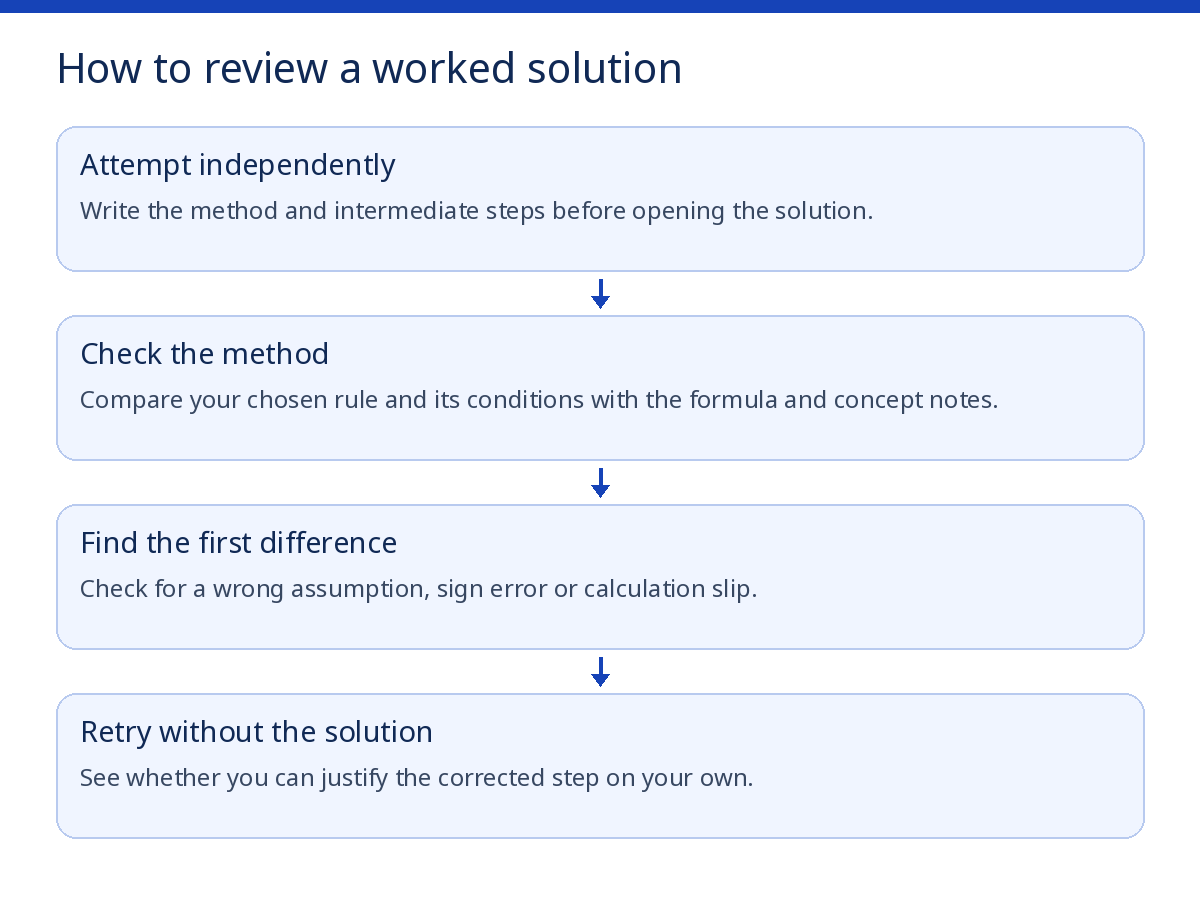
Attempt the question paper first without opening the linked solutions. Then use the question-number links to compare your work with the formula used, concept used and explanation in steps. Look for the first point where your reasoning diverges, not just a mismatch in the final answer. A wrong direction sign calls for a different correction from choosing the wrong vector operation; a missed domain restriction calls for a different correction from an algebra slip.
After reviewing your attempted choices, try an unused OR alternative on its own. This lets you practise the other method without treating both alternatives as required under exam conditions. This guide omits the continuity MCQ's worked result and answer options because the resource flags a mismatch between the printed expression and the listed choices.
Spotted an error? Report a correction. Practise this in the app: notes, formula sheets and mind maps.





























































































































































Loading comments…