CBSE Class 12 Mathematics 2024 Solved Paper (65/4/2)
CBSEMathematics2024 Previous Year Paper
Paper code: 65/4/2 · 2024Use this full CBSE Class 12 Mathematics main-examination paper to practise the 2024 board format. Then use the linked worked solutions to check where you chose a method, applied a condition or made a calculation error.
This set is one of the year's papers. See every set from 2024, grouped by series.
How the 2024 paper is organised
This English-version paper, set 65/4/2, carries 80 marks and allows three hours, without a calculator. It is a full year-wise paper, not a chapter worksheet. Its 38 questions are arranged in five sections, so a single sitting tests how you move between topics as well as how you handle different answer formats.
- Section A: 18 multiple-choice questions and two assertion–reason questions, worth one mark each.
- Sections B, C and D: Very short, short and long answers, worth two, three and five marks per question, respectively.
- Section E: Three case-study questions, worth four marks each.
There is no overall choice. Where the paper prints an OR, choose one alternative for a timed attempt. The worked-solutions file covers both alternatives, so you can try the unused one during review without changing the conditions of your first sitting.

Mathematics 2024 | Class 12 | Previous Year Paper | Code 65/4/2
In the StudentCurio app
A solved CBSE Class 12 Mathematics paper from 2024, with questions spanning the syllabus, including calculus, vectors, probability, matrices and linear programming. It helps students practise the board-exam format and review solution methods.
Where calculus changes the task
The calculus questions ask you to do more than differentiate or integrate an expression. A piecewise function asks whether its rules fit together continuously. A related-rates problem links the volume and surface area of a cube through a changing edge length. A revenue case study gives a demand function and asks you to build and maximise revenue, then verify the result. In each setting, it helps to identify what the calculation is meant to establish before choosing a procedure.
Good to remember: If the separate branches are continuous on their own intervals, the join is where the one-sided limits must agree with the function value. And when an integration question asks for geometric area, check where the curve lies relative to the axis. A definite integral counts contributions below the axis negatively; geometric area does not.
What to check before using an algebraic shortcut
The matrices and determinants questions range from recognising a scalar matrix to using matrix products with a system of linear equations. When reviewing a determinant expansion, check whether the entries and cofactors come from the same row. Using entries from a different row changes what the expression represents. For an inverse method, check that the square matrix you intend to invert is nonsingular; the fact that a system has been written in matrix form does not by itself justify taking an inverse.
The paper also tests relations, functions and inverse trigonometry. One-one concerns whether distinct inputs can share an output; onto concerns whether every element of the stated codomain is reached. For inverse trigonometric simplification, keep both the given input interval and the principal-value range in view. A trigonometric identity alone does not tell you which angle the inverse function returns.
From coordinates to directions in three dimensions
The vectors and three-dimensional geometry questions move between line equations, direction vectors and distances. The star-position case study gives position vectors from a common origin, then asks about relationships between the points. Read the endpoint order carefully: the displacement from one point to another is the destination position vector minus the starting position vector. Reversing that order leaves the distance unchanged, but reverses the direction.
Common mix-up: a point on a line is not its direction. For a perpendicularity test, take the dot product of the two nonzero direction vectors, not the vectors locating points on the lines. When finding a unit vector in a specified direction, divide a nonzero displacement by its magnitude. That preserves its direction while changing its length to one.
Probability and linear programming: set up before calculating
The probability questions use several kinds of information: a table for a discrete random variable, evidence from a card draw and an interview case study with independent selection events. A discrete probability distribution needs nonnegative probabilities that sum to one. In a conditional probability question, identify the event after the conditioning bar first and check that it has positive probability. In the interview case, distinguish at least one from exactly one before calculating; they describe different sets of outcomes.
In graphical linear programming, the constraints determine which points are feasible, while the objective function tells you how to compare them. On a nonempty, closed and bounded feasible polygon, a linear objective attains an optimum at a vertex. That does not mean only vertices can be optimal: if two adjacent vertices have the same optimal value, the edge between them shares it.
Use the worked solutions to locate your first error
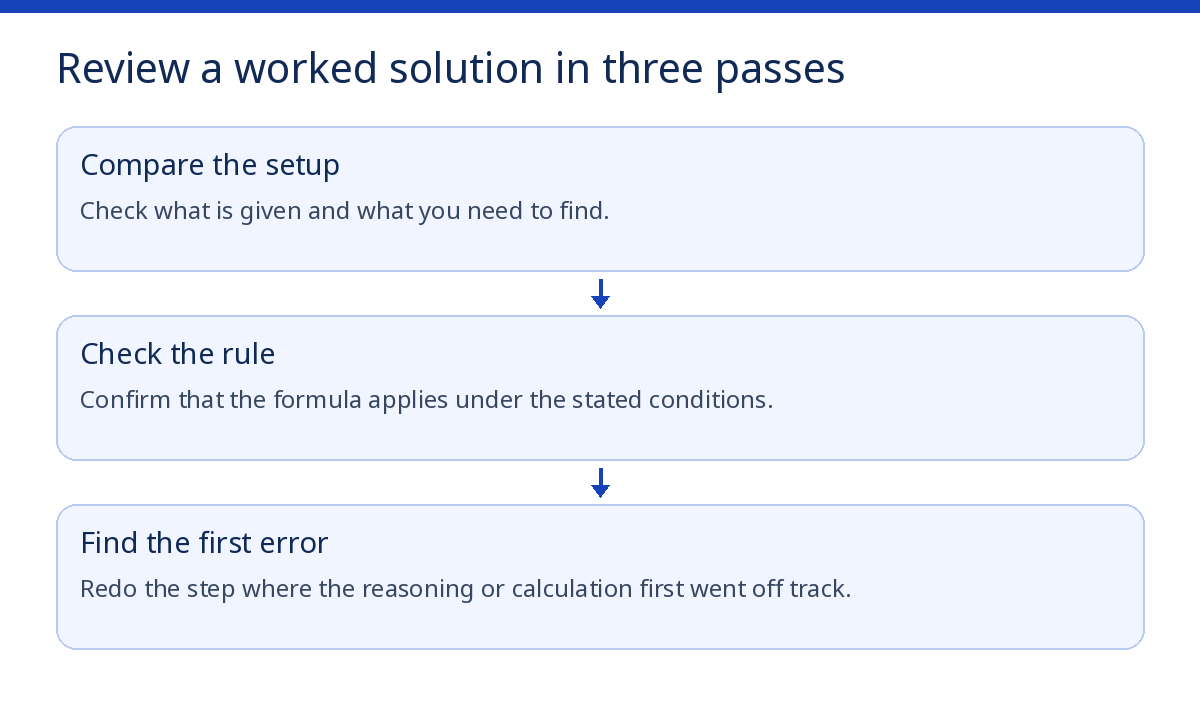
Start from the question pages and leave the solution links unopened during your attempt. Afterwards, jump to the relevant question number. The worked pages separate Formula used, Concept used and Explanation in steps. Compare the setup before the final answer: did you choose a rule that applies, preserve the domain and signs, and carry out the algebra correctly? For an assertion–reason question, judge each statement on its own before deciding whether the reason explains the assertion.
Before you move on: For a missed question, identify the first line you would change and explain why. Then redo the question or try its unused OR branch if it has one. This guide leaves out the option verdict on the strict-increase item, the verdict on the corner-point assertion–reason item and the worked treatment of the biased-die alternative, where wording or assumptions need care.
Spotted an error? Report a correction. Practise this in the app: notes, formula sheets and mind maps.





























































































































































Loading comments…