CBSE Class 12 Mathematics 2024 Solved Paper 65/5/1
CBSEMathematics2024 Previous Year Paper
Paper code: 65/5/1 · 2024Practise the full English version of the 2024 CBSE Class 12 Mathematics main-examination paper, then use the worked solutions to check why each method applies, not just whether your final answer matches.
This set is one of the year's papers. See every set from 2024, grouped by series.
What this year-wise paper contains
This resource presents the full 2024 paper for set 65/5/1, with a printed time of 3 hours and a maximum of 80 marks. It preserves the English question layout, options and diagrams. The worked-solutions file covers every question and subpart, including both alternatives wherever an OR choice is printed. This is a year-wise board paper, not a chapter worksheet: you have to recognise the topic and choose a method from the question itself.
The question-number index gives you a way to return to a specific item during review. The solution entries separate the formula used, concept used and explanation in steps, so you can find the part of the reasoning you need without treating the final answer as the entire check.

Mathematics 2024 | Class 12 | Previous Year Paper | Code 65/5/1
In the StudentCurio app
Complete solved CBSE Class 12 Mathematics paper 65/5/1 from 2024, with worked solutions including questions on applications of derivatives and probability. Helps students practise the board-exam format and review solution methods.
Attempt the paper before reading the solutions
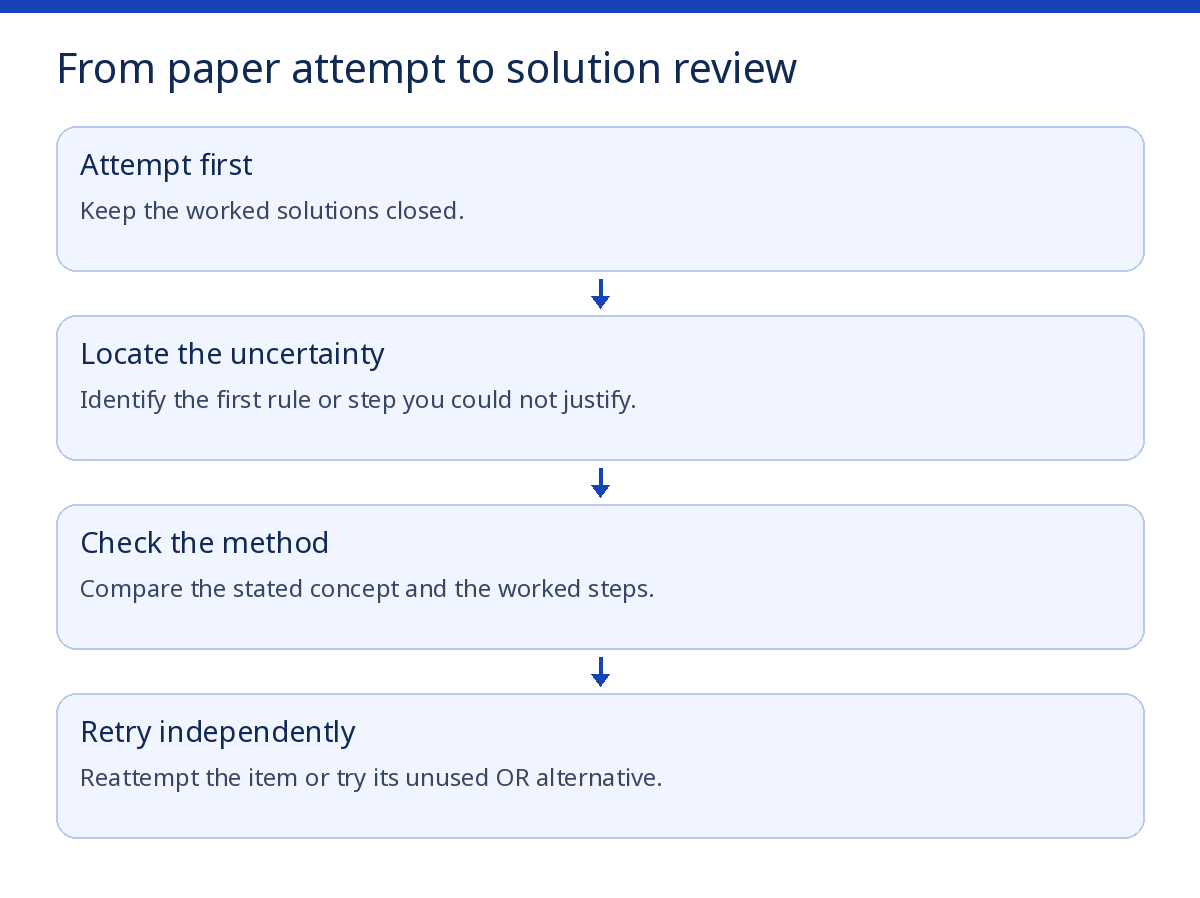
For a timed attempt, use the printed three-hour limit and follow the instructions on the question paper. Keep the worked solutions closed. For a shorter sitting, attempt a group of questions from the paper in order rather than selecting only familiar topics. That preserves some of the practice in switching between methods, even when you are not simulating the full exam.
Afterwards, revisit questions where you hesitated, including ones you eventually got right. Identify the first decision you were unsure about: what the question was asking for, which rule applied, or how to carry out the calculation. Use the printed OR alternative you did not attempt as a fresh question later. Try it independently before opening its worked solution.
Functions and matrices: check what the definition requires
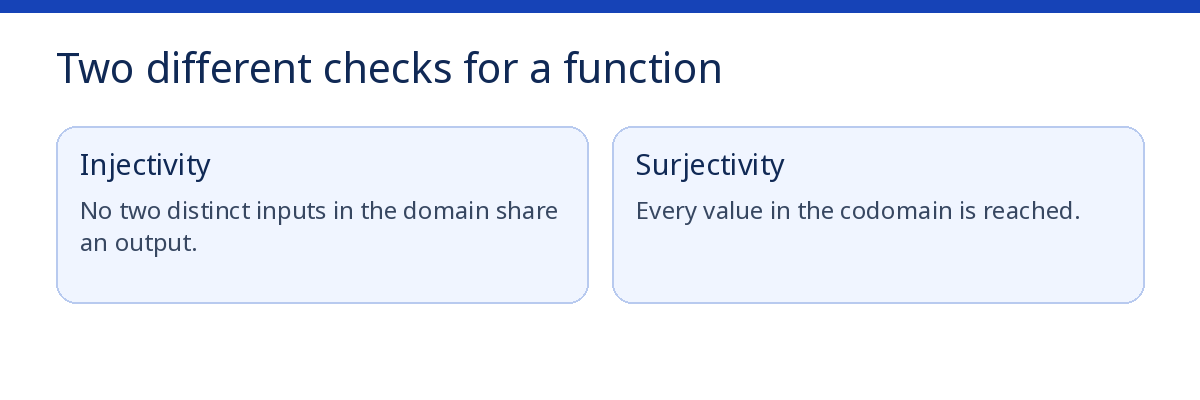
The functions material gives you a reason to keep injectivity and surjectivity separate. For injectivity, ask whether distinct inputs in the stated domain can share an output. For surjectivity, compare the range with the stated codomain. Deciding that some outputs occur is not enough; every element of the codomain must occur. In review, write down which of these two checks your reasoning actually addresses.
For matrices, translate the defining relation into an entry-level check before doing arithmetic. In a real skew-symmetric matrix, forces diagonal entries to be zero and entries across the diagonal to be negatives of one another. For a proposed inverse of a square matrix, check the product against the identity: the diagonal entries must be one and the off-diagonal entries zero.
When derivative shortcuts apply
The calculus questions include implicit differentiation, derivatives taken with respect to a common variable, stationary points and rates of change. When differentiating implicitly, remember that a term involving the dependent variable may require the chain rule. If two quantities depend on a common variable, the quotient of their derivatives gives one derivative with respect to the other at points where the denominator derivative is nonzero. Cancelling a common factor does not by itself justify using that quotient at a point where the original denominator vanishes.
For applications of derivatives, name the quantity being requested before differentiating. A rate of change of slope is not a rate of change of the original function. Likewise, finding a stationary point is not the same as classifying it: in the second derivative test, a positive or negative second derivative at a stationary point distinguishes a local minimum from a local maximum, respectively.
Common mistakes with integrals and regions
In logarithmic substitution, check the domain of both the logarithm and the original integrand. A real requires ; if the logarithm is also in the denominator, exclude points where it is zero. When you compare your steps with the worked method, check that your substitution accounts for the differential as well as the expression being replaced.
For definite integrals, symmetry is useful only after checking the interval and the integrand. On an interval symmetric about zero, an even integrand has equal contributions from the two halves. For an area question, first trace the boundary of the requested region on the printed diagram or on your own sketch. Two reflected regions may have equal areas, but that does not tell you whether the question asks for one region or their union.
Other distinctions worth checking
In differential equations, order comes from the highest derivative present. You can identify it even when the equation does not meet the conditions for defining degree as a polynomial in its derivatives. In vector and three-dimensional geometry questions, distinguish the point a line passes through from the direction it follows. Parallel lines can share a direction without sharing the specified point; check both pieces of information when setting up a line.
In probability, check that the conditioning event has positive probability before using the elementary conditional-probability formula. Also check the sample-space model before interpreting a zero probability. In a finite equiprobable space, every individual outcome has positive probability; in a general probability space, an event can be nonempty and still have probability zero.
How to read the notes on ambiguous items
Use the solution notes to distinguish what the stated assumptions justify from what a printed option appears to expect. When an interpretation depends on an extra assumption, make that assumption explicit in your review rather than learning the option as a general rule.
This guide leaves out the disputed determinant-sign, area-region and probability answer choices. It also omits the inverse-matrix worked example because its method label and the product entry cited in the steps do not agree. You can still review the underlying concepts independently: ask what the data determine, what the rule requires and which part of the conclusion depends on how the question is read.
Spotted an error? Report a correction. Practise this in the app: notes, formula sheets and mind maps.





























































































































































Loading comments…